Choose individual organic nuts if you want to decide what goes into your breakfast; an organic nut mix is a good option if you want to buy several types in one product. Check the organic labelling, ingredients, allergen information and quantity for each product. Unsalted, unroasted and Fairtrade are not, in themselves, proof of organic certification.
Who is this guide for?
Organisers planning an organic festival breakfast
You want to buy nuts and distinguish organic labelling from other product claims. So, check the specific product rather than relying on the retailer’s image alone. The European Commission explains the labelling associated with the EU organic logo.
Breakfast makers who like to choose their own ingredients
You want to choose between one type of nut and a ready-made mix, so the ingredients suit your breakfast. Cashews, walnuts and nut mixes give you different ways to decide what goes into it.
Festival traders answering allergen questions
If you sell breakfast or nuts, you need clear allergen information and safe, hygienic practices. The Netherlands Food and Consumer Product Safety Authority (NVWA) outlines what to consider when selling food at markets and events.
What should you look for when buying?
Start by checking the labelling on the specific product. Then decide whether you need one type of nut or a mix, and plan your purchase around allergens, quantity and storage.
| What to consider |
What should you check? |
Who does this matter most to? |
| Organic labelling |
Check the organic labelling on the packaging. The European Commission explains that the EU organic logo appears alongside a control code and an indication of the agricultural origin. |
If I want to buy organic nuts for my breakfast, I check the labelling on the exact variant. Around 28% of consumers prioritise buying products that are demonstrably organic. |
| Ingredients |
Choose between one type of nut and a set mix; also check whether unroasted or unsalted nuts suit your recipe. These are product characteristics separate from whether something is organic. |
If I want to decide which nuts go into the breakfast myself, buying one type gives me more choice when putting it together; a mix has its ingredients set in advance. Around 22% of consumers prioritise the ingredients. |
| Allergens and serving |
Read the up-to-date ingredients and allergen information for every component. The NVWA says consumers must be able to get allergen information before buying; safe and hygienic practices are also required when selling food. |
If I sell breakfast, I want to be able to provide information about every component and organise serving properly. Around 22% of consumers prioritise allergen information and responsible food service. |
| Quantity and cost |
Compare the net weight and price of each pack on the same weight basis. Work out how many breakfasts you are serving and how many nuts you want to use in each one. |
When I’m buying for a planned number of breakfasts, I want to take enough without having too much left over. Around 17% of consumers prioritise quantity and purchasing costs. |
| Storage |
Follow the storage advice for the specific pack and plan how to store opened packs and leftovers. Advice for plain dried nuts does not automatically apply to a prepared breakfast. |
If I buy in advance, I want to know how to store and assess any leftovers. Around 11% of consumers prioritise shelf life and managing leftovers. |
Common buying mistakes
-
Mistaking a Fairtrade claim or green packaging for proof that a product is organic
Fairtrade and organic refer to different claims. Lidl, for example, lists Fairtrade cashews; that claim alone does not prove that the nuts are organic.
Check the organic labelling on the exact product variant. The Netherlands Enterprise Agency explains the rules for using the term ‘organic’.
-
Looking only at the type of nut when answering allergen questions
A warning about possible traces may also be relevant. And if you’re serving a prepared breakfast, the information for every component needs to be accurate.
Check the current labels and ingredients for each component, and don’t present organic nuts as safe for people with allergies.
-
Assuming a product page means a product variant is available to order
Jumbo’s product page states that the organic nut mix described is no longer part of its online range. A product information page does not automatically confirm that the exact variant is available for your purchase.
Check that the exact variant can be ordered before basing your festival shopping on it.
Having to buy a replacement at the last minute can mean extra work.
-
Applying storage advice for plain dried nuts to the whole breakfast
The Netherlands Nutrition Centre provides storage advice for mixed unsalted nuts; that advice does not automatically apply to a prepared or assembled breakfast. If you’re selling food, safe storage remains a separate responsibility.
Follow the instructions for the specific product and use suitable practices for prepared breakfast items.
Plan carefully for leftovers so the nuts you buy don’t go unused.
Brands and retailers for reference
The examples below refer to specific product ranges or listings. A brand name alone does not mean that every product is organic or suitable for your festival shopping.
Albert Heijn
Albert Heijn describes AH Organic Unsalted Cashews as a single type of nut for anyone who wants to put their own breakfast together.
- The product name says organic and unsalted.
- Check the current packaging for product and allergen information.
Jumbo
Jumbo describes organic unroasted, unsalted walnuts and an organic nut mix as different options for breakfast.
- The mix described contains almonds, cashews, hazelnuts and walnuts from organic sources.
- The product page says this specific mix is no longer part of the online range; don’t take this as confirmation that it can currently be ordered.
PLUS
PLUS describes an organic nut mix in a 150 g tub, suitable if you’re looking for a ready-made mix.
- The product listing gives the pack weight.
- Check the current packaging and ingredients of the variant you choose.
Lidl
Lidl presents Alesto as a range of nuts, dried fruit and snacks. The Fairtrade cashews mentioned are an example of a different product claim.
- The product range includes different types of nuts and snacks.
- A Fairtrade claim is not a substitute for organic labelling.
Aldi
Aldi’s organic range page mentions almond drink, among other products. This is not a pack of nuts.
- The range page gives an overview of organic products at Aldi.
- An organic product range does not prove that an individual pack of nuts is organic.
Duyvis
Duyvis presents a range of snacks for drinks, including borrelnootjes, peanuts and mixes; this positioning does not prove organic certification.
- The packaging information may be relevant when checking for possible traces.
- Check the warnings on the current packaging; a product marketed as a snack for drinks is not automatically a suitable organic nut for breakfast.
Joybuy products
These Joybuy products are unsalted peanuts and a nut mix. Check the organic labelling on the current packaging separately; unsalted or unroasted does not automatically mean organic.
 No image available
g'woon Unsalted Peanuts - 250g
A good fit if you want to use unsalted peanuts as an ingredient; the product description also suggests using them in recipes.
The description lists 99% peanuts and sunflower oil. The product contains peanuts and may contain traces of cashews.
View at Joybuy
 No image available
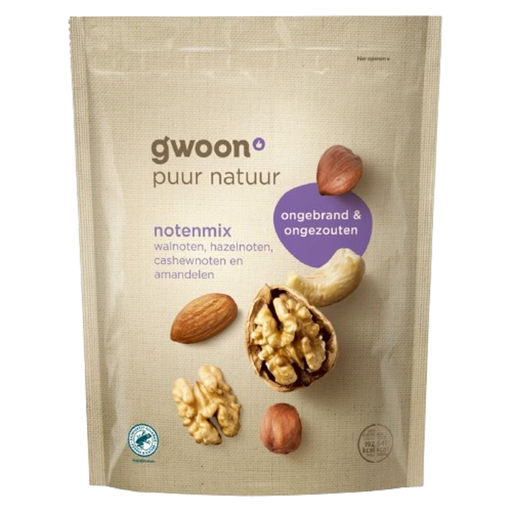
g'woon Nut Mix Raw & Unsalted - 200g
A good fit if you want to use several types of nuts in one breakfast ingredient; the product description suggests adding the mix to breakfast.
According to the product description, the mix contains 30% hazelnuts, 30% walnuts, 20% almonds and 20% cashews. The product contains nuts and may contain traces of peanuts.
View at Joybuy
Frequently asked questions
Does unroasted or unsalted mean the same as organic?
No. Unroasted and unsalted describe product characteristics; organic is covered by separate labelling rules. Check each characteristic separately on the specific packaging.
Do organic nuts have to come from the Netherlands?
No. For organic products, the European Commission describes labels such as EU Agriculture, non-EU Agriculture and EU/non-EU Agriculture. Organic therefore does not mean that the agricultural origin is exclusively Dutch.
What do I need to arrange if I sell loose nuts or breakfast?
Make sure consumers can get allergen information before buying. The NVWA mentions options such as shelf labels and menus; you can also provide the information verbally, as long as customers are clearly told they can ask for it. For prepacked products, the information must be on the label.
Do I need to follow food-safety practices if I’m selling privately at a festival?
Yes. The NVWA states that food at markets and events must be prepared, sold and stored safely and hygienically, whether you’re selling as a business or as a private individual.
How do I work out how many packs I need?
Multiply the number of breakfasts by the amount of nuts you want to use in each one. Divide the result by the net weight of the pack you’ve chosen, then round up to the next whole pack. This gives you the quantity to buy; you can’t work out a specific number without those details.


