
Conscious snack buyers
You’re looking for organic nuts to enjoy with a drink and want to know whether they’re unroasted, roasted or unsalted. The European Commission explains the requirements for the EU organic logo.


For drinks on the terrace, choose an unroasted nut mix if you want a variety of nuts. If you specifically want them roasted, go for roasted, unsalted cashews. Albert Heijn lists sunflower oil as an ingredient in the cashew variety reviewed. For breakfast, your choice depends on whether you want just nuts or a mix with dried fruit and seeds. Also check the organic label and allergen information.
You’re looking for organic nuts to enjoy with a drink and want to know whether they’re unroasted, roasted or unsalted. The European Commission explains the requirements for the EU organic logo.
You want to enjoy nuts at more than one time of day and are choosing between a nut mix and a combination with dried fruit and seeds. Albert Heijn also describes such mixes as toppings for yoghurt.
If you or someone at your table has allergen requirements, the ingredients and allergen information will determine which product is suitable. The Netherlands Food and Consumer Product Safety Authority explains what information consumers must be able to access before buying.
Choose this if: you want a variety of nuts to enjoy with a drink or add to yoghurt.
Bear in mind: a mix of different nuts also means several nut allergens are present; Albert Heijn lists four types in the mix reviewed.
Choose this if: you want roasted cashews to serve with drinks.
Bear in mind: unsalted doesn’t mean unroasted or oil-free; Albert Heijn lists sunflower oil for the variety reviewed.
Choose this if: you also want dried fruit and seeds, for example to add to yoghurt.
Bear in mind: this isn’t a mix of nuts alone; Albert Heijn lists 25 g of total sugars per 100 g for the variety reviewed, despite an average of 0 g of added sugars per 100 g.
Start by checking the organic label and allergen information, then compare the preparation and ingredients with when you plan to eat the nuts.
| What to consider | What should you check? | Who is this important for? |
|---|---|---|
| Organic label | Check the product’s organic label. If the EU organic logo is on the packaging, also look for the associated control code and agricultural origin; the European Commission explains these details. | If I want organic nuts, I’d rather check the label than rely on a natural-looking appearance. Around 29% of consumers want to check this first. |
| Preparation and ingredients | Check separately whether the nuts are unroasted or roasted, and whether they also contain oil, dried fruit or seeds. Albert Heijn lists these differences for the varieties reviewed. | If I’m choosing nuts for drinks or breakfast, I want to know in advance what ingredients they contain. Around 29% of consumers prioritise preparation and ingredients. |
| Allergens | Read the ingredients and warnings on the packaging. If you’re buying unpackaged nuts on a terrace, ask for allergen information before you buy; the Netherlands Food and Consumer Product Safety Authority explains this information requirement. | If I’m sharing nuts with someone who has allergen requirements, I want to check the information before ordering. Around 21% of consumers consider allergens first. |
| Quantity and storage | Choose a net weight that suits how much you plan to use, and follow the storage advice on the packaging. The Netherlands Nutrition Centre recommends storing nuts in a tightly sealed container in a dry place. | If I’m buying nuts for several occasions, I want to be able to seal and store the rest properly. Around 21% of consumers mainly consider quantity and storage. |
The European Commission and Skal Biocontrole explain that the EU organic logo is a protected label; packaging that simply looks natural does not establish a product’s organic status.
Check the organic label and, if the EU organic logo is used, look for the associated details too.
For the cashew variety reviewed, Albert Heijn warns that other nuts and peanuts may be present. So a product containing just one type of nut doesn’t automatically mean there are no warnings about other allergens.
Check both the ingredients and the warnings on the current packaging.
For the date and nut mix reviewed, Albert Heijn lists an average of 0 g of added sugars, but 25 g of total sugars per 100 g.
Check the ingredients list and compare the total sugars per 100 g if this matters to your choice.
The Netherlands Nutrition Centre advises storing nuts in a dry place in a tightly sealed container, as they can be affected by mould. Any nuts you can’t seal or store properly may end up going unused.
Choose an amount that suits how you plan to use them, and reseal the packaging carefully after opening.
The organic varieties reviewed include unroasted nuts, roasted unsalted cashews, and a mix with fruit and seeds. Albert Heijn’s product information lists the EU organic logo and NL-BIO-01 for these varieties.
PLUS describes an organic, unroasted and unsalted nut mix in a 150 g tub.
Jumbo described an organic, unroasted and unsalted nut mix containing five types of nuts. The product page for this specific variety says it’s no longer part of the online range.
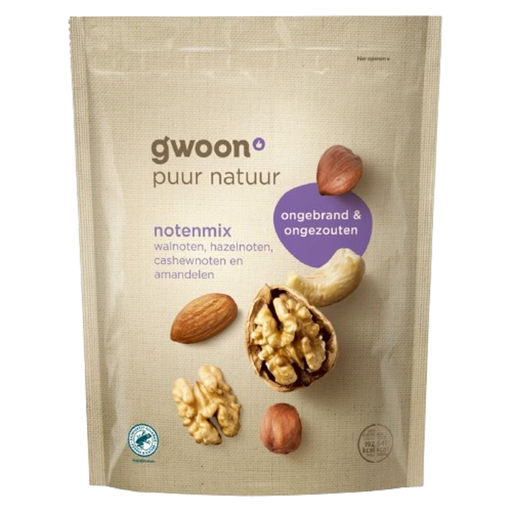
This selection includes a Joybuy nut mix for drinks, suited to anyone looking for an unroasted, unsalted variety.
 No image available
Ideal for drinks if you’re looking for an unroasted, unsalted nut mix.
Contains nuts and may contain traces of peanuts; check the product information if this is relevant to you.
According to the European Commission and Skal Biocontrole, the EU organic logo is required on prepacked food produced in the EU and sold as organic. Different rules apply to imported or unpackaged organic products, so the absence of the logo doesn’t mean the same thing in every situation.
Yes. The Netherlands Food and Consumer Product Safety Authority says you must be able to get allergen information about unpackaged products before buying them. The information can be provided in writing or verbally; ask before you order if you need it.
Since 1 January 2026, new rules have applied in the Netherlands on how and when food businesses warn about the unintended presence of allergens in prepacked products. The Netherlands Food and Consumer Product Safety Authority gives the wording as ‘May contain X’ and ‘Not suitable for people with an X allergy’; warnings must be based on a risk assessment.
Store nuts in a tightly sealed container in a dry place, preferably somewhere cool. The Netherlands Nutrition Centre gives 10–15 °C as an example. Also follow the specific storage instructions on the packaging.
No. Albert Heijn describes the organic cashews reviewed as both unsalted and roasted in sunflower oil. Check the preparation and ingredients separately on the packaging.