Who is this buying guide for?

Shoppers following a specific exclusion diet

You want to know whether your chosen nut and the other ingredients fit your diet. If you’re allergic to that particular nut, this option isn’t suitable; an organic label or gluten claim doesn’t change that. The Netherlands Food and Consumer Product Safety Authority (NVWA) states that allergen information must appear on the label of prepacked products.

Shoppers who choose organic mindfully

You’re looking for a product that is itself labelled organic, and don’t want to confuse that label with being allergen-free or a health claim. Skal Biocontrole describes ‘organic’ as a legally protected term.

Everyday snack shoppers

You’re looking for an unsalted snack and a quantity that suits how much you eat and how you store it. The Netherlands Nutrition Centre advises keeping nuts in a sealed container in a dry place, as they’re susceptible to mould.

What should you look out for when choosing?

First, check whether the exact product suits your dietary requirements. Then check the organic label separately, and choose the ingredients, pack size and storage method to suit how you’ll use it.

What to consider What should you check? Who should pay particular attention?
Allergens and diet Check the named type of nut, ingredients and information about possible cross-contamination on the exact pack. Check peanuts separately. If you’re allergic to the nut listed, that product isn’t suitable. Around 39% of consumers prioritise avoiding allergens.
Avoiding gluten Check the gluten information and ingredients for the exact product; a gluten claim says nothing about other allergens. If avoiding gluten is your deciding factor, look for information about the specific product. Around 23% of consumers primarily choose products based on avoiding gluten.
Organic label Check the organic label and certification mark on the product itself, not just the shop’s product name or range. If verified organic production is your main reason for choosing a product, you’ll want to see the label on the product. Around 23% of consumers prioritise organic certification.
Ingredients and storage Compare unsalted options and pack sizes. Follow the storage instructions and keep nuts in a sealed container in a dry place. For everyday snacking, consider whether the ingredients, quantity and storage suit your routine. Around 15% of consumers prioritise practical everyday use.

Common pitfalls

  • Assuming organic means allergen-free

    An organic label doesn’t tell you whether the nut or another allergen is suitable for your diet.

    Check the organic label and allergen information separately. Always check the exact pack.

  • Treating a free-from claim as a general guarantee

    A gluten claim relates to gluten; it doesn’t tell you whether a product is free from nuts or other allergens.

    Identify the ingredient you need to avoid, then check the information for the specific product.

  • Buying nuts without considering how to store them

    Nuts are susceptible to mould. The Netherlands Nutrition Centre advises keeping them in a sealed container in a dry place.

    Choose a quantity that suits how much you use and follow the storage instructions on the pack.

    A pack that you can’t seal properly or use in time could lead to waste.

Brands to consider

Albert Heijn

Albert Heijn describes AH Biologisch unsalted cashew nuts as a single-ingredient organic option.

  • The product description identifies the nuts as organic cashews and unsalted.
  • The product name doesn’t confirm that other allergens or cross-contamination are absent. Albert Heijn advises checking the pack, as ingredient and allergy information may change.

Jumbo

Jumbo describes organic, unroasted and unsalted cashew nuts in a 150 g pack.

  • The product description specifies its organic status, preparation method and pack size.
  • These details don’t confirm that the product is free from other allergens or suitable for a specific exclusion diet.

PLUS

PLUS describes an organic nut mix in a 150 g tub, for shoppers looking for a mix rather than a single type of nut.

  • The product description identifies it as an organic nut mix and gives the pack size.
  • The mix name and packaging alone don’t confirm whether it’s suitable for an exclusion diet. Check the information on the exact pack.

Duyvis

Duyvis describes nut and snack products; allergen information is important when checking a specific product.

  • Duyvis refers shoppers to product information to check allergens.
  • Duyvis warns that products may contain traces of peanuts and/or nuts due to cross-contamination. This doesn’t support positioning the range as a generally allergen-free snack.

Lidl

Lidl describes Alesto nuts, dried fruit and snacks, alongside a separate organic range.

  • The separate range pages describe both the Alesto range and an organic range.
  • An organic range across the shop doesn’t confirm that every Alesto nut product is organic. Check the exact product description.

ALDI

ALDI describes a 200 g Trader Joe’s nut and fruit mix, and also has a separate organic range.

  • The mix offers a different type of snack from single-ingredient nuts.
  • The shop’s organic range page doesn’t confirm that this specific mix is organic or suitable for an exclusion diet.

Nut mixes at Joybuy

The Joybuy option shown is a raw, unsalted nut mix. Check the exact pack separately to see whether it’s organic and whether the ingredients suit your diet.
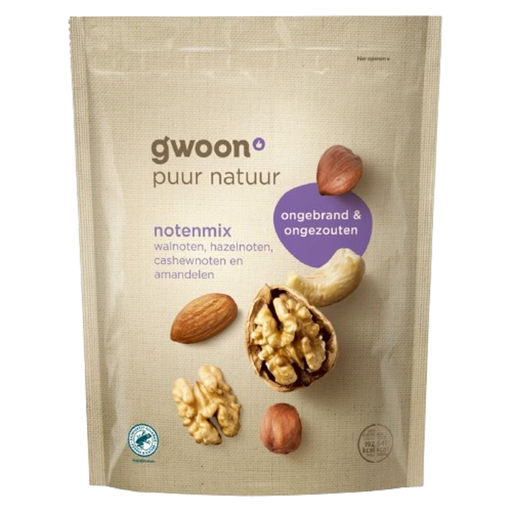
g'woon Nut Mix Raw & Unsalted, 200 g

g'woon Nut Mix Raw & Unsalted, 200 g

This mix is a good option if you’re looking for a raw, unsalted nut mix, provided the listed types of nut fit your diet.

The ingredients include hazelnuts, walnuts, almonds and cashews; the mix may contain traces of other nuts and peanuts.

Pack size: 200 g. Check the pack for the organic label and up-to-date allergen information.

Joybuy

Frequently asked questions

Do allergens have to be listed on packaged nuts?

Yes. The NVWA states that allergen information must appear on the label of prepacked products. Nuts and peanuts are among the allergens covered by EU information requirements. Check the information on the exact pack.

What Dutch rules apply to cross-contamination warnings?

According to the NVWA, the new Dutch rules on warnings about possible cross-contamination have applied since 1 January 2026. They apply to suppliers of prepacked products and don’t replace your own checks of the information on the pack.

Does ‘gluten-free’ also mean a product contains no nuts?

No. The conditions for claims such as ‘gluten-free’ and ‘very low gluten’ are set out in Commission Implementing Regulation (EU) No 828/2014, but this covers gluten information. Nuts are a separate allergen, so check the ingredients and allergen information for the product.

How should you store nuts after buying them?

The Netherlands Nutrition Centre advises keeping nuts in a sealed container in a dry place, preferably somewhere cool, such as at 10 to 15 °C. Also follow the storage instructions on the pack, as these apply to the specific product.

Does the NVWA warning about Trader Joe’s cashews apply to all ALDI nuts?

No. The NVWA warning of 20 May 2026 concerns Trader Joe’s unsalted cashews, 170 g, with barcode 2003020120930 and a best-before date of 23-09-2026. This date has passed; if you still have that specific pack at home, don’t eat the cashews. The warning doesn’t apply to all ALDI nuts.
