
Eco-conscious coffee drinkers
You want to be able to check what the organic label is based on, rather than relying on words such as ‘natural’ or ‘pure’. The European Commission explains the requirements for using the EU organic logo.


Choose nuts for your morning coffee break based on the type of nut, how much you want and whether you’d prefer one variety or a mix. Check the organic certification separately from the ingredients and allergen information: according to the European Commission, the EU organic logo indicates organic certification, not the product’s composition or whether it is suitable for an individual consumer.
You want to be able to check what the organic label is based on, rather than relying on words such as ‘natural’ or ‘pure’. The European Commission explains the requirements for using the EU organic logo.
You’re looking for nuts to enjoy during a regular coffee break, and you pay attention to the ingredients, added salt and a quantity that suits your needs. Check the ingredients list and nutritional information for the variety you choose.
You take nuts with you or use a pack over several days. In that case, it helps to choose a pack size that matches how much you eat and to follow the storage instructions after opening.
Start by checking the labels and allergen information. Then decide whether you want one type of nut or a mix, and choose a pack size that suits how you’ll use it.
| What to consider | What to check when buying | Who might prioritise this? |
|---|---|---|
| Organic label | Look for the EU organic logo and, where the logo is used, check the control code and origin statement. | If I want to check what the organic label is based on, I look at the packaging rather than relying only on the product description. Around 25% of consumers prioritise verifiable organic certification. |
| Ingredients | Read the ingredients list and check separately whether salt has been added. | For my regular coffee break, I want to know what’s in my snack and whether salt has been added. Around 25% of consumers prioritise ingredients for regular use. |
| Flavour and variety | Compare the types of nuts and their proportions in the mix; PLUS states that its mix contains 40% almonds and 35% hazelnuts. | I’d rather choose one familiar type of nut, or have several varieties in the same pack. Around 20% of consumers put flavour or variety first. |
| Pack size and storage | Compare the net weight with how much you’ll use, and follow the storage instructions after opening. The varieties reviewed range from 110 g at Jumbo to 400 g at Albert Heijn. | I want a quantity that suits how often I eat nuts and that I can store properly once opened. Around 15% of consumers prioritise a suitable quantity and pack size. |
| Allergen information | Check both the ingredients and allergen information on the exact pack; organic labelling is not an assessment of allergens. | If I’m sharing nuts or need to consider allergens, I check the information for the variety I’ve chosen carefully. Around 15% of consumers prioritise allergen information for themselves or others. |
Organic labelling relates to production standards. The ingredients and allergen information answer different questions; even a short ingredients list does not automatically rule out the possible presence of other allergens.
Check the organic certification, ingredients and allergen information separately on the packaging. The European Commission explains the requirements for the EU organic logo, while the NVWA provides guidance on allergen labelling in the Netherlands.
Albert Heijn lists its 350 g organic nut mix and Jumbo its 150 g organic nut mix as discontinued. A saved page is therefore no guarantee that the exact variety is still available.
Check the retailer’s current range before relying on a specific product variety being available.
A pack that doesn’t suit how much you eat could leave you with nuts you don’t use.
Choose a pack size based on how often you eat nuts and whether you can store them in a tightly sealed container in a dry place after opening, as recommended by the Voedingscentrum.
If the quantity doesn’t suit your needs or storage options, some of the nuts may go unused.
The organic, unroasted cashews and walnuts reviewed are options if you’re looking for a single type of nut.
The organic, shelled walnuts reviewed come in a smaller 110 g pack for anyone looking for a single type of nut.
PLUS describes a 150 g unroasted, unsalted nut mix as organic on its product page; this is information supplied by the retailer.
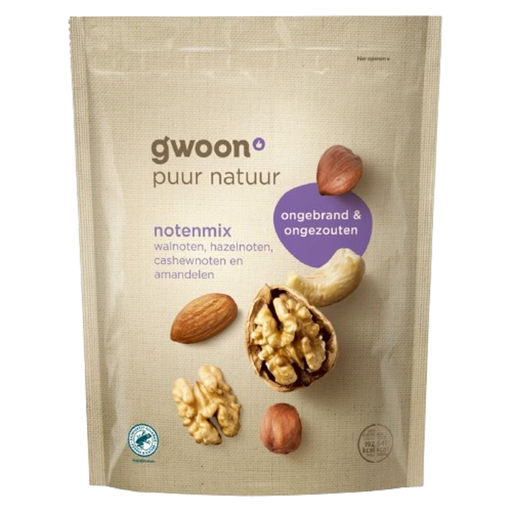
This selection of Joybuy products focuses on nut mixes for anyone who wants several types of nuts in one pack for their coffee break.
 No image available
A good fit if you want several types of nuts in one unsalted mix for your coffee break.
The product name describes a 200 g raw, unsalted mix. The product information lists hazelnuts, walnuts, almonds and cashews, with stated proportions of 30%, 30%, 20% and 20%.
The product information warns that it contains nuts and may contain traces of peanuts. Check the allergen information on the packaging.
Once opened, store in a tightly sealed container in a dry place.
According to the European Commission, the EU organic logo may be used on products that have been certified as organic by an authorised control body. The logo is accompanied by a control code and an indication of the agricultural origin; it is not a nutritional rating.
No, not on every pack. According to the European Commission, the logo is compulsory on pre-packed food produced in the EU and sold there as organic. Its use may be optional for imported products that comply with EU import rules.
Check the ingredients list and any additional allergen information on the exact pack. The NVWA states that any applicable allergens from the mandatory list of 14 must be clearly indicated in the ingredients list. Organic labelling does not replace this check.
Store the nuts in a tightly sealed container in a dry place. For the AH varieties reviewed, Albert Heijn also recommends storing them in a cool, dark place and sealing the pack securely after use. Follow the use-by or best-before information and storage instructions on your pack.
No. For the AH products reviewed, 25 g is the portion stated on the label; this does not automatically make it personal dietary advice. Check the information on the specific pack.