What should you look for when buying?
First check the gluten information for the exact product, then confirm its organic certification. Finally, check that the ingredients, processing and packaging suit your breakfast.
| What to check |
What to look for |
Who is this important for? |
| Gluten information |
Check the information for the exact product, its ingredients and any warnings about possible unintended presence. |
When I choose nuts with coeliac disease, I want to know what’s stated about the finished product and possible cross-contamination. Around 33% of consumers put gluten information and cross-contamination first. |
| Organic certification |
Look for the EU organic logo and the relevant certification information; this is not a gluten statement. |
Anyone looking for organically certified nuts will want to assess the certification separately from the gluten information. Around 27% of consumers give proven organic certification their highest priority. |
| Ingredients and processing |
Check which nuts are included and whether anything has been added, such as oil; unsalted doesn’t automatically mean unroasted. |
When I add nuts to breakfast, I want to know which ingredients and processing methods I’m choosing. Around 27% of consumers focus on a simple mix that suits breakfast. |
| Packaging and storage |
Choose a quantity that suits how quickly you use the nuts and follow the storage instructions once opened. |
Anyone who eats nuts regularly will want packaging that can be sealed properly and contents that can be used in good time. Around 13% of consumers prioritise buying and storing an appropriate amount. |
The European Commission makes clear that the EU organic logo is used only for products certified as organic. On its own, this certification says nothing about whether the finished product is suitable for someone with coeliac disease. The Dutch Celiac Society also advises checking separately for possible gluten contamination.
Joybuy products
The products below are unsalted nut mixes and peanuts. Product information alone doesn’t confirm that a product is certified organic or suitable for someone with coeliac disease, so check the current packaging.
 No image available
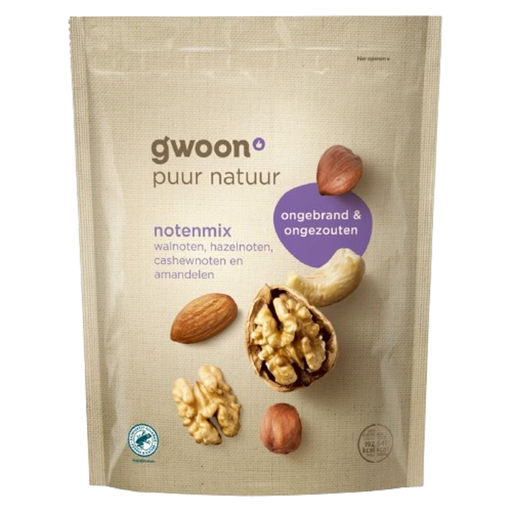
g'woon Nut Mix Raw & Unsalted, 200 g
The product title describes this mix as raw and unsalted; the product description lists hazelnuts, walnuts, almonds and cashews.
The product information lists nuts as an allergen and says traces of peanuts may be present. Before choosing this product with coeliac disease, check the current packaging for organic certification, gluten information and warnings.
Joybuy
 No image available
g'woon Unsalted Peanuts, 250 g
The title says these are unsalted peanuts; the product description lists 99% peanuts and sunflower oil.
The product information says traces of cashews may be present. Before choosing this product with coeliac disease, check the current packaging for organic certification, gluten information, ingredients and warnings.
Joybuy
Frequently asked questions
Does the EU organic logo prove that nuts are suitable for coeliac disease?
No. The EU organic logo relates to organic certification, not gluten information. Check the gluten statement and any warnings for the exact product separately.
Are nuts naturally gluten-free?
The Dutch Celiac Society says that nuts are naturally gluten-free. For packaged products, still check the ingredients and any risk of cross-contamination, as these can affect the finished product.
What do warnings about unintended allergens on Dutch packaging mean?
According to the Netherlands Food and Consumer Product Safety Authority, new rules for these warnings apply from 1 January 2026, and warnings must be based on a risk assessment. The Dutch Celiac Society describes the warnings ‘may contain cereals containing gluten’ and ‘not suitable for people with coeliac disease’ as equivalent in terms of the risk they indicate; a warning doesn’t mean that every pack actually contains gluten.
How should you store opened nuts?
Store opened nuts in a tightly sealed container in a cool, dark, dry place and follow the instructions on the packaging. For mixed, unsalted nuts, the Netherlands Nutrition Centre gives general storage advice of six months in a kitchen cupboard or a year in the freezer.
How can you avoid gluten contact at breakfast?
Keep bread crumbs away from your nuts and breakfast. Use clean utensils to handle and serve the nuts, and store them in a sealed container. The Dutch Celiac Society gives contact with crumbs in the kitchen as an example of cross-contamination.


