What should you look for when choosing?
First, check whether the exact variety is certified organic. Then compare the nutritional information per 100 grams with your weighed portion, and make sure the ingredients suit your breakfast.
| What to consider |
What should you check? |
Who is this most relevant to? |
| Fat and energy per serving |
Compare the values per 100 grams and calculate them for the weight of your portion. Check saturated fat separately from total fat. |
If you want to know how much fat and energy your breakfast topping provides, weighing your portion will help you assess it. Around 36% of consumers prioritise portion control when making this choice. |
| Organic certification |
Where applicable, check for the EU organic logo, the code of the control body and the indication of agricultural origin. |
If organic production is a must, you’ll want to be able to identify it on the exact variety rather than infer it from words such as unroasted. Around 29% of consumers give organic certification top priority. |
| Ingredients and allergens |
Read the ingredients, check whether salt or other ingredients have been added, and look at the allergen information on the packaging. |
If you’re looking for an unsalted addition with ingredients that suit your preferences, the ingredients list matters more than the product name alone. Around 21% of consumers start by looking for a simple ingredient list. |
| Packaging and storage |
Compare the net weight with how often you use the product, and follow the storage instructions on the packaging. |
If you want to choose a pack that suits how you use the product, check the pack size and storage instructions before buying a larger quantity. Around 14% of consumers make this their main consideration. |
Joybuy product picks
These Joybuy picks are unsalted peanuts and nut mixes whose nutritional values you can assess per serving. The product information doesn’t confirm organic certification for these varieties.
 No image available
g'woon Unsalted Peanuts - 250g
An unsalted option if you want to weigh out the peanuts you add to breakfast and calculate the nutritional values per serving.
The listed nutritional values are 50 g of fat and 0.02 g of salt per 100 g.
The ingredients list 99% peanuts and sunflower oil. The product may contain cashew nuts.
At 50 g of fat per 100 g, this variety doesn’t meet the European Commission’s limit of no more than 3 g per 100 g for a ‘low fat’ claim.
Buy at Joybuy
 No image available
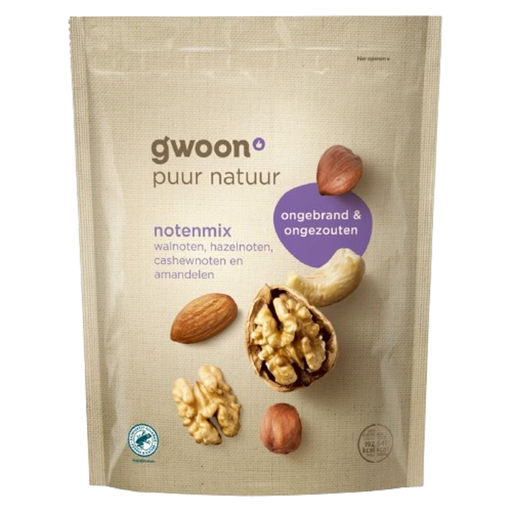
g'woon Nut Mix Raw & Unsalted - 200g
An unroasted, unsalted mix if you want to add different types of nuts to breakfast and weigh out your own portion.
The listed nutritional values are 55.7 g of fat and 0.01 g of salt per 100 g.
The mix contains hazelnuts, walnuts, almonds and cashew nuts, and may contain traces of peanuts.
At 55.7 g of fat per 100 g, this variety doesn’t meet the European Commission’s limit of no more than 3 g per 100 g for a ‘low fat’ claim.
Buy at Joybuy
Frequently asked questions
Does organic mean a nut mix is low in fat?
No. Organic certification relates to how a product is made, not its fat content. According to the European Commission, a solid food can only be labelled ‘low fat’ if it contains no more than 3 grams of fat per 100 grams; a smaller serving doesn’t change the fat content per 100 grams.
How do I calculate the nutritional values for my breakfast portion?
Multiply the value per 100 grams by the weight of your portion, then divide by 100. For 25 grams of the organic PLUS nut mix, that works out at 14.25 grams of fat and 159 kcal, based on the values listed by PLUS of 57 grams of fat and 636 kcal per 100 grams. This is a calculation based on the product information, not personal portion advice.
How can I identify organic nuts?
Check the organic information on the exact packaging, including the EU organic logo where applicable, the control code and the indication of agricultural origin. The European Commission says the organic logo can only be used on products certified as organic by a recognised control authority or control body.
What allergen information should I check for nuts?
Read both the ingredients and any warnings about the possible presence of allergens on the packaging. The Netherlands Food and Consumer Product Safety Authority treats nuts and peanuts as separate allergens that must be listed on prepacked products.
How should I store the PLUS nut mix?
PLUS recommends storing this variety in a cool, dry, dark place. Follow the storage instructions and best-before information on your own pack, as these can vary by product and packaging.


