Who are these nut options for?

Breakfast lovers looking for plain nuts

You’re looking for nuts to add to something like yoghurt, and want to know whether they’re unroasted or roasted and what else has been added. Albert Heijn recommends its unroasted nut mix as a topping for yoghurt.

Hosts planning an organic spread

You want to serve organic nuts around New Year’s Eve and are choosing between a mix and one favourite type of nut. Check the ingredients and allergen information in advance for your guests.

Shoppers who use small amounts at a time

You want to choose a pack size that suits how much you use and seal the rest properly. The Netherlands Nutrition Centre advises storing nuts in a cool, dark and dry place.

What should you look for when buying?

Organic unroasted nut mix

Choose this if: you want a selection of different nuts for breakfast and prefer them unroasted.

Bear in mind: the proportions of each nut vary by product. Check the organic labelling and allergen information too.

Organic roasted unsalted cashews

Choose this if: you mainly want cashews for entertaining. Albert Heijn describes this particular variety as roasted and unsalted.

Bear in mind: this variety contains sunflower oil and may contain other nuts and peanuts.

What to consider What to check when buying Who is this most relevant to?
Organic status Check the organic labelling and, where shown, the inspection code and agricultural origin. I want to be able to check that the organic claim matches what I’m looking for. Around 31% of consumers prioritise verifiable organic status.
What’s in your breakfast mix Read the ingredients and check whether the nuts are unroasted or roasted, and whether salt or other ingredients have been added. For a breakfast topping, I want to know which nuts and ingredients I’m choosing. Around 25% of consumers prioritise a mix that’s right for breakfast.
Nuts for entertaining Check which types of nuts are included and, for a mix, the proportion of each. I want to choose between a variety of nuts and one favourite type for entertaining. Around 19% of consumers put the mix’s suitability for entertaining first.
Allergens and use Check the ingredients and allergen warnings on the packaging. For young children, also look out for product warnings about choking. When I’m hosting, I check the allergen information and usage warnings in advance. For around 13% of consumers, catering for guests is the main consideration.
Quantity and storage Compare the net weight with how much you use and follow the storage advice on the packaging. Keep nuts tightly sealed in a cool, dark and dry place. If I don’t use many nuts, I want to buy a suitable amount and store the rest properly. Around 12% of consumers prioritise quantity and storage.

Common buying mistakes

  • Assuming natural or unroasted means organic

    A preparation method or a word such as ‘natural’ does not, on its own, prove that a product is organically certified. The European Commission explains when the EU organic logo can be used; Skal Biocontrole explains that the term ‘organic’ is protected by law.

    Check the organic information separately from how the nuts are processed, whether they contain salt and what other ingredients they include. If the EU organic logo appears on the packaging, check the associated inspection code and agricultural origin too.

  • Assuming one type of nut rules out other allergens

    The AH cashews examined list cashews as their main ingredient, but may also contain other nuts and peanuts. So a product with one main type of nut does not automatically rule out warnings about other allergens.

    Read the ingredients and allergen warnings on the packaging before serving. The NVWA states that allergen information must appear on the label of prepacked products.

  • Assuming all nut mixes have the same ingredients

    The PLUS product page lists 40% almonds and 35% hazelnuts for the organic mix in question. That applies to this particular mix, not to nut mixes in general.

    Check the ingredients and percentages if you particularly like or want to avoid certain types of nuts.

  • Leaving leftovers open and storing them carelessly

    The Netherlands Nutrition Centre says that nuts are susceptible to mould and can absorb smells from other foods.

    Put any leftover nuts in an airtight container and store them in a cool, dark and dry place. Follow the product-specific storage advice too.

    This helps limit exposure to moisture and odours, and prevents unused nuts from going to waste unnecessarily.

Organic nut brands to consider

Albert Heijn

Albert Heijn’s product information describes an organic unroasted nut mix and organic roasted, unsalted cashews.

  • Both product pages show the EU organic logo and inspection code NL-BIO-01.
  • These details apply to the products mentioned; they don’t automatically apply to the entire nut range.

PLUS

The PLUS product page labels a nut mix as organic and lists the proportions of each type of nut.

  • According to PLUS, the mix contains 40% almonds and 35% hazelnuts, as well as Brazil nuts, cashews and walnuts.
  • These proportions apply to this particular mix. Check the packaging if you need a specific ratio or allergen information.

Jumbo

Jumbo has a product listing for an organic unroasted mix containing cashews, almonds, hazelnuts, walnuts and pecans.

  • The listing describes a mix containing several types of nuts.
  • The product listing says that this mix is no longer available in its online range.

Nut options at Joybuy

This Joybuy selection is a raw, unsalted nut mix. Check the packaging to see whether its organic status meets your requirements.
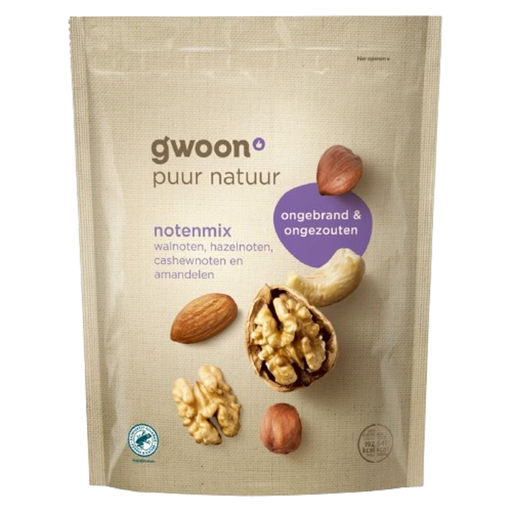
g’woon Nut Mix Raw & Unsalted, 200 g

g’woon Nut Mix Raw & Unsalted, 200 g

Ideal if you’re looking for a raw, unsalted mix. Check the organic labelling separately if that’s important to you.

The product description lists 30% hazelnuts, 30% walnuts, 20% almonds and 20% cashews.

The product description warns that the mix may contain traces of other nuts and peanuts.

View at Joybuy

Frequently asked questions

Do organic nuts always have to display the EU organic logo?

No, it isn’t compulsory in every situation. According to the European Commission, the EU organic logo is required for prepacked food produced in the EU and sold as organic. It’s optional for certain imported or unpackaged organic products. If the logo is used, the inspection code and agricultural origin should also appear on the packaging.

Are organic nuts automatically unsalted or unroasted?

No. Organic refers to certified production, while unsalted and unroasted describe the product itself. For example, the organic AH cashews are roasted and unsalted, so check the preparation method and ingredients separately.

What do allergen warnings on Dutch nut packaging mean?

Check both the ingredients and any warnings about the possible presence of allergens. The NVWA says that, from 1 January 2026, warnings such as ‘May contain X’ and ‘Not suitable for people with an X allergy’ must be based on a risk analysis. Such a warning does not mean that the allergen is always present in the product.

Can you give whole nuts to young children without any concerns?

No. Don’t assume that an organic label means whole nuts are suitable for young children. The AH products examined carry choking warnings, so follow the warning on the packaging.

How should you store nuts left over after New Year’s Eve?

Store nuts in a tightly sealed container in a cool, dark and dry place. The Netherlands Nutrition Centre gives this general storage advice; also follow the instructions and use-by date on the packaging.
