Choose loose muesli if you have yoghurt, milk or quark and cutlery where you’ll be eating breakfast. If you want to carry as few separate items as possible, a ready-portioned yoghurt and muesli combination may suit you better. For either option, check the organic labelling on the packaging, and compare the ingredients, nutritional information and allergens separately.
Who is this choice relevant to?
Breakfast lovers who choose organic
You don’t want to rely on the packaging’s appearance alone. Check the organic labelling, then read the ingredients, nutritional information and allergens too. The European Commission explains that the EU organic logo is linked to certification by a recognised control authority or control body.
Commuters short on time to prepare breakfast
You want to carry as few separate items as possible. A yoghurt and muesli combination in one pack may suit you better than loose muesli, which also needs a base and cutlery. For example, ALDI offers a 150 g portion of organic yoghurt with muesli.
Breakfast lovers who compare labels
You want to compare sugars, fibre and ingredients across different types of muesli, rather than relying on names such as ‘fruit’ or ‘crunchy’. The Netherlands Nutrition Centre points out that breakfast cereals can also vary in salt and fat.
What should you look for when choosing?
First decide whether you want to put your breakfast together or take a ready-made portion with you. Then check the organic labelling and the product label for the option that fits your morning.
Loose muesli
When to choose it: choose this if you want to decide the portion size yourself and have yoghurt, milk or quark available.
Trade-off: you can combine the ingredients yourself, but you’ll still need a base and cutlery.
Yoghurt with muesli
When to choose it: choose a ready-made portion if you’d rather not carry a separate base; ALDI offers a 150 g organic option.
Trade-off: check the ingredients, portion size and storage instructions on the packaging for each flavour.
| What to consider |
What to check when buying |
Who is this important to? |
| Organic labelling |
Check the organic labelling on the packaging; then assess the ingredients and nutritional information separately. |
If I want to buy organic, I want to be able to identify it on the packaging before comparing flavours. For around 42% of consumers, this would be the first priority. |
| Preparation |
Decide whether you’ll have a base and cutlery available, or would rather take a ready-made portion with you. |
On a morning when there’s no time to put anything together, I don’t want to have to sort out separate breakfast items too. Minimal preparation would matter most to around 33% of consumers. |
| Ingredients |
Compare sugars and fibre per 100 g, and read the ingredients and allergen information for your chosen option. |
When choosing fruit, nut or crunchy muesli, I want to know what’s actually in it. For around 25% of consumers, comparing labels would be the top priority. |
Common mistakes
-
Assuming organic means a particular nutritional profile
Organic labelling doesn’t tell you how much sugar or fibre muesli contains. For example, Jumbo lists 20.0 g of sugars and 8.0 g of fibre per 100 g for its organic wholegrain muesli with raisins.
Once you’ve found products that meet your organic preferences, compare them on the same basis, for example using the nutritional information per 100 g.
-
Taking loose muesli without a breakfast plan
A bag of muesli isn’t the same as a ready-made breakfast portion. If you’re having muesli with yoghurt, milk or quark, you’ll also need a base and suitable cutlery.
Check what you’ll have available where you’re eating breakfast. If you don’t want to carry a separate base, look at a ready-portioned combination and check the packaging for your chosen option.
-
Relying on the flavour name alone for allergen information
A name mentioning fruit or nuts doesn’t give you the full picture of the ingredients and allergens. The Netherlands Food and Consumer Product Safety Authority explains the requirements for listing allergens on the labels of prepacked foods.
Read the ingredients and full allergen information on the current packaging, even if you already know the product by name.
Brands and product ranges to consider
Jumbo
Jumbo describes organic wholegrain muesli with fruit and nuts, as well as a variety with raisins; both are 500 g.
- For its raisin variety, Jumbo lists 20.0 g of sugars and 8.0 g of fibre per 100 g. You can compare these figures with the labels of other varieties.
- Don’t assume the nutritional information for the raisin variety also applies to the fruit and nut variety; check the label on the pack you choose.
AH Biologisch
Albert Heijn’s AH Biologisch range includes, among other products, a 350 g crunchy wholegrain muesli with four types of nuts.
- This gives you a specific crunchy nut option to compare with non-crunchy muesli.
- Compare sugars, fat and fibre on the label; a crunchy texture alone doesn’t tell you anything about these values.
Zonnatura
Jumbo lists Zonnatura Organic Muesli Nuts & Seeds, 375 g.
- The nut and seed variety offers a different mix to compare with fruit or raisin muesli.
- Read the ingredients and allergen information on the pack you choose; don’t rely on the product name alone.
ALDI BIO
ALDI offers BIO organic yoghurt with muesli in a 150 g portion, including plain, banana, strawberry and vanilla flavours.
- This product combines yoghurt and muesli, so you don’t need to choose a separate base.
- For your chosen flavour, check the ingredients, allergens, nutritional information and storage instructions on the packaging.
Loose muesli on Joybuy
These two options are loose muesli with nuts, fruit or seeds, for a breakfast where you add your own base. If verified organic labelling is essential to you, check the current packaging before you choose.
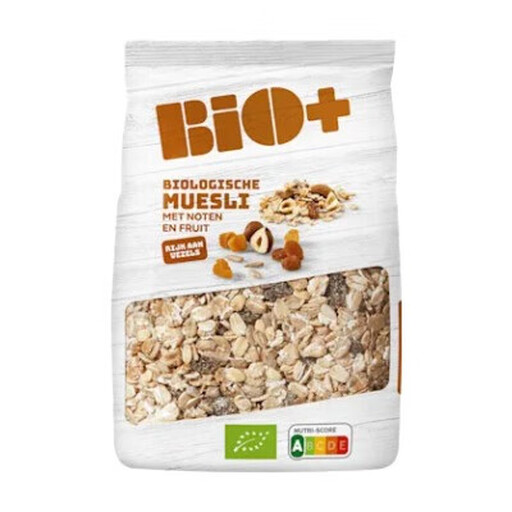 No image available
B+ Muesli Nuts and Fruit, 450 g
An option if you’re looking for loose muesli with nuts and fruit and want to add your own breakfast base.
The product name says 450 g, while the description says 400 g. Check the pack size, organic labelling and allergen information on the current packaging.
View on Joybuy
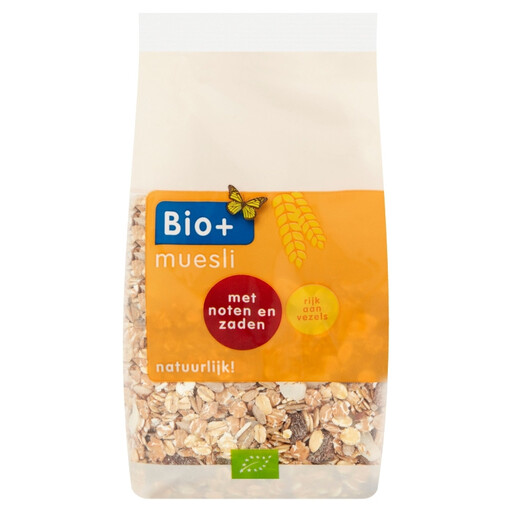 No image available
Bio+ B+ Muesli Nuts and Seeds, 450 g
An option if you want to combine loose muesli with nuts and seeds with a base of your choice.
The product name states 450 g. Check the organic labelling and allergen information on the current packaging: the allergen list and ingredients list in the product information don’t fully match.
View on Joybuy
Frequently asked questions
How can I identify organic muesli on the packaging?
Look for the organic labelling on the packaging. According to the European Commission, the EU organic logo may only be used for products certified as organic by a recognised control authority or control body. Also read the label to check the ingredients of the specific muesli.
Can I take loose muesli with me for a quick breakfast?
Yes, if you’ll also have a base and cutlery available where you’re eating. ALDI describes muesli as a breakfast food to have with yoghurt, milk or quark. If you don’t want to carry a separate base, a ready-portioned yoghurt and muesli combination is another option to consider.
Does organic muesli automatically contain less sugar?
No. Organic labelling doesn’t tell you how much sugar the muesli contains. The Netherlands Nutrition Centre points out that breakfast cereals vary, so compare the ‘of which sugars’ figure per 100 g. Jumbo lists 20.0 g of sugars per 100 g for its organic wholegrain muesli with raisins.
What should I check if I have an allergy or need to avoid gluten?
Read the ingredients and allergen information on the current packaging for the option you choose. The Netherlands Food and Consumer Product Safety Authority explains how allergens must be listed on the labels of prepacked foods; don’t rely on the flavour name or a product photo alone.


