
Families who want to buy certified organic
You want to be able to check whether a specific pack of granola or crunchy muesli is organic. Words such as ‘natural’ are no substitute for this.


Before choosing organic granola for a large household, check the organic label on the exact pack. Then compare the pack size and nutritional information per 100 g: organic status alone tells you nothing about sugar content or allergens, and a larger pack is only practical if its ingredients suit everyone who’ll be eating it.
You want to be able to check whether a specific pack of granola or crunchy muesli is organic. Words such as ‘natural’ are no substitute for this.
You regularly buy breakfast cereals for several people and want to know whether the pack size suits your household, without overlooking organic status or ingredients.
You compare sugar and fibre per 100 g, or need to check the ingredients and allergens in a specific variety for someone in your household.
First decide whether organic is a must. Then check the pack size and read the nutritional and allergen information for the specific variety.
A good choice when: you want granola and can check the organic status of the exact pack.
Things to consider: check the sugar content and allergens separately; the organic label doesn’t tell you anything about them.
A good choice when: a pack of organic muesli better suits your household and ready-to-eat granola isn’t essential.
Things to consider: muesli isn’t the same product as granola. Jumbo suggests baking it until crisp; this takes extra time, and you’ll choose the added ingredients yourself.
| What to consider | What to check when buying | Who it matters to |
|---|---|---|
| Organic status | Check the label on the exact pack. According to Skal Biocontrole, the EU organic logo is compulsory for pre-packed foods produced in the EU and sold as organic. | If organic is a must for my family, I want to be able to recognise it on the pack. Around 37% of consumers put this check first. |
| Pack size | Check the net weight and whether the pack suits the needs of several people. If you’re buying from a shop, check current availability too. | When buying breakfast for several family members, I want to choose a pack that suits how much we use. This is the top priority for around 36% of consumers. |
| Nutritional value and allergens | Compare similar products for sugar and fibre per 100 g. Also read the ingredients and allergen information on the current pack. | When the ingredients are a deciding factor for someone at the table, I want to assess the exact variety. Around 27% of consumers prioritise this check. |
An organic label says nothing about sugar or fibre content. According to the Netherlands Nutrition Centre, crunchy breakfast cereals can contain added ingredients such as sugar, honey or chocolate.
Compare the nutritional information per 100 g for similar products, even if both packs are organic.
For its Granola Amandel Cashew, Zonnatura lists wheat, almonds, cashew nuts and soya, among other ingredients, and notes that other allergens may also be present. The organic ingredients don’t change this information.
Check the current label of your chosen variety every time you buy it, including any warnings about possible traces.
Lidl lists its 500 g organic fruit breakfast cereal as an in-store-only product. This doesn’t guarantee that it will be available on your next visit.
Check availability shortly before your family shop and read the label on the pack you choose in store.
If the product isn’t available, you may need to make an extra trip or choose something else.
Use these names to compare specific products: organic muesli, granola and regular crunchy breakfast cereals aren’t interchangeable.
Albert Heijn lists AH Biologisch Krokante muesli naturel, 300 g, as a specific product you can use to compare labels.
At Jumbo, you can compare specific organic muesli varieties with larger packs of regular products.
Lidl lists organic fruit breakfast cereal in a 500 g pack.
ALDI lists organic muesli and also offers a range of regular breakfast cereals.
Zonnatura describes its Granola Amandel Cashew as made with organic ingredients.
Cruesli is a name to consider when comparing crunchy breakfast cereals, but it isn’t an organic label in itself.
This is a 350 g pack of granola. If you want to buy organic, check the label on the exact pack. To see whether it suits your household, compare the ingredients and nutritional information.
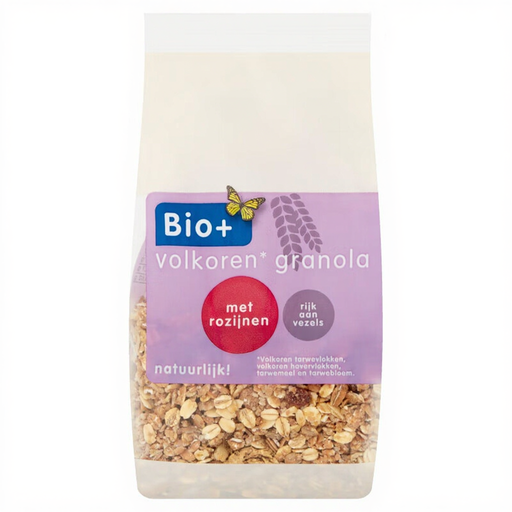 Image unavailable
A 350 g pack of granola for anyone looking for a size that suits how much they use at home.
The product description lists wheat, oat, barley and rye flakes, as well as dried fruit. Check the organic label and nutritional values per 100 g on the exact pack.
If you have allergies, read the current label carefully: the listed ingredients and the separate allergen information may differ.
Check the organic label on the exact variety. According to Skal Biocontrole, the EU organic logo is compulsory for pre-packed foods produced in the EU and sold as organic.
No. The organic label says nothing about sugar content, so compare the nutritional information per 100 g for similar products. The Netherlands Nutrition Centre points out that crunchy breakfast cereals may contain added sugar or honey.
Compare the net weight with how much breakfast cereal you use, then check the nutritional values per 100 g. Check the organic status and allergens of each product separately, even when the packs are the same size.
Before buying, read the ingredients list and allergen information on the current pack, including warnings about possible traces. The Netherlands Food and Consumer Product Safety Authority explains that 14 designated allergens must be listed on food labels.
Follow the storage instructions on the pack you choose. For its AH Biologisch Krokante muesli naturel, for example, Albert Heijn recommends storing it in a cool, dark and dry place and closing the pack tightly after use. Check the instructions again if you choose a different product.