
Breakfast fans who want to choose organic
You want to put together a bowl of granola quickly, but only choose a product whose organic certification you can verify on the packaging. The EU organic logo and inspection code help you check the claim.


Choose organic granola if verifiable organic certification is essential to you: check the EU organic logo, inspection code and ingredients on the packaging. For a quick breakfast, also compare added sugars, fibre, your usual portion and allergens. An organic label alone won’t answer those questions.
You want to put together a bowl of granola quickly, but only choose a product whose organic certification you can verify on the packaging. The EU organic logo and inspection code help you check the claim.
You eat granola regularly and want to look beyond words such as organic or natural. Compare the ingredients and nutritional information per 100 g, then consider how much you usually eat.
You’re looking for crunchy granola to enjoy with yoghurt, milk, fromage frais or a plant-based alternative. The exact variety also needs to meet your requirements for ingredients such as cereals containing gluten, nuts or soya.
First decide whether organic certification is essential. Then compare granolas using the same nutritional basis and check that the ingredients suit your breakfast routine.
| What to consider | What to check | Who it matters to |
|---|---|---|
| Organic certification | Check the EU organic logo and inspection code on the packaging; words such as natural or wholegrain are no substitute for this check. | If I choose organic, I want to be able to verify the claim on the pack rather than judge by its appearance; this assurance is a priority for around 42% of consumers. |
| Sugars, fibre and portion size | Compare the nutritional information per 100 g, check the ingredients list for added sweeteners, then consider your own portion. | For everyday use, I want to compare sugars and fibre without mixing up different portion sizes; this nutritional comparison is the top priority for around 33% of consumers. |
| How you’ll use it and allergens | Read the allergen information for the exact variety and check whether the packaging can be sealed securely after use. | For a rushed breakfast, I want granola that’s quick to use, with ingredients that meet my allergen requirements; around 25% of consumers prioritise this practical choice and ingredient suitability. |
Organic certification relates to how a product is produced. Organic breakfast cereals can still contain added sweeteners; the label doesn’t tell you how much sugar or fibre the product contains.
Check the ingredients and compare the nutritional information per 100 g before choosing based on the front of the pack.
A fibre claim doesn’t tell you whether the granola also suits your preferences for added sugars, portion size or ingredients.
Consider fibre alongside the rest of the nutritional information, then think about how much granola you actually put in your bowl.
Organic certification says nothing about whether a product contains cereals with gluten, nuts or soya. Warnings about possible traces can also vary between varieties.
Before eating it, read the allergen information on the current packaging of the exact granola you’ve chosen.
Product ranges can change, and a product’s composition may be updated. This is particularly important if organic certification or a specific ingredient is essential to you.
Check the latest product information when you buy and read the label on the packaging you receive.
These brands give you a starting point for comparison. Assess organic claims, nutritional information and allergens for each individual variety.
Albert Heijn’s AH Biologisch range includes crunchy muesli that you can quickly pair with yoghurt, milk or fromage frais. Muesli isn’t automatically the same product as granola.
Zonnatura Bio Granola Classic Crunchy is an organic granola to consider if fibre and added sugar matter to you.
Quaker Cruesli Granola Original is worth comparing if organic certification isn’t essential.
At Jumbo, you can compare its own-brand granola with other varieties.
ALDI is a place to shop for breakfast cereals and also lists organic muesli in its range.
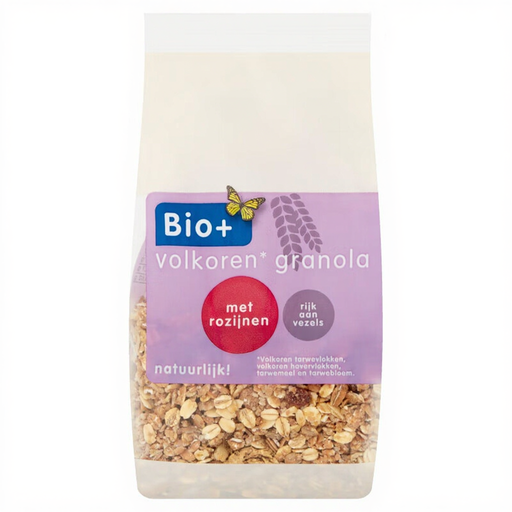
This wholegrain granola is one product to consider for a quick breakfast. If organic certification is essential to you, check the label on the packaging before choosing.
 No image available
A wholegrain granola to consider for a quick breakfast.
Pack size: 350 g. Before choosing, check the EU organic logo, nutritional information and allergens on the current packaging.
Check for the EU organic logo on the packaging, as well as the code of the inspection body and the origin statement. According to the European Commission, the logo may only be used on products certified as organic by an authorised body.
No. Organic certification doesn’t set a limit on added sugar in itself. Read the ingredients and compare the nutritional information per 100 g. A ‘no added sugar’ statement also doesn’t mean that a product contains no naturally occurring sugars.
First compare sugars, fibre, salt, fat and energy on the same basis, for example per 100 g. Then consider your own portion and the ingredients you add to breakfast, so you’re not comparing different portion sizes.
Organic certification doesn’t tell you that. Read the allergen information and any warnings about possible traces on the current packaging of the exact variety. Don’t rely on the label or the product category alone.
Follow the storage instructions on the packaging and seal it securely after use. That way, you can quickly serve yourself a portion with yoghurt, milk, fromage frais or a plant-based alternative the next morning.