For an organic TV snack, raisins are a good choice if you’d also like to use the same pack at breakfast. Unsweetened dried pineapple is an alternative if you’d prefer a different fruit. Albert Heijn lists 59 g of total sugars and 0 g of added sugar per 100 g for its organic raisins; for its dried pineapple, the figures are 67 g and 0 g respectively. So organic or unsweetened doesn’t mean sugar-free: compare the nutritional information, portion some out in advance and check the allergy warnings on the pack.
Who is this dried fruit suitable for?
Mindful TV snackers
You don’t want to mistake organic labelling for sugar-free snacking. Compare total sugars with the amount of added sugar, and decide in advance how much you’ll have. Albert Heijn lists 0 g of added sugar per 100 g for its organic raisins and unsweetened dried pineapple, but both still contain natural sugars.
Snack-and-breakfast fans
You want one pack to use for a night in front of the TV and as a breakfast topping. So consider the type of fruit, pack size and storage advice. The Netherlands Nutrition Centre lists dried fruit as a breakfast topping.
Shoppers who check ingredients
You want to know whether you’re buying fruit with oil or a product carrying a warning about the possible presence of peanuts or nuts. If you have a relevant allergy, always check the ingredients and warnings on the pack; Albert Heijn includes such a warning for its dried pineapple.
What should you look for when choosing?
Start by choosing the type of fruit, then check the organic labelling, nutritional information and packaging for the way you plan to use it.
| What to consider |
What to look for |
Who is this important to? |
| Organic labelling |
Check for the EU organic logo, the control code and the agricultural origin. The logo may be optional for imported organic products (European Commission). |
If verifiable organic origins matter more to you than other buying factors, checking the logo and product information can help you choose. Around 25% of consumers give organic certification top priority. |
| Sugars and portion size |
Compare total sugars per 100 g with added sugar, and weigh your snack before eating. |
If you want a measured sweet snack for a night in front of the TV and are keeping an eye on total sugars, check both figures and your portion size. Around 25% of consumers put sugars and portion size at the top of their list. |
| Ingredients and allergens |
Read the ingredients list and any allergen warnings on the current pack. |
If the ingredients or an allergen relevant to you will determine your choice, check the label before choosing a pack. Around 25% of consumers give ingredients and allergens top priority. |
| Pack size and versatile use |
Compare pack sizes and follow the storage advice after opening; consider whether you’ll also use the fruit at breakfast. |
If you want to use the same pack for a TV snack and as a breakfast topping, choose a quantity that suits how you’ll use it and follow the storage advice. Around 25% of consumers prioritise versatile use. |
Common mistakes
-
Assuming organic or unsweetened means sugar-free
Organic raisins and unsweetened dried pineapple can still contain naturally high levels of sugars. Albert Heijn lists 59 g of total sugars per 100 g for its raisins and 67 g for its pineapple, alongside 0 g of added sugar per 100 g.
Compare total sugars with added sugar and weigh your snack in advance; don’t use the whole pack as a portion size.
-
Assuming a product is allergy-friendly just because fruit is its only ingredient
Albert Heijn warns that its dried pineapple may contain peanuts and various nuts, even though dried pineapple is the only ingredient listed.
If you have a relevant allergy, check both the ingredients and warnings on the current pack.
-
Applying the same storage period to all dried fruit
Storage advice can vary from product to product. Albert Heijn says its dried pineapple has a limited shelf life after opening; advice for another type of fruit won’t necessarily apply.
Follow the storage advice on the pack and choose an amount that suits how often you use the product.
If a pack doesn’t suit the way you use it, you may not finish it before the recommended storage period after opening has passed.
Brands to compare
Albert Heijn
Its organic raisins and unsweetened dried pineapple offer two different fruit choices for snack time.
- Albert Heijn lists raisins and sunflower oil as ingredients of organic origin in its raisins; for the pineapple, it lists dried pineapple as the ingredient.
- The pineapple pack warns that it may contain peanuts and various nuts. Check the nutritional information too: unsweetened doesn’t mean sugar-free.
Jumbo
Jumbo Sun-Dried Organic Sultana Raisins are an organic option for anyone looking for one pack to use on different occasions.
- Jumbo lists raisins and organic sunflower oil as ingredients; the product name specifies a 250 g pack.
- This ingredient list doesn’t tell you anything about other Jumbo raisins. Compare the full ingredients list and nutritional information to decide if they’re right for you.
PLUS
BIO+ Sultana raisins are an option with information provided about ingredients and storage.
- PLUS lists 99% raisins and organic sunflower oil in a 250 g pack, with advice to store it in a cool, dry, dark place.
- The product information warns that natural impurities may be present. Check the pack before serving.
Lidl
Belbake Organic Raisins is the raisin option Lidl specifically labels as organic.
- The product name identifies both the type of raisins and their organic status.
- Don’t assume specific nutritional values, allergen information or pack details from the product name alone; check the current product information.
Dirk
Dirk lists BIO+ Sultana Raisins in a 250 g pack.
- The product name makes the variety and pack size clear for anyone looking for raisins to use on different occasions.
- Don’t assume the ingredients or certification details are the same as those of a product with the same name at another supermarket; check the label.
ALDI
ALDI lists Trader Joe’s raisins in a 500 g pack.
- The product information confirms that these are raisins and states the pack size.
- The organic status of this product hasn’t been confirmed. So if organic certification is a requirement, don’t choose it based on the product name alone.
Joybuy products
These products are aimed at anyone looking for organic raisins for a measured snack, with options that can also be enjoyed at breakfast.
 No image available
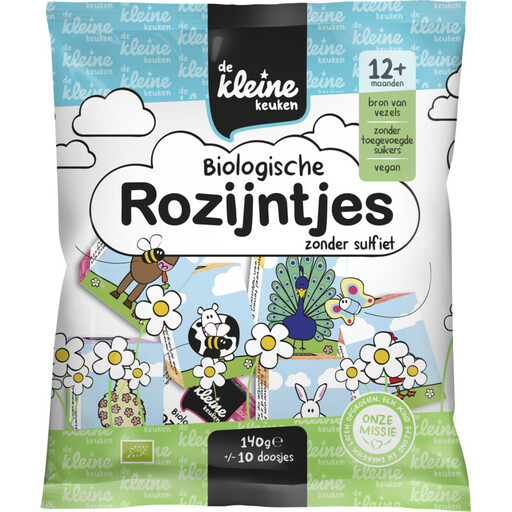
De Kleine Keuken Organic Raisins 12M+ 140 g
A good choice if you’re looking for organic raisins as a measured snack; the product listing is intended for children aged 12 months and over.
The product information advises supervising children while they eat and says the product isn’t suitable for children with swallowing difficulties.
View at Joybuy
 No image available
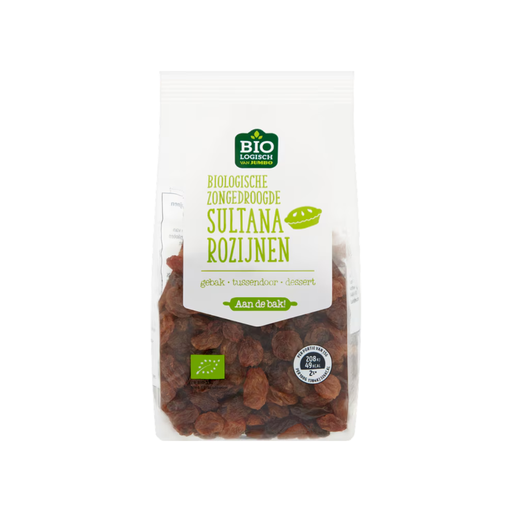
B+ Sultana Raisins 250 g
A good choice if you’re looking for organic sultana raisins to snack on or add to cereal; the product description also mentions baking and desserts.
Bear in mind that the product contains sunflower oil; the nutritional information lists 75,5 g of sugars per 100 g. The product description says that a stem or stone may remain despite checks.
View at Joybuy
Frequently asked questions
Does organic dried fruit always have to display the green EU logo?
Not in every situation. According to the European Commission, the EU organic logo is compulsory for pre-packed organic food produced in the EU and sold there as organic; the logo may be optional for imported organic products. If the logo is used, also check the control code and the relevant agricultural origin.
Does organic mean a product contains only organic ingredients?
No, not necessarily. Skal Biocontrole states that composite organic products must contain at least 95% organic agricultural ingredients, with a limited remainder permitted under certain conditions. So check the ingredients list too, for example on a fruit mix.
How should I store an opened pack?
Follow the advice for the product you’ve chosen. PLUS advises storing its BIO+ Sultana raisins in a cool, dry, dark place. Albert Heijn also advises keeping its dried pineapple cool, dark and dry, and says it has a limited shelf life after opening. Don’t automatically apply the storage period for one type of fruit to another.
Can I mix dried fruit with unsalted nuts?
Yes. The Netherlands Nutrition Centre lists dried fruit with unsalted nuts as one way to enjoy it. If you have a nut or peanut allergy, check the ingredients and warnings for every item. Albert Heijn warns that its dried pineapple may contain peanuts and various nuts.
Where can I find allergen information?
According to the Netherlands Food and Consumer Product Safety Authority, allergen information appears on the label of pre-packed food. Check the ingredients list and any warnings on the current pack; an organic label doesn’t replace this information.


