
Shoppers who want to check where their food comes from
You want to be able to recognise the organic designation and check it separately from the ingredients list. The European Commission explains what information accompanies the EU organic logo.


For an organic afternoon snack, choose a product whose organic status you can check on the packaging, then compare the ingredients and the amount you want to eat. Raisins are a good fit for a simple, regular snack routine; dried mango is another fruit option, but you’ll need to check its ingredients and allergen information separately. Organic certification alone tells you nothing about sugar content or whether a product is suitable for someone with an allergy.
You want to be able to recognise the organic designation and check it separately from the ingredients list. The European Commission explains what information accompanies the EU organic logo.
You’d rather set aside a small amount in advance than treat a whole bag as one portion. Serving sizes can vary between product pages; the Netherlands Nutrition Centre advises having no more than a handful of dried fruit with no added sugar.
You’re looking for dried fruit you can eat on its own or add to breakfast. Jumbo, for example, suggests adding raisins to porridge or having them as a snack; the ingredients and portion size should still be part of your decision.
| What to consider | What should you check? | Who should give this more weight? |
|---|---|---|
| Organic origin | Check the organic designation and, if the EU organic logo is used, the control code and agricultural origin. | If organic origin matters to me, I want to be able to check the designation on the packaging; around 34% of shoppers give origin the highest priority. |
| Sugar and portion size | Check the ingredients and the total sugar per 100 g. Decide how much you want for your snack. | If I’m keeping an eye on added sugar and my snack portion, I want to be able to assess them separately; around 33% of shoppers put sugar and portion size first. |
| Packaging and use | Check the net weight, whether items are supplied individually, the storage instructions and any allergen information. | If I want to take my snack with me, I want to know whether I have an individual portion or need to measure one out myself; around 33% of shoppers give practical use the highest priority. |
Organic origin and sugar content answer different questions. Albert Heijn says AH Organic Raisins contain no added sugar, but do contain 59 g of total sugar per 100 g.
Read both the ingredients list and the nutrition table, and decide in advance how much you want to eat.
The Jumbo product page reviewed lists a 15 g serving, while AH and PLUS list 25 g. That means figures per serving aren’t directly comparable.
First compare the nutritional values per 100 g, then assess the same snack portion for yourself.
Albert Heijn says the items in AH Organic Dried Mango 3-pack are supplied individually; the bundle name doesn’t mean it contains three small portions.
Check the bundle contents and the weight of each item.
You could end up with more stock at home than you intended for your afternoon snacks.
The product information for AH Organic Dried Mango & Unsweetened Mango states that it may contain peanuts and various nuts. An organic designation says nothing about whether a product is suitable for someone with an allergy.
Check the allergen information on the packaging of the exact product variant.
The official product information covers AH Organic Raisins and AH Organic Dried Mango & Unsweetened Mango.
Jumbo sells Organic Sun-Dried Sultana Raisins in a 250 g pack.
Lidl’s official Dutch product listing names Belbake Organic Raisins.
ALDI lists an organic range and also has a separate product listing for Trader Joe’s raisins.
PLUS sells BIO+ Sultana raisins in a 250 g stand-up pouch.
Dirk’s product listing is for raisins.
This selection includes dried raisins and dates in packs described as suitable for snack time. For each variant, check the organic designation, ingredients and portion size on the packaging.
 No image available
The product information describes ten individual 14 g boxes for measured portions.
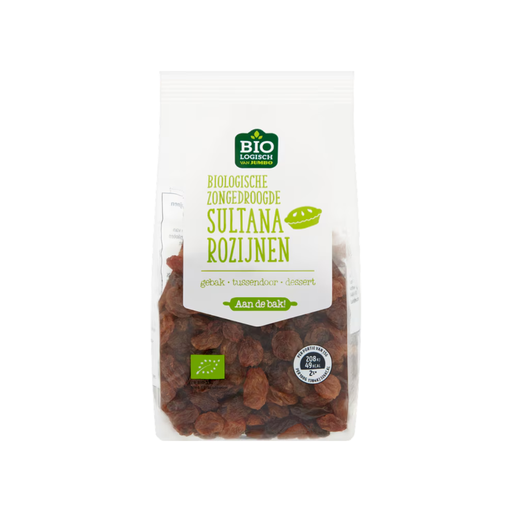
According to the product information, the raisins contain no added sugars or sulphites. Check the organic designation and related information on the packaging.
The product information says they can be used from 12 months, advises supervision while eating and states that the product isn’t suitable for children with swallowing difficulties.
 No image available
The product information describes a bag of raisins for snack time; you’ll need to measure out your own snack portion.
The ingredients information lists raisins and sunflower oil of organic origin. The product information lists 3,7 g of fibre per 100 g and no added sugars.
Once opened, the pack should be kept tightly closed. The product information warns that a stalk or pip may remain despite cleaning. Check the organic designation on the packaging.
 No image available
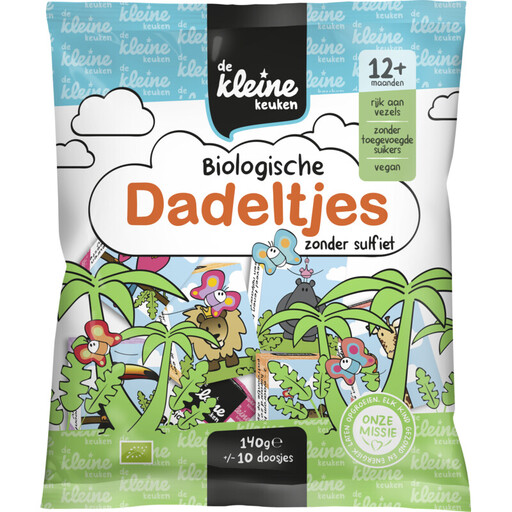
The product information describes individual 14 g snack boxes.
According to the product information, the ingredients are 95% dates and 5% rice flour; no added sugars are listed. Check the organic designation on the packaging.
The product information says they can be used from 12 months and advises keeping a child sitting upright and supervising them while they eat.
Not in every case. According to the European Commission, the logo is compulsory on pre-packed foods produced in the EU and sold as organic; it’s optional for imported products that meet EU rules for organic imports. When the logo is used, the control code and agricultural origin should also be shown.
Not by itself: the control code doesn’t have to be Dutch. The AH Organic Raisins product reviewed lists TR-BIO-154, while AH Organic Dried Mango & Unsweetened Mango lists IT-BIO-009. Assess the code alongside the organic information on the exact packaging.
Follow the storage advice for the exact variant. For BIO+ Sultana raisins, PLUS advises storing them in a cool, dry, dark place. For its unsweetened dried mango, AH also advises cool, dark and dry storage and says it has a limited shelf life once opened.
Check the allergen information on the exact packaging. AH Organic Dried Mango & Unsweetened Mango states that it may contain peanuts and various nuts; an organic designation doesn’t tell you whether a product is suitable for your allergy.
No. The Netherlands Nutrition Centre advises having no more than a handful of dried fruit with no added sugar, as dried fruit is high in sugar. This is dietary guidance, not a legal limit.