
Shoppers looking for low-fat organic snacks
You’re looking for organic dried fruit that’s low in fat, so you check the nutrition table rather than relying only on a search term or packaging claim.


Jumbo and PLUS list 0.5 g and 0.8 g of fat per 100 g respectively for their organic raisins, but these figures do not prove a reduction in fat compared with similar products. Compare energy, sugars and the portion you eat too: low fat does not automatically mean low in energy.
You’re looking for organic dried fruit that’s low in fat, so you check the nutrition table rather than relying only on a search term or packaging claim.
For you, a lighter snack is mainly about choosing an amount that suits the occasion. The amount you actually eat matters just as much as the fat content.
You want to pick up a suitable option as part of your usual shop, taking into account organic credentials, packaging and how easy it is to buy. In 2023, Motivaction reported that daily and weekly grocery shopping is often routine; the research was not specifically about dried fruit.
When choosing organic dried fruit for a snack, it helps to assess fat, nutritional values per portion, organic labelling and pack size separately.
A good fit if: you want to decide for yourself how many raisins to eat and prefer a standard bag.
Bear in mind: the bag does not divide the contents into portions, so you’ll need to weigh them yourself if that matters to you.
A good fit if: a pre-measured amount matters more to you than a standard bag.
Bear in mind: the De Kleine Keuken option mentioned is intended for children aged 12 months and over; follow the instructions on sitting upright and supervision.
| What to consider | What should you check? | Which consumers is this for? |
|---|---|---|
| Fat content and reduction | Check the fat per 100 g; treat a claim about a reduced content as a comparison with similar products. | I want a low absolute fat value, but don’t want to mistake it for a proven reduction; around 33% of consumers prioritise fat content. |
| Organic labelling | Check the organic label and applicable certification mark on the packaging; look for the origin statement on each product. | I want the organic status to be verifiable, rather than simply suggested by the product’s appearance; around 27% of consumers prioritise assurance that a product is organic. |
| Portion, sugars and energy | Compare energy and sugars per 100 g and per portion; check the net weight too. | I want to choose a snack portion that suits the occasion, rather than looking at fat alone; around 27% of consumers prioritise portion control. |
| Packaging and convenience | Check the net weight and storage instructions; check the retailer if home delivery is important to you. | I want to fit dried fruit into my usual shop without an awkward pack size; around 13% of consumers place most importance on packaging and convenience when buying. |
Alongside their fat values, Jumbo and PLUS also list energy and sugars. A low fat figure alone doesn’t tell you how much energy or sugar a portion contains.
Check energy and total sugars alongside fat, and compare the values with the amount you actually eat.
The Netherlands Bakery Centre defines a reduced nutrient content as at least 30% less than in similar products. A standalone fat value per 100 g does not prove this comparison.
Assess a reduction claim by comparing it with similar products; don’t infer one from a low absolute value.
PLUS lists 68.2 g of sugars per 100 g for BIO+ Sultana raisins and states that these occur naturally. This description does not mean the product contains no sugars.
Check both the ingredients and the ‘of which sugars’ line in the nutrition information, and pay attention to the amount per portion.
The Jumbo and BIO+ standard bags contain 250 g; the Joybuy listing for the small De Kleine Keuken boxes gives a total of 140 g. Looking only at the total pack size makes portions difficult to compare.
Compare packs on the same weight basis and choose a size that suits how you’ll use the product and its storage instructions.
Albert Heijn’s category overview includes AH organic raisins, pineapple and a fruit and almond mix.
Jumbo lists a 250 g pack of Organic Sun-Dried Sultana Raisins.
PLUS lists both a standard 250 g bag of BIO+ Sultana raisins and a separate De Kleine Keuken product.
Dirk identifies a 250 g pack of Bio+ Sultana raisins.
The Lidl product page lists dried fruit at selected stores.
ALDI Netherlands lists Trader Joe’s raisins in a 500 g pack.
This selection includes organic raisins and dates, with options for children aged 12 months and over. As well as the nutritional values, check the age guidance and instructions for use.
 Image unavailable
The product listing describes organic raisins in individual boxes, a good option if you want to measure out portions in advance.
Joybuy lists 10 boxes of 14 g each, 140 g in total.
Intended for children aged 12 months and over; make sure the child is sitting upright and supervise them while they eat.
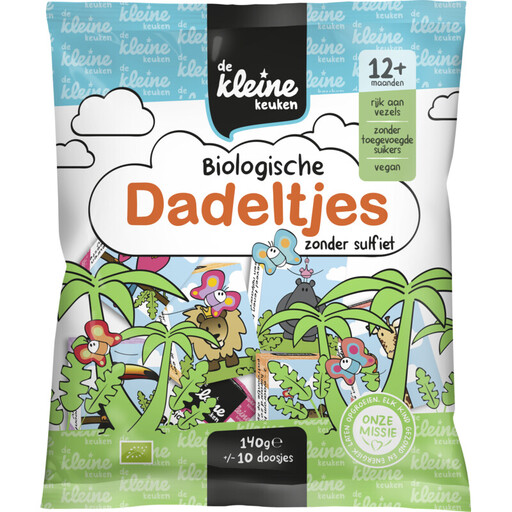 Image unavailable
The product description presents these organic dates as a snack; Joybuy lists 0.0 g of fat and 61.0 g of sugars per 100 g.
Intended for children aged 12 months and over; make sure the child is sitting upright and supervise them while they eat.
No. For solid foods, the European Commission defines the claim ‘low fat’ as a maximum of 3 g of fat per 100 g. The Netherlands Bakery Centre defines a reduced nutrient content as at least 30% less than in similar products. A low absolute fat value does not prove this comparison.
No, don’t use a Dutch code as a universal requirement. Jumbo lists TR-BIO-132 and Non-EU Agriculture for its organic raisins. Skal Biocontrole states that the EU logo is mandatory for prepacked foods produced in the EU and sold as organic.
The World Cancer Research Fund advises eating no more than 20 g of dried fruit a day because of its concentrated sugar content. This is dietary advice, not a legal product limit; the portion stated on a pack may differ.
De Kleine Keuken raisins are intended for children aged 12 months and over. The product instructions say that the child must sit upright and be supervised; a portion-sized box does not replace these requirements.
Follow the storage instructions on your own pack. Jumbo and PLUS say to store the raisins mentioned in a cool, dry, dark place.