What should you look for when choosing?
Start with the ingredients you’re looking for, then check the certification, nutritional information and quantity that suit the way you’ll use it.
| What to consider |
What to look for |
Who is this most important for? |
| Verifiable organic certification |
Check the EU organic logo, control code and farming origin. The European Commission links the logo to organic certification. |
If you choose organic, you’ll want to be able to verify the claim on the packaging; around 20% of consumers put organic certification first. |
| Sugar and portion size |
Read the ingredients and nutritional information; compare sugars per 100 g and decide on your portion size. |
I don’t want to mistake unsweetened for sugar-free, and I want to choose my portion mindfully; around 20% of consumers prioritise sugar and portion size. |
| Snack or topping |
Choose a combination you’ll enjoy on its own or with yoghurt or breakfast; check the net weight. |
If I want one product for different occasions, I look for a combination that works for both; around 20% of consumers prioritise versatility. |
| Variety and ingredients |
Choose between a single fruit and a mix; if you have allergies, check the full allergen information. |
I want to try a different fruit or deliberately combine fruit and nuts; around 20% of consumers make variety their main priority. |
| Quantity and storage |
Choose a pack size that suits how you’ll use it and follow the storage advice for that exact product. |
If I want to use a pack before it gets left untouched, I consider the quantity and storage advice; around 20% of consumers prioritise buying an amount that suits them. |
Organic raisins at Joybuy
This Joybuy selection focuses on organic raisins for a measured snack.
 No image available
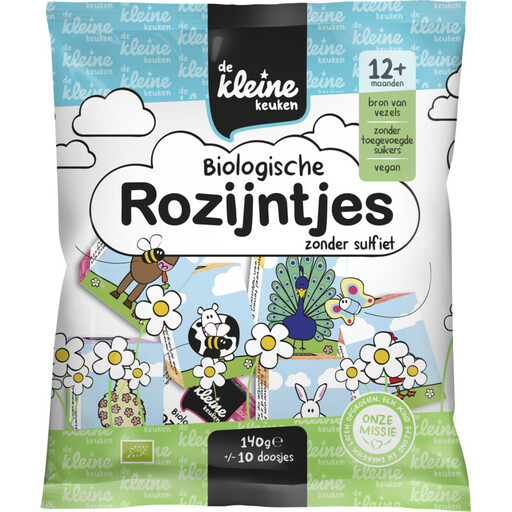
De Kleine Keuken organic raisins 12M+ 140g
The product description lists organic raisins with no added sugars, in 10 snack boxes of 14 g.
According to the product information, store in a cool, dry, dark place. Suitable for children over 12 months; supervise them while they eat. Not suitable for children with swallowing difficulties.
View at Joybuy
Frequently asked questions
Does ‘natural’ mean the same as organic?
No. Don’t use ‘natural’ as a substitute for an organic claim. Skal Biocontrole explains that ‘organic’ and related terms are protected; the EU organic logo is intended for organically certified products.
Does every organic product need to have the same logo and control code?
Not necessarily: control codes can vary between certification bodies. The European Commission states that the EU organic logo is compulsory for pre-packed foods produced in the EU and sold as organic. Also check the relevant code and farming origin on the packaging.
Can I use the portion size on the packaging as a daily recommendation?
Not automatically. A portion size on the packaging is product information. The Netherlands Nutrition Centre advises eating no more than a handful of dried fruit with no added sugar; this is different from the portion size a retailer lists for a product.
What should I look for if I need to avoid sulphites or nuts?
Check the full allergen information on the exact pack. The NVWA states that allergen information must appear on the label of pre-packed foods. The AH fruit and nut mix we looked at contains almonds and pecans; according to the Food Allergy Foundation, dried fruit can contain sulphites.
How should I store an opened pack?
Follow the storage advice for the exact product. For the raisins we looked at, AH and PLUS recommend storing them in a cool, dry, dark place; AH says to store the mango we looked at at room temperature in a dark place. For mixed dried fruit, the Netherlands Nutrition Centre recommends a well-sealed container; don’t automatically apply that advice to other products.


