Who is organic dried fruit suitable for?

Students bringing their own lunch

You want to take a small amount with you and pay attention to ingredients, portions and storage. The raisin packs from Albert Heijn, Jumbo and PLUS contain 250 g; the product pages recommend storing them in a cool, dry, dark place.

Students avoiding added sugar

You’re looking for something to add to your lunch that has no added sugar, but you also want to know how much total sugar it contains. Albert Heijn lists 0 g of added sugars for its raisins and unsweetened mango; the total sugar content is not zero.

Students who need to check allergens

You want to check the allergen information for the exact product variant before choosing. This is also important for unpackaged fruit in a canteen; the Netherlands Food and Consumer Product Safety Authority explains what information providers must make available.

What should you look for in organic dried fruit?

What to consider What should you check? Who is this important for?
Organic certification Check for the EU organic logo, the control code and the indication of agricultural origin. The European Commission explains this labelling for organic products. If I want to be sure that the organic status is clearly shown on the label, I check the product variant. Around 36% of consumers give organic certification the highest priority.
Sugars and ingredients Read the ingredients and compare total sugars on the same basis, for example per 100 g. Then consider the amount you’ll use. If I want to avoid added sugar, I also check the total sugars and my portion size. Around 29% of consumers prioritise ingredients and sugar information.
Portions and storage Compare the net weight and portion information, and follow the storage instructions on the packaging. Portion sizes on different labels are not automatically comparable. If I want to spread the fruit across several lunches, I look for a pack that suits how I’ll use it and consider how to store what’s left. Around 21% of consumers prioritise repeat use and suitable packaging.
Allergen information Read the warnings for the exact product variant. If buying unpackaged food from a canteen, ask what allergen information is available before you buy. If I have an allergy, I want to be able to check whether a product is suitable before choosing it. Around 14% of consumers make allergen information their top priority.

Common pitfalls when buying dried fruit

  • Confusing organic with sugar-free

    Organic certification relates to how a product is produced, not how much sugar it contains. Albert Heijn lists 0 g of added sugars for its organic raisins, but also 59 g of total sugars per 100 g.

    Check both the ingredients and the total sugars, then decide how much to add to your lunch.

  • Comparing nutritional values for different portion sizes

    The Albert Heijn and PLUS raisin pages give a portion size of 25 g; Jumbo shows nutritional values for 15 g. So a per-portion comparison isn’t based on the same quantity.

    Compare the values per 100 g first, then look at the amount you’ll actually have.

  • Assuming fruit doesn’t need an allergen warning

    Albert Heijn states that its unsweetened organic mango may contain peanuts and various nuts. So a fruit product isn’t automatically suitable for everyone with an allergy.

    Read the information on the exact pack. If buying unpackaged food from a canteen, ask about allergen information before you buy.

Brands and product ranges for reference

Albert Heijn

The product information covers AH Biologisch Rozijnen and AH Biologisch Mango gedroogd & ongezoet.

  • Albert Heijn lists control code TR-BIO-154 for the raisins and TR-BIO-009 for the mango variant, alongside organic product information.
  • The mango comes with a warning that it may contain peanuts and various nuts. Check the information on the pack you’re buying.

Jumbo

The relevant product range is Jumbo Zongedroogde Sultana Rozijnen Biologisch, in a 250 g pack.

  • Jumbo displays a European organic certification mark and control code TR-BIO-132.
  • The product page uses a 15 g portion size, so compare nutritional values per 100 g as well.

Lidl

The product listing names Belbake Biologische rozijnen.

  • The product name identifies an organic raisin variant.
  • Check the pack for the ingredients, allergen information and certification details that matter for your choice.

ALDI

The product listing is for a 500 g pack of Trader Joe’s raisins.

  • The product listing names the product type and pack size.
  • The product name doesn’t state that it’s organic, so don’t treat this variant as demonstrably organic.

PLUS

The relevant product range is BIO+ Sultana rozijnen in a 250 g stand-up pouch. BIO+ is the product brand name here.

  • PLUS states the organic origin and EU Organic Farming. The ingredients are listed as 99% organic raisins and organic sunflower oil.
  • Check the pack in your order, as product information can change.

Dirk

The product listing names Bio+ Rozijnen sultana in a 250 g pack.

  • The product name and pack size tell you which sultana raisins these are.
  • The name alone doesn’t confirm organic certification. Check the pack for the organic label and related details.

Product picks at Joybuy

These product picks are dried raisins and dates in small lunch portions. To verify organic certification, check the exact pack for the EU organic logo, the control code and the indication of agricultural origin.
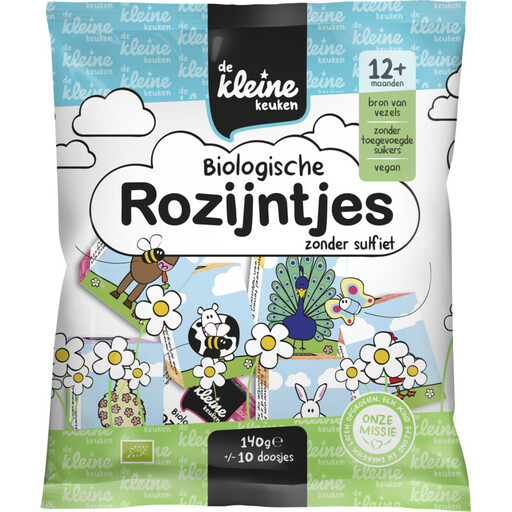
De Kleine Keuken Organic raisins 12M+ 140g

De Kleine Keuken Organic Raisins 12M+ 140g

The individual portions are designed to make it easy to take a small amount with you for lunch.

The product information lists ten 14 g snack boxes and raisins. Follow the storage instructions provided: store in a cool, dry, dark place.

View at Joybuy
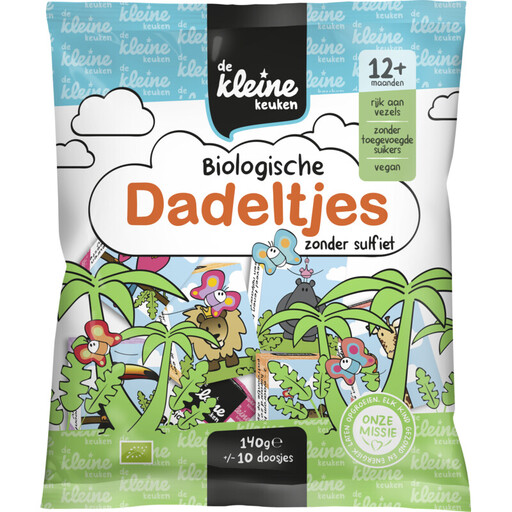
De Kleine Keuken Organic Dates 12+

De Kleine Keuken Organic Dates 12+

These dates are an option if you’re specifically looking for dried dates to add to your lunch.

The product information lists 95% dates and 5% rice flour. Nutritional values are shown per 14 g; follow the storage instructions on the packaging.

View at Joybuy

Frequently asked questions about organic dried fruit

Does organic dried fruit always have to show NL-BIO-01?

No. The control code relates to the relevant control body and doesn’t have to be Dutch. Albert Heijn lists TR-BIO-154 for its raisins and IT-BIO-009 for its mango; Jumbo lists TR-BIO-132 for its organic raisins. The European Commission explains that the EU organic logo must be accompanied by a control code and an indication of agricultural origin.

Is the portion size on the pack the same as a recommended daily amount?

No. The portion sizes shown are label information, not a standard daily recommendation: Albert Heijn and PLUS list 25 g for their raisins, while Jumbo uses 15 g. The Netherlands Nutrition Centre advises having no more than a handful of dried fruit with no added sugar.

How should I store raisins for future lunches?

Follow the instructions on the pack for the exact variant. For the raisins mentioned, Albert Heijn, Jumbo and PLUS recommend storing them in a cool, dry, dark place. Albert Heijn also advises checking, smelling and tasting these raisins after the best-before date; this isn’t general guidance for products with a use-by date.

Is unsweetened organic mango automatically suitable for someone with a nut allergy?

No. For AH Biologisch Mango gedroogd & ongezoet, Albert Heijn states that the product may contain peanuts and various nuts. Check the warning on the exact pack before choosing this variant.

Does a university canteen have to provide allergen information for unpackaged dried fruit?

Yes. When a canteen offers unpackaged food to consumers, information about any allergens present must be available before purchase. The Netherlands Food and Consumer Product Safety Authority explains that this information can be given in writing or, under certain conditions, verbally. If nuts are present, the types must be clearly identified; this applies to the provider, not to a student simply bringing their own lunch.
