
Lunch packers who care about organic food
You want to be able to recognise organic certification, rather than relying on a product’s natural look. The European Commission explains when the EU organic logo may be used on certified products.


Organic dried fruit can make a handy little addition to a packed lunch or breakfast on the go: raisins are easy to portion out, while mango adds a bit of variety. Organic doesn’t automatically mean low in sugar or allergen-free, so check the ingredients, total sugars and allergen warnings. The Voedingscentrum recommends eating no more than 20 g of dried fruit a day.
You want to be able to recognise organic certification, rather than relying on a product’s natural look. The European Commission explains when the EU organic logo may be used on certified products.
You’re looking for a little sweet addition and want to distinguish between total sugars, added sugars and the serving size shown on the packaging.
You take breakfast to the office and want to keep dry toppings separate. If your breakfast is already prepared or chilled, follow the storage instructions for the whole dish. The Voedingscentrum recommends using airtight containers when preparing meals in advance.
Choose this when: you want to measure out a small amount for lunch or breakfast. AH Biologisch and Jumbo list raisins and organic sunflower oil; BIO+ at PLUS lists 99% raisins.
Bear in mind: a bag isn’t a separate lunch portion, so you’ll need to portion it out yourself. The ingredients aren’t always fruit alone.
Choose this when: you want to take mango with you and are looking for a product with just one listed ingredient. AH Biologisch Mango gedroogd & ongezoet lists dried mango as its ingredient.
Bear in mind: unsweetened doesn’t mean sugar-free: Albert Heijn lists 61 g of sugars per 100 g and warns that peanuts and nuts may be present. The product has a limited shelf life once opened.
| What to consider | What to look for | Who should consider this? |
|---|---|---|
| Organic certification | Check the organic labelling, inspection code and agricultural origin. The EU organic logo is intended for certified products; the logo is optional for certain imported organic products (European Commission). | If you’re looking for verifiably organic fruit for your packed lunch, you’ll want to check the certification on the packaging. Around 30% of consumers prioritise organic certification. |
| Portion and ingredients | Check the ingredients and compare total sugars with added sugars. AH Biologisch Mango lists 0 g of added sugars and 61 g of sugars per 100 g; the Voedingscentrum recommends eating no more than 20 g of dried fruit a day. | If you want to measure out a small amount for lunch or as a topping, the portion and ingredients matter more than the word ‘unsweetened’ alone. Around 30% of consumers prioritise these factors. |
| Taking it with you and storage | Follow the product’s storage instructions after opening. Store raisins in a cool, dry, dark place in a tightly sealed container; if you’ve prepared breakfast in advance, follow the storage instructions for the whole dish (Voedingscentrum). | If you prepare breakfast in advance or take fruit to the office, you’ll want to know how to keep the dry topping separate and store the complete breakfast. Around 20% of consumers prioritise taking food with them and storage. |
| Pack size | Compare the net weight with the amount you use and check the storage instructions after opening. The packs listed come in different sizes. | If you want to divide a pack across several lunches, choose a quantity you can use while following the recommended storage instructions. Around 10% of consumers prioritise pack size and how they’ll use the product. |
| Allergens | Read the ingredients list and any warnings about the possible presence of allergens on the exact pack. The NVWA explains the mandatory allergen labelling requirements. | If you have an allergy and an ingredient or cross-contamination warning is relevant to you, check the information on the exact variant. Around 10% of consumers prioritise allergen information. |
The product information for AH Biologisch Mango lists 0 g of added sugars, but also 61 g of total sugars per 100 g.
Check the total sugars on the label and measure out a small portion.
The BIO+ pack at PLUS lists a serving size of 25 g; the Voedingscentrum recommends eating no more than 20 g of dried fruit a day.
Follow the dietary guidance and don’t automatically treat the serving size on the pack as a daily recommendation.
Organic labelling doesn’t replace allergen information. The AH mango warns that peanuts and nuts may be present.
If an allergy is relevant to you, check the ingredients and warnings on the pack of the variant you plan to use.
Dried fruit and a prepared breakfast containing highly perishable ingredients don’t have the same storage requirements.
If you like, keep dry toppings separate. For a prepared breakfast, follow the storage instructions for the whole dish. The Voedingscentrum recommends keeping a fridge at 4 °C for highly perishable food.
AH Biologisch lists raisins and dried mango as products suitable for a small portion on the go.
Jumbo lists organic sultana raisins in a 250 g pack.
BIO+ Sultana rozijnen is a BIO+ brand product listed at PLUS.
Dirk lists Bio+ Rozijnen sultana in a 250 g pack.
Lidl lists Belbake Biologische rozijnen.
These Joybuy fruit snacks are suitable for taking with you as a portion. Check the pack for organic certification if that’s a requirement for you.
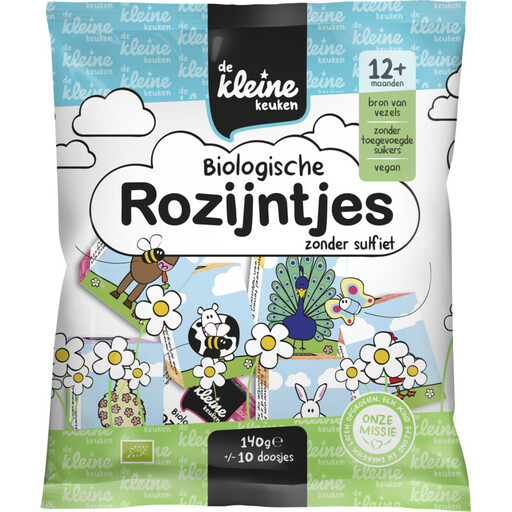 No image available
The product information lists 14 g snack boxes for taking a small portion with you.
The product information says it is suitable from 12 months; supervise children while they eat. Not suitable for children with swallowing difficulties.
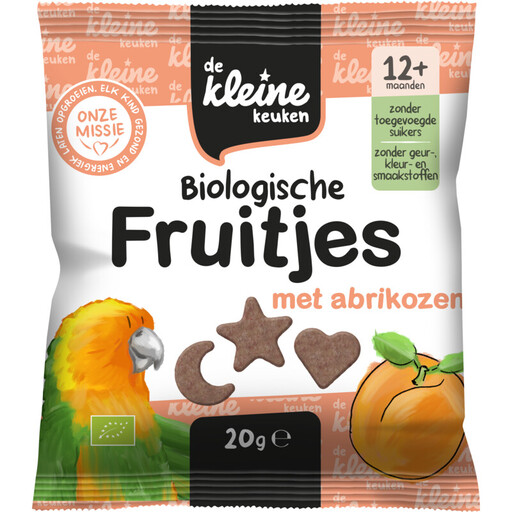 No image available
The 20 g pack is a small, fruity portion to take with you.
The product information lists dried apricots, dates, bananas and rice flour as ingredients, and warns that traces of nuts may be present. According to the product information, it is suitable from 12 months.
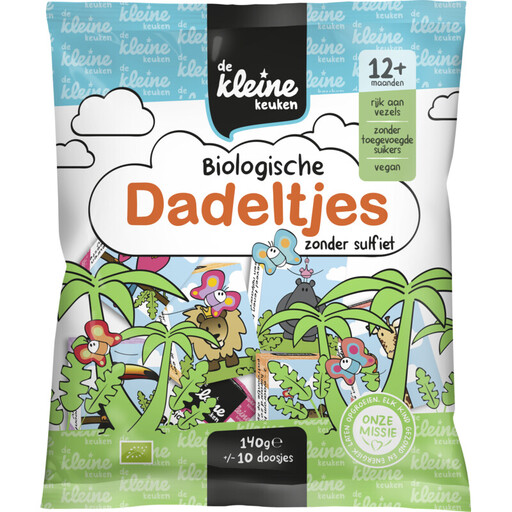 No image available
The product information lists 14 g snack boxes for taking a small portion with you.
The description lists dates as 95% of the ingredients and recommends storing the product in a cool, dry, dark place. According to the product information, it is suitable from 12 months; young children should sit upright and be supervised.
No, the origin information is separate from organic certification. According to the European Commission, the EU organic logo may be used on certified products that meet the requirements; the logo is optional for certain imported organic products.
No. AH Biologisch Mango gedroogd & ongezoet lists 0 g of added sugars, but also 61 g of sugars per 100 g (Albert Heijn). Check the label and measure out your portion.
For raisins, the Voedingscentrum recommends storing them in a cool, dry, dark place in a tightly sealed container. If you mix them into a prepared breakfast or with highly perishable ingredients, follow the storage instructions for the whole dish; the Voedingscentrum recommends keeping highly perishable food in a fridge at 4 °C.
Check the ingredients list and any warnings about possible allergens on the exact pack. The NVWA explains the mandatory declaration of 14 allergens; organic certification doesn’t replace this information.
No, there are legal exceptions to the cooling-off period. According to the ACM, online purchases usually come with a 14-day cooling-off period, with exceptions including products that spoil or go out of date quickly. This exception doesn’t automatically apply to every product with a long shelf life, so check the information that applies to your purchase.