What should you look for in organic dried fruit?
This guide is for shoppers looking for organic dried fruit for match night, perhaps to enjoy at breakfast as well. Each row focuses on the main buying priority.
Dried mango
A good fit if: you want to serve pieces of fruit and are looking for a product with dried mango as its only ingredient.
Bear in mind: Albert Heijn lists 61 g of total sugars per 100 g and warns that the product may contain peanuts and various nuts.
Sultanas
A good fit if: you want to serve raisins and use the pack for breakfast, too; the Jumbo and PLUS varieties mentioned come in 250 g packs.
Bear in mind: both ingredients lists also include sunflower oil; Jumbo lists 75.5 g of sugars per 100 g.
| What to consider |
What to look for |
Who is this most important for? |
| Organic certification |
Check for the EU organic logo, the control body and the stated agricultural origin. For imported products, the logo is optional in certain circumstances, so its absence alone doesn’t prove that a product isn’t organic. |
I want to be able to check that the organic claim is verifiable while watching the match; a natural appearance alone isn’t enough for me. Around 31% of consumers put verifiable organic certification first. |
| Ingredients and portion size |
Read the ingredients list and compare total and added sugars on the same basis, for example per 100 g. |
I want to be able to prepare a portion without mistaking ‘unsweetened’ for sugar-free. For around 31% of consumers, ingredients and portion control are the top buying priorities. |
| Packaging for snacking and breakfast |
Check the net weight and storage instructions, and decide in advance how much you’ll use during the match and later at breakfast. |
I want to choose one pack that works for both the match and a later breakfast, so I’ll use all of it. Around 23% of consumers prioritise this combination of uses. |
| Allergens |
As well as the ingredients, check the current pack for warnings about possible allergens. |
When we’re sharing snacks, I want to know whether the product suits the allergen needs of my guests. For around 15% of consumers, this check comes first. |
Which brands offer relevant product examples?
The examples below relate to specific products and labels; they aren’t an assessment of a brand’s or supermarket’s entire range.
Albert Heijn
AH Biologisch Mango gedroogd & ongezoet is one option if you’re looking for pieces of dried fruit.
- Albert Heijn lists dried mango as the sole ingredient, along with the EU organic logo and control code IT-BIO-009. The label states 0 g of added sugars per 100 g.
- The label also states 61 g of total sugars per 100 g and warns that the product may contain peanuts and various nuts.
Jumbo
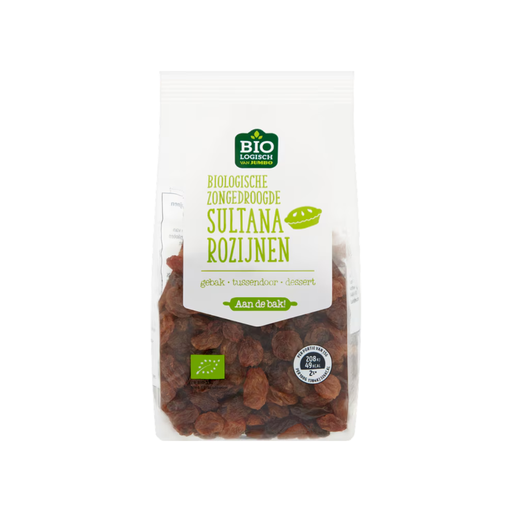
Jumbo Zongedroogde Sultana Rozijnen Biologisch 250 g is a sultana option reviewed for snacking and breakfast.
- Jumbo lists raisins and sunflower oil of organic origin as ingredients.
- The nutrition table lists 75.5 g of sugars per 100 g; organic doesn’t mean sugar-free.
PLUS
BIO+ is the product brand of the 250 g stand-up pouch of sultanas reviewed here.
- PLUS lists 99% organic raisins, organic sunflower oil and the EU Organic Farming logo.
- The product information warns that small stalks and stones may be present and recommends storing the product in a cool, dry, dark place.
Joybuy products for snacking and breakfast
According to the product information, these Joybuy products are organic raisins that are suitable as a snack or for breakfast.
 No image available
B+ Sultana raisins, 250 g
The product information says these organic raisins are suitable as a snack or added to breakfast cereal.
Ingredients: raisins and sunflower oil of organic origin. The nutrition information lists 75.5 g of sugars per 100 g.
According to the product information, a stalk or stone may remain despite checks.
View at Joybuy
 No image available
De Kleine Keuken Organic raisins 12M+, 140 g
The product information describes organic raisins in small boxes, making it easy to serve a measured snack portion.
The pack contains 10 boxes of 14 g. The product information says it is suitable from 12 months, advises adult supervision while eating and states that it is not suitable for children with swallowing difficulties.
View at Joybuy
Frequently asked questions
Does organic dried fruit always need to have the EU organic logo?
No, not in every situation. According to the European Commission, the logo is compulsory for pre-packed organic food produced in the EU. It’s optional for imported products that meet EU import requirements. If the logo is used, the control body and agricultural origin must also be stated.
Does unsweetened mean sugar-free?
No. For AH Biologisch Mango gedroogd & ongezoet, Albert Heijn lists 0 g of added sugars and 61 g of total sugars per 100 g. Read these two figures separately.
Can you use leftover snacks for breakfast?
Dried fruit can be added to breakfast; the Netherlands Nutrition Centre also suggests using it this way. Follow the storage instructions for your chosen product: PLUS BIO+ recommends storing it in a cool, dry, dark place, while AH states that the mango has a limited shelf life after opening.
What should you check if someone in your group has an allergy?
Check both the ingredients and the allergen information on the current pack. The Netherlands Food and Consumer Product Safety Authority highlights the importance of allergen information on pre-packed products. AH Biologisch Mango warns that it may contain peanuts and various nuts.
How do you choose a pack for both the match and breakfast?
Check the net weight, how much you want to serve during the match and whether you’ll use the rest later. The mango pack mentioned contains 130 g; the Jumbo and PLUS raisin varieties mentioned each contain 250 g. Store the product according to the instructions on the pack.


