What should you look for when buying?
First decide whether you’re mainly looking for a supply of raisins for snacks and breakfast, or want to offer a selection of fruit. Then check the exact pack for organic information, ingredients, quantity and storage advice.
| What to consider |
What should you check? |
Who should give this more weight? |
| Organic origin |
Check the organic label, control code and origin information on the exact pack. The European Commission explains the information shown alongside the EU organic logo. |
If organic certification is why I’m choosing this fruit for game night, I want to be able to check the origin of the specific pack; around 29% of consumers put this check first. |
| Ingredients and quantity |
Read the ingredients and compare added sugars with total sugars per 100 g. The Netherlands Nutrition Centre advises eating no more than a handful of dried fruit because of its sugar content. |
If I want to offer a simple snack and decide how much to put out, I prioritise ingredients and portion size; around 23% of consumers do the same. |
| Serving in advance |
Check the net weight and stated serving size separately. Albert Heijn and PLUS list a 25 g serving for their raisins; Jumbo uses 15 g in its nutrition table. So compare nutritional values per 100 g as well. |
If I want to get the food ready in advance for an evening, choosing my own portion is more practical than treating the whole bag as one serving; around 18% of consumers prioritise ease of serving. |
| Saving some for later |
Match the pack size to your plans for the evening and the following morning’s breakfast. Follow the storage advice on the exact pack; Albert Heijn, Jumbo and PLUS advise keeping their raisins in a cool, dry, dark place. |
If I want to use the rest for breakfast too, I choose an amount that suits how much I expect to use afterwards; around 18% of consumers prioritise using it on more than one occasion. |
| Specific guest requirements |
If there’s a relevant dietary requirement, check the ingredients and allergen information on the packaging. Sulphites can be present in dried fruit; Stichting Voedselallergie describes a possible intolerance reaction. |
If a specific dietary requirement of mine or a guest affects the choice, I want to check the exact pack before serving anything; around 12% of consumers put this check first. |
Joybuy product picks
These product picks focus on organic raisins and dates as snacks you can portion out in advance; the raisin variants are also suggested for adding to breakfast cereal.
 Image unavailable
De Kleine Keuken Organic raisins 12M+ 140 g
The product information describes these organic raisins as a snack and states that they contain no added sugars.
The pack contains 10 snack boxes of 14 g. Store in a cool, dry, dark place.
The product information says they’re suitable from 12 months, with supervision while eating. According to the information, the product isn’t suitable for children with swallowing difficulties.
View at Joybuy
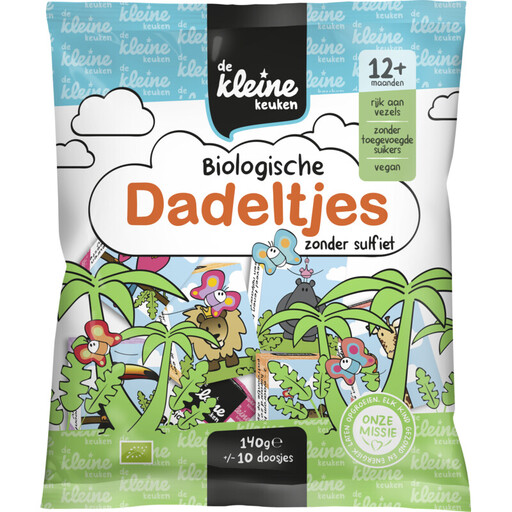 Image unavailable
De Kleine Keuken organic dates 12+
The product information describes organic mini dates as a snack and lists dates and rice flour as ingredients.
The ingredients are 95% dates and 5% rice flour. The product information states that there are no added sugars and gives a serving size of 14 g.
The information says they’re suitable from 12 months; young children should sit upright and eat under supervision.
View at Joybuy
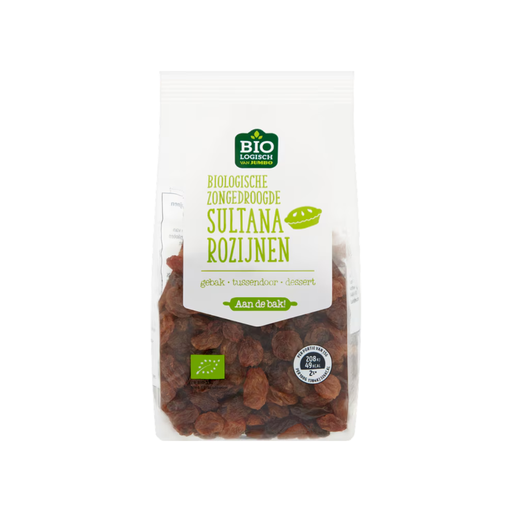 Image unavailable
B+ Sultana raisins 250 g
The product information describes organic sultanas for snacking or adding to breakfast cereal.
The pack contains 250 g. The product information lists raisins with sunflower oil and advises storing them in a tightly closed pack in a cool, dry place.
According to the product information, a stalk or pip may occasionally be present despite cleaning.
View at Joybuy
Frequently asked questions
Does every organic product have to display the green EU logo?
No. According to the European Commission, the logo is compulsory for pre-packed food produced in the EU and sold as organic. For imported products that meet EU import rules, using the logo is optional. When the logo is used, it must be accompanied by a control code and the prescribed information about the agricultural origin.
How should I compare added and total sugars?
Check the two figures separately and compare nutritional values on the same basis, preferably per 100 g. For AH Biologisch Rozijnen, Albert Heijn lists 0 g of added sugars and 59 g of total sugars per 100 g; these figures describe different things.
How much dried fruit should I put out per person?
The Netherlands Nutrition Centre advises eating no more than a handful of dried fruit because of its sugar content. The 15 g or 25 g servings used by manufacturers for the raisin packs covered here aren’t a standard guideline for your game night.
Why should I check for sulphites in organic dried fruit too?
An organic label doesn’t tell you by itself whether a product contains sulphites. Stichting Voedselallergie explains that sulphites can be present in dried fruit and may cause an intolerance reaction. Check the specific pack if this is relevant to you or a guest.
How should I store raisins I want to use for breakfast later?
Follow the storage advice on the packaging. For the Albert Heijn, Jumbo and PLUS raisins mentioned here, that means storing them in a cool, dry, dark place. Albert Heijn and PLUS also advise checking the product’s appearance, smell and taste by the best-before date.


