
Children's Easter egg hunt organisers
You want to prepare small edible treats and consider supervision, packaging and the children taking part. The Netherlands Nutrition Centre advises not to give young children too many raisins at once.


Organic raisins are a practical choice if you want to put together small treat portions yourself. Supervise young children while they eat, and use packaging suitable for direct contact with food. Check the organic certification and ingredients separately: unsweetened does not mean a product contains no naturally occurring sugars. For a change at breakfast, try plain dried mango, but check the allergen warning on the exact pack too.
You want to prepare small edible treats and consider supervision, packaging and the children taking part. The Netherlands Nutrition Centre advises not to give young children too many raisins at once.
You want a clearly identifiable organic product and also check the ingredients and added sugars. The European Commission explains the requirements for using the EU organic logo.
You want to divide one pack between several occasions and choose an amount you can store appropriately. Product information from Albert Heijn and PLUS can help you compare pack sizes and storage instructions.
First check the organic certification and ingredients. Then decide how you’ll hand out the treats and how much you’re likely to use.
| What to consider | What should you look for? | Who is this important for? |
|---|---|---|
| Organic certification | Check the EU organic logo and control code on the exact pack; check the ingredients separately. | I want to be able to check whether the organic claim suits my choice, rather than relying on how it looks. Around 29% of consumers prioritise recognisable organic certification. |
| Handing out treats carefully | Consider who is taking part, any allergens and the need to supervise young children; use packaging suitable for direct contact with food. | For an Easter egg hunt, I want to consider who will be eating the treats and prepare carefully. Around 29% of consumers give careful serving their top priority. |
| Ingredients and sugars | Read the ingredients and check total and added sugars separately, for example per 100 g. | At breakfast, I want to know exactly what’s in the fruit and how much total and added sugar is listed. Around 24% of consumers focus mainly on the ingredients. |
| Quantity and leftovers | Work out how many portions you need and follow the storage instructions for your chosen product. | I want to prepare enough for the planned portions and think about whether I’ll use any leftovers later. Around 18% of consumers prioritise portioning and minimising leftovers. |
Organic certification does not mean a product contains no naturally occurring sugars. Albert Heijn lists AH Biologisch Rozijnen as containing 0 g of added sugars and 59 g of total sugars per 100 g.
Check the ingredients and nutrition information separately, and don’t let a product’s natural appearance determine how much you serve.
The amount in a pack is not a personal serving recommendation for every child. The Netherlands Nutrition Centre warns that young children can choke on raisins.
Adjust the amount to suit the child, don’t give them too many at once, and supervise them while they eat.
Any material that comes into direct contact with food must be suitable for that purpose. The Netherlands Food and Consumer Product Safety Authority explains which products count as food contact materials.
Keep decorations separate from food if you’re not sure whether the material is suitable.
Putting together small portions yourself takes suitable food packaging and time to prepare.
The AH dried mango variety states that the product may contain peanuts and various nuts. Organic certification does not make this warning any less important.
Check the exact pack and, if someone has an allergy, discuss the treats with their parent or carer and follow their individual dietary advice.
The range includes 250 g packs of AH Biologisch Rozijnen and 130 g packs of AH Biologisch Mango gedroogd & ongezoet.
Jumbo offers sun-dried organic sultana raisins in a 250 g pack.
BIO+ Sultana raisins are available in a 250 g stand-up pouch.
Lidl lists Belbake Organic raisins in a 200 g pack.
ALDI lists Trader Joe's raisins in a 500 g pack.
Dirk lists raisins in a 750 g pack.
These products are organic dried fruit, with options for small snack portions and portioning yourself.
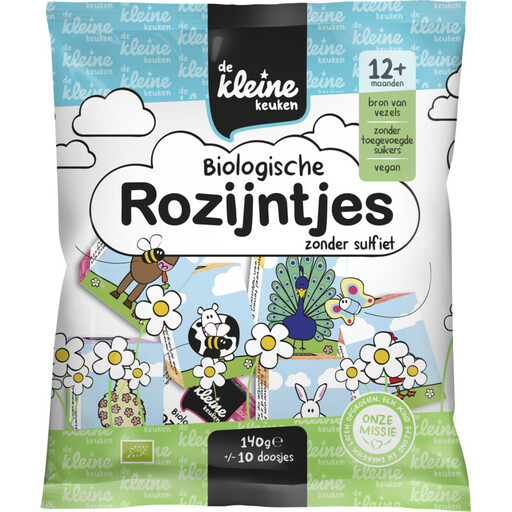 No image available
An option if you’re looking for organic raisins in small snack portions.
The product information advises supervising children while they eat and states that this variety is not suitable for children with swallowing difficulties.
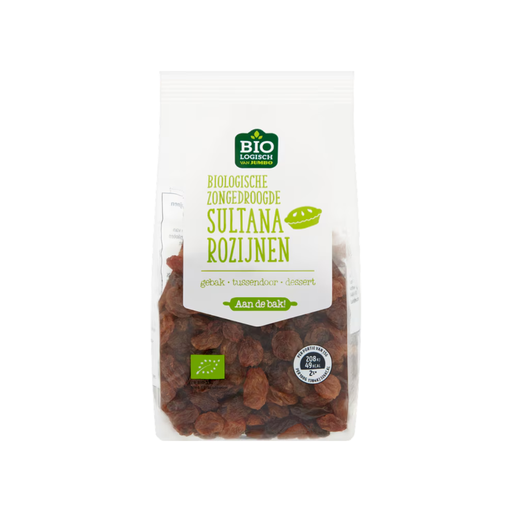 No image available
Suitable if you want to portion organic sultana raisins yourself for snacks or breakfast cereal.
The product information warns that a stem or stone may occasionally remain.
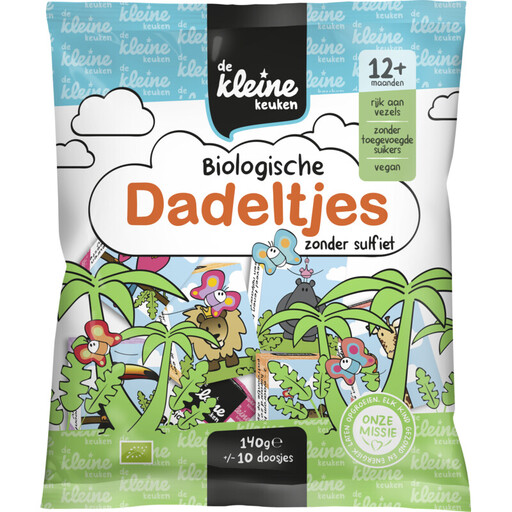 No image available
An option if you’re looking for organic dried dates as a fruity treat.
According to the product information, this variety is intended for children aged 12 months and over. Make sure the child is sitting upright and supervise them while they eat.
Supervise young children and don’t give them too many raisins at once. The Netherlands Nutrition Centre lists raisins as a possible snack around a child’s first birthday, once they’re eating meals with the family; this is not a guarantee that they’re suitable for every child.
For direct contact with fruit, use materials intended for food use. If you’re not sure whether the decorative egg is suitable, keep the fruit in separate food packaging. Wash your hands before portioning and use clean utensils.
Prepacked food produced in the EU and sold as organic must display the EU organic logo. The European Commission says the logo is optional, among other cases, for compliant organic products from other countries and for unpackaged organic products. If the logo is used, it should be accompanied by the control code and an indication of the agricultural origin.
No. Check the ingredients and allergen information for the exact variety. For example, the AH dried mango variety warns that it may contain peanuts and nuts. If you have an allergy, follow your individual dietary advice and don’t try products you suspect may be unsafe.
No. For example, Albert Heijn lists AH Biologisch Rozijnen as containing 0 g of added sugars and 59 g of total sugars per 100 g. Check the ingredients and nutrition information separately.