Who is this relevant to?

Cyclists with a regular breakfast routine

If you want to add dried fruit to your breakfast and are looking for a suitable daily portion, this is for you. Jumbo suggests adding raisins to porridge, while the Netherlands Nutrition Centre provides separate general guidance on portions of dried fruit.

Shoppers who want to check organic production

If organic production is an important factor in your purchase and you want to check the labels on the packaging, this is for you. The EU organic logo, control code and indication of origin each serve a different purpose, as explained by the European Commission.

Cyclists who pay attention to tolerance

If you want to choose food around intense exercise based on what you can tolerate, or if sulphites are a concern for you, this is for you. The Australian Institute of Sport discusses low-fibre sports foods for athletes who struggle to tolerate ordinary foods; this does not tell you whether a specific dried fruit product is right for you. The Food Allergy Foundation discusses sulphites in dried fruit.

What should you look for when choosing?

What to consider What should you look for? Who is this most relevant to?
Portion for your everyday breakfast Weigh out your portion. The Netherlands Nutrition Centre recommends no more than 20 g of dried fruit per day. This is general dietary advice, not a guideline for a long bike ride. If I add dried fruit to my usual breakfast, I want to be able to adjust my portion for everyday use. Around 40% of consumers prioritise their breakfast portion.
Organic label Check the label on the specific product. For prepacked foods produced in the EU and sold there as organic, the European Commission explains the EU organic logo, along with the associated control code and indication of origin. If organic production is my main criterion, I want to check the label on the packaging rather than rely on the product name alone. Around 30% of consumers prioritise this check.
Tolerance and timing Consider your own tolerance and when you plan to eat the product. If you are sensitive to sulphites, the ingredients and allergen information are also relevant; consult the information from the Netherlands Food and Consumer Product Safety Authority and the Food Allergy Foundation. If I’m choosing food for an intense ride, I want to take the timing into account, as well as what I can tolerate. For around 20% of consumers, this matters more than the other considerations.
Pack size Compare the net weight and think about how much you use each time you eat it. Pack size is not the same as a recommended portion. If I’m choosing a pack for breakfast, I want its size to suit how I use the product. Around 10% of consumers prioritise pack size.

Common mistakes

  • Assuming an organic range is proof that every product is organic

    A retailer may have a page for its organic range as well as a separate page for dried fruit. The organic status of a range does not automatically tell you anything about a specific pack.

    Check the organic labelling on the product you want to buy.

  • Confusing an everyday breakfast portion with food for intense exercise

    General information about dried fruit and sports nutrition advice answer different questions. The Australian Institute of Sport discusses a low-fibre sports bar for specific athletes; this is not product advice about dried fruit.

    Keep your daily portion separate from a personal plan for exercise, and don’t use general advice about fruit to work out how much to eat on a long ride.

  • Comparing granola with raisins to plain raisins

    Granola and plain raisins are different product categories. An organic name for granola does not prove that plain raisins from the same retailer are organic.

    Check the product category and ingredients before comparing products.

Brands and retailers for reference

Albert Heijn

Albert Heijn has a product page for AH Organic Raisins. The retailer recommends checking the current packaging, as product information may change.

  • The product page presents the raisins as organic.
  • The product name is not an independent product test and does not tell you whether the product is suitable around exercise.

Jumbo

Jumbo lists, among other products, an organic variety of sun-dried sultanas in a 250 g pack, and suggests adding raisins to porridge.

  • The product page lists the pack size and Turkey as the country of origin.
  • The breakfast suggestion is retailer information, not a proven benefit for cyclists.

PLUS

PLUS has a product page for BIO+ Sultana Raisins in a 250 g stand-up pouch. BIO+ is the product brand here.

  • The product page lists the product name and pack size.
  • Distinguish between the BIO+ product brand and the PLUS retail chain.

Lidl

Lidl has a page for dried fruit mix as well as a separate page about its organic range.

  • The retailer’s information distinguishes the fruit mix from the wider range.
  • The range page does not prove that the fruit mix mentioned is organic.

Aldi

Aldi lists raisins in a 500 g pack and also has a separate page about organic products.

  • The product page lists the pack size.
  • The organic range page does not confirm that these raisins are organic.

Dirk

Dirk has a page for plain raisins and a separate page for Bio+ Granola Raisins.

  • The retailer’s pages distinguish between plain raisins and granola.
  • The organic name of the granola does not automatically apply to the plain raisins.

Joybuy products for a dried fruit breakfast

This Joybuy selection focuses on sultanas for breakfast cereal. If organic production is a requirement for you, check the organic label on the current packaging.
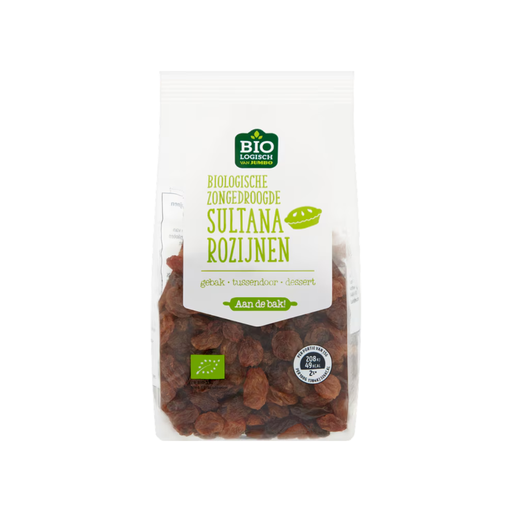
B+ sultanas, 250 g

B+ Sultanas, 250 g

The product description suggests using them in breakfast cereal.

The ingredients are listed as raisins and sunflower oil.

The nutrition information lists values per 15 g serving. According to the product description, a stalk or stone may remain in the product despite cleaning.

Joybuy

Frequently asked questions

Does every organic product have to display the same Dutch control mark?

Alongside the EU organic logo, the European Commission describes the code number of the control body and an indication of the agricultural origin. The logo must be used on prepacked foods produced in the EU and sold there as organic; this does not necessarily apply to every import situation.

Is a maximum of 20 g of dried fruit a legal limit or a sports nutrition plan?

No. The Netherlands Nutrition Centre recommends a maximum of 20 g of dried fruit per day as general dietary advice. This is not a legal limit on consumption, nor a personal recommendation for a long bike ride.

What should I look out for if I’m sensitive to sulphites?

Check the ingredients and allergen information for the specific product. The Food Allergy Foundation lists dried fruit as a possible source of sulphites and distinguishes between sulphite intolerance and an allergic reaction; the Netherlands Food and Consumer Product Safety Authority explains the rules on clear allergen labelling.

How do I check the storage instructions after opening?

Follow the instructions on the current packaging. Albert Heijn warns that product information may change, so don’t assume the storage period for a different fruit or pack applies.

How many carbohydrates does a serving of these raisins provide?

The product information lists nutritional values per 15 g serving, but the available product details do not provide any values to quote here. Check the nutrition information on the packaging of the variety you buy.
