
Budget-conscious breakfast shoppers
You’re looking for organic raisins for breakfast and want to compare the contents of similar packs. The Albert Heijn, Jumbo and PLUS product pages list the pack sizes for the variants mentioned.


For a breakfast with dried fruit, organic raisins are a good choice if you’re specifically looking for raisins; choose dates if you want to use dates instead. Compare the organic label, ingredients and pack size, and check the warnings and storage instructions: organic doesn’t mean sugar-free.
You’re looking for organic raisins for breakfast and want to compare the contents of similar packs. The Albert Heijn, Jumbo and PLUS product pages list the pack sizes for the variants mentioned.
You want to check which organic label is shown on the pack and what ingredients it contains besides the fruit. The European Commission explains the requirements for using the EU organic logo; check the ingredients for each product individually.
You choose between fruit such as raisins and dates based on the type of fruit and how much you use. Also check the storage advice for each product: the Voedingscentrum provides advice for raisins, while the product information for the AH dates reviewed here states that they have a limited shelf life once opened.
First choose the type of fruit you want to use for breakfast, then check the organic label, ingredients and quantity on the pack.
Suitable if: you want to add raisins to breakfast and are looking for a 250 g pack.
Worth noting: the product information reviewed from Albert Heijn, Jumbo and PLUS also lists sunflower oil among the ingredients, so compare the full ingredient list.
Suitable if: you specifically want to use dates; the AH pack reviewed here contains 500 g.
Worth noting: Albert Heijn warns that the product may contain peanuts and nuts, and that a stone may have been left behind; it has a limited shelf life once opened.
| What to consider | What to look for | Who is this important for? |
|---|---|---|
| Pack size | Check the net quantity and whether it suits how much you use. | When choosing dried fruit for breakfast, I want a quantity that suits how often I use it. Around 33% of consumers prioritise pack size. |
| Organic label | Check the product label and, where shown, the EU organic logo and inspection code. | When I’m looking for organic dried fruit, I want to be able to check the label on the specific pack. Around 27% of consumers give the clearest priority to being able to identify organic products. |
| Ingredients and allergens | Read the full ingredient list and allergen information on the pack. | When I want to know what’s going into my breakfast besides the fruit, I check the ingredients and warnings on the pack. Around 27% of consumers weigh the ingredients most heavily. |
| Use and storage | Follow the storage instructions once opened and check any product-specific warnings. | When I don’t use dried fruit very often, I want to know how to store it once opened and whether there are any special considerations. Around 13% of consumers prioritise practical use and storage. |
The organic label and sugar information describe different product characteristics. For the organic raisins reviewed here, Albert Heijn lists 0 g of added sugars and 59 g of total sugars per 100 g.
Read both the ingredient list and the nutrition table; don’t assume the organic label tells you how much sugar the product contains.
The organic raisin packs reviewed here contain 250 g, while the AH dates reviewed contain 500 g. They are also different types of fruit.
Check the net quantity and choose based on the fruit you use and the amount that suits your routine.
A supermarket can sell organic products without every individual pack being labelled organic. Search results may also include other types of product, such as granola.
Check the product name, category and organic information for the specific pack.
According to the product information, the AH dates reviewed here may contain a leftover stone and may contain peanuts and nuts.
If allergens are relevant to you, check the current packaging and inspect the dates for stones before eating them.
The product pages list organic raisins and organic pitted dates as different fruit options.
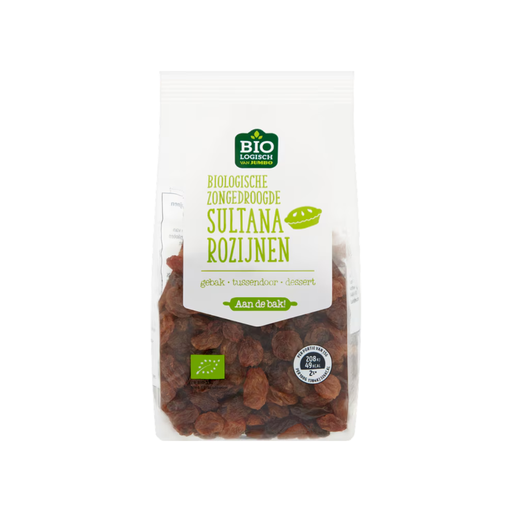
Jumbo lists organic sultanas in a 250 g pack.
Lidl lists an organic range and also provides information about dried tropical fruit.
The listing for Trader Joe’s raisins is for a 500 g pack.
The 250 g BIO+ Sultana raisins are sold by PLUS.
The product listings distinguish loose raisins from other products containing raisins, such as granola.
These Joybuy products are organic raisins for breakfast, as a snack or for baking; check the usage information and warnings for each product.
 No image available
The product description is aimed at children aged 12 months and over and advises supervision while eating; the product is not suitable for children with swallowing difficulties.
The title gives the weight as 140 g; the description says there are ten 14 g boxes.
 No image available
The product description suggests using them in breakfast cereal, as a snack and in baking, and identifies the raisins as organic.
According to the description, a stalk or small stone may remain despite checks; the ingredients are listed as raisins and sunflower oil.
Read the ingredients and allergen information on the current packaging. The AH dates reviewed here may contain peanuts and nuts, so don’t assume they’re suitable if you react to either of these ingredients.
Follow the instructions on the pack. For opened raisins, the Voedingscentrum recommends 6–9 months in a kitchen cupboard; don’t automatically apply this period to other types of dried fruit. The product information for the AH dates reviewed here states that they have a limited shelf life once opened.
No. The AH and PLUS raisins reviewed here list a 25 g serving, Jumbo uses 15 g and the AH dates use 50 g. These are serving sizes specific to each product, not a standard portion for all types of dried fruit.
Contact the seller if the product doesn’t meet what you could reasonably expect when used normally. According to ACM ConsuWijzer, the solution for a faulty product depends on the circumstances; this is different from having a general right to return a product in good condition just because you don’t like the taste.