Choose organic dried fruit as a measured addition to your breakfast, not as a weight-loss product: the Voedingscentrum recommends a maximum of 20 grams of dried fruit a day, but this isn’t a required portion. Compare the organic certification, ingredients and nutritional information for the same quantity. Organic describes how a product is made; it doesn’t remove the need to watch your portion size.
Who is this guide for?
Breakfast lovers who watch their portions
You want to add something sweet to your breakfast without accidentally eating a lot of dried fruit. Weighing your portion and comparing nutritional information for the same quantity will help you make a more informed choice than relying on a health claim on the packaging.
Conscious organic shoppers
You check the organic certification, control code and ingredients list. Consider how the product is made separately from its nutritional information and the amount you use.
Practical everyday shoppers
You’re looking for a product that’s easy to portion, store and take with you as part of your regular shopping. Pack size and storage advice can help you decide whether a variety suits your routine.
What should you look for when choosing?
Weigh your portion and compare products by the same quantity. The Voedingscentrum recommends a maximum of 20 grams of dried fruit a day; this is dietary advice, not a required amount. The European Commission describes the EU organic logo as a mark for products that are certified organic.
| What to consider |
What to look for |
Who is this most important to? |
| Portion and energy |
Weigh the amount and compare energy per 100 grams or per equal-sized portion. |
I want to weigh the amount I add to breakfast and compare the nutritional information for the same quantity. Around 36% of consumers pay most attention to portion size and energy. |
| Organic status |
Check the EU organic logo, control code and the statement of agricultural origin. |
I want to be able to check that the organic label suits my choice. Around 29% of consumers give organic certification the highest priority. |
| Ingredients and sugar |
Read the ingredients list alongside the nutrition table; ‘no added sugars’ doesn’t mean ‘sugar-free’. |
I want to know what ingredients go into my breakfast and pay attention to added sugar. Around 21% of consumers focus mainly on the ingredients. |
| Portioning and storage |
Check the pack weight and follow the storage advice on the packaging. |
I’m looking for packaging that’s easy to portion and can be stored according to the product advice. Around 14% of consumers consider ease of use most important. |
Common mistakes
-
Thinking organic means it helps you lose weight
An organic label relates to how a product is made, not to a lower energy content or weight loss. The Voedingscentrum explains that weight loss is linked to consuming less energy than you use.
Choose organic if it suits your preferences, and assess the portion and nutritional information separately.
-
Confusing ‘no added sugars’ with ‘sugar-free’
AH Biologisch Rozijnen lists 0 grams of added sugars and 59 grams of total sugars per 100 grams. These are different figures on the label, not contradictory claims.
Read both the ingredients list and the nutrition table for the variety you’re buying.
-
Comparing label portions directly
Label portions can vary and aren’t the same as the Voedingscentrum’s daily recommendation. You can’t directly compare nutritional information per 15 grams with a figure per 25 grams.
Compare per 100 grams or calculate the figures for exactly the same amount.
-
Mistaking a regular variety or fruit mix for the same organic option
A regular variety of raisins and a dried fruit mix are different products from organic raisins. For example, ALDI and Lidl product listings describe raisins and a fruit mix respectively; the supermarket name alone doesn’t mean a product is organic.
Check the organic label and ingredients for the exact variety.
Brands and product ranges to consider
Albert Heijn
AH Biologisch Rozijnen is a specific option for anyone looking for organic raisins with a control code and ingredient information.
- Albert Heijn’s product information lists the EU organic logo, control code TR-BIO-154, and raisins with organic sunflower oil as ingredients.
- For this variety, Albert Heijn lists 0 grams of added sugars, 59 grams of total sugars and 344 kcal per 100 grams. No added sugar doesn’t mean sugar-free or low in energy.
Jumbo
Jumbo Zongedroogde Sultana Rozijnen Biologisch 250g is an organic variety of raisins with information about its ingredients and nutritional values.
- Jumbo lists control code TR-BIO-132 and raisins with sunflower oil of organic origin.
- The nutritional information also uses a 15-gram portion; treat this as a label portion, not personal dietary advice.
PLUS
PLUS sells BIO+ Sultana raisins in a 250-gram stand-up pouch; BIO+ is the product brand.
- PLUS’s product information lists organic certification, 99% raisins and organic sunflower oil.
- The label lists 342 kcal and 5.5 grams of fibre per 100 grams. These values alone don’t prove greater satiety or weight loss.
Dirk
Dirk lists Bio+ Rozijnen sultana, in a 250-gram pack, as a product option.
- Dirk’s product listing names the variety and its 250-gram pack size.
- Product details for a BIO+ variety at PLUS don’t automatically apply to the Dirk listing.
Products at Joybuy
These products are suited to anyone looking for organic raisins or dates as a measured addition to breakfast or as a snack.
 No image available
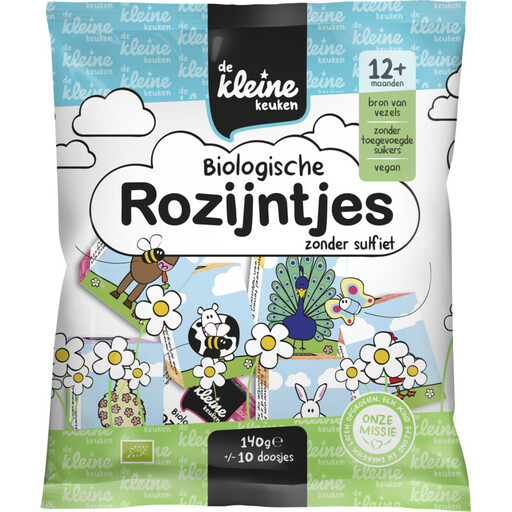
De Kleine Keuken Organic Raisins 12M+ 140g
The ten individual boxes are designed for anyone who wants a ready-portioned amount.
Packaging according to the product information: ten 14 g boxes.
According to the product information, suitable from 12 months; supervise children while they eat. Not suitable for children with swallowing difficulties.
View at Joybuy
 No image available
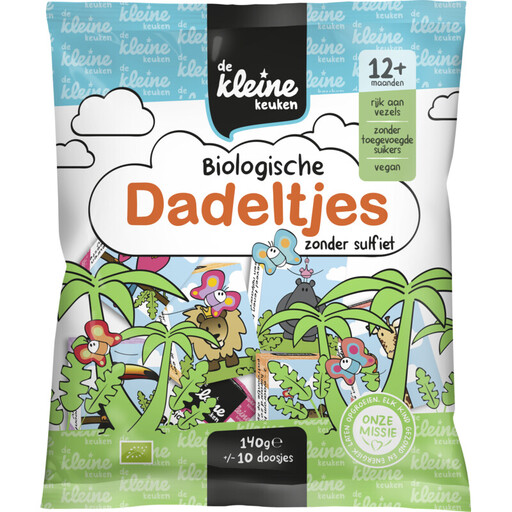
De Kleine Keuken Organic Dates 12+
This date variety offers an alternative to raisins; the product information lists values per 14 g portion.
Ingredients according to the product information: 95% dates and 5% rice flour.
The product information lists 324 kcal per 100 g and 45 kcal per 14 g, with no added sugars.
According to the product information, suitable from 12 months. Ensure young children are sitting upright and supervise them while they eat.
View at Joybuy
 No image available
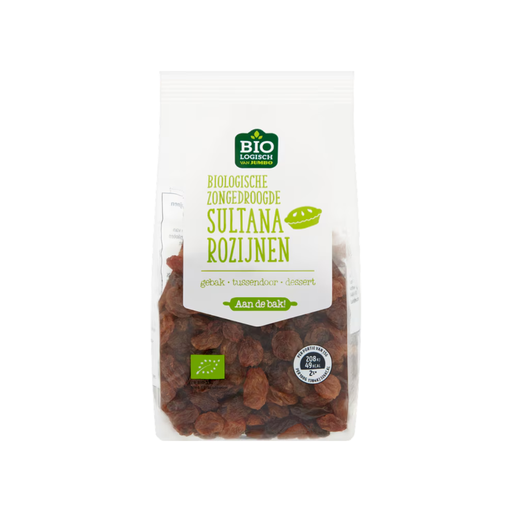
B+ Sultana Raisins 250 g
This variety of raisins is a good option if you want to add raisins to your breakfast cereal.
The product information lists raisins and sunflower oil of organic origin.
Nutritional values according to the product information: 326 kcal and 3.7 g of fibre per 100 g.
According to the product information, a stem or pip may remain despite cleaning.
View at Joybuy
Frequently asked questions
How can you have dried fruit for breakfast if you’re watching your weight?
Weigh out a portion and take into account what else you eat. The Voedingscentrum recommends a maximum of 20 grams of dried fruit a day; this isn’t a required amount.
What does the EU organic logo on a product mean?
The EU organic logo indicates organic certification. The European Commission states that the logo may only be used on products certified as organic by a recognised control authority or control body. Also check the code and the relevant origin statement on the packaging.
Does ‘no added sugars’ mean raisins are sugar-free?
No. AH Biologisch Rozijnen lists 0 grams of added sugars and 59 grams of total sugars per 100 grams. For the variety you buy, check both the ingredients and the nutrition table.
What should you check if you’re sensitive to sulphites?
Check the ingredients and allergen information on the exact packaging. Stichting Voedselallergie states that sulphites can be found in dried fruit and may cause an intolerance reaction. The NVWA says allergen information for prepacked products appears on the label.
How should you store raisins after buying them?
The product information for the AH, Jumbo and PLUS varieties reviewed recommends storing them in a cool, dry and dark place. Follow the storage advice and best-before date on your own pack.


