What should you look for when buying?
First check the organic certification, then look at the ingredients, quantity and warnings. Only then decide whether you’d prefer a single fruit or a mix.
| What to consider |
What should you check? |
Who is this important for? |
| Organic certification |
Check the organic certification, inspection code and indication of agricultural origin. The European Commission explains the requirements for the EU organic logo. |
If I choose organic, I want to be able to check the certification on the product. Around 26% of consumers say verified organic status is their top priority. |
| Ingredients and quantity |
Read the ingredients and nutritional information per 100 grams, and keep in mind your total daily intake of dried fruit. |
For my breakfast, I want to know whether sugar has been added and how much dried fruit I’m having. Around 26% of consumers say what goes into their breakfast is their top priority. |
| Pack size |
Compare the net weight of the same type of product and think about how much you’ll use. |
I want to choose a pack size that suits how often I eat dried fruit and what I usually buy. Around 21% of consumers say this is what they consider first. |
| Product type |
Decide whether you want one type of fruit or a mix with other ingredients, such as nuts. |
If I want a bit of variety, I can choose between individual fruits and a mixed topping. Around 16% of consumers put variety first. |
| Allergens |
Read both the ingredients and any warnings about the possible presence of allergens. |
If I have allergy requirements, I want to know what’s in the product and what it may contain before I buy it. Around 11% of consumers put suitability first. |
Products at Joybuy
These raisin products are a simple way to add something to breakfast. If organic certification is a must for you, check the documentation for the exact pack.
 No image available
De Kleine Keuken organic raisins 12M+ 140 g
The product description says these raisins contain no added sugars. If certification matters to you, check the documentation for the exact pack.
The pack contains 10 boxes of 14 g. According to the product information, suitable from 12 months; supervise children while they eat. Not suitable for children with swallowing difficulties.
View at Joybuy
 No image available
B+ Sultana raisins 250 g
The product description says these sun-dried sultanas contain no added sugars and can be enjoyed with breakfast cereal, for example. If certification matters to you, check the documentation for the exact pack.
The pack contains 250 g and, according to the description, the ingredients are raisins and sunflower oil. A stalk or stone may remain despite cleaning.
View at Joybuy
Frequently asked questions
Does organic dried fruit always have to display the green EU leaf logo?
Not in every situation. According to the European Commission, the EU organic logo is compulsory for pre-packed organic food produced in the EU. Its use is optional for imported and unpackaged organic products. If the logo is used, it should also be accompanied by the inspection body’s code and an indication of agricultural origin.
Does the inspection code on a Dutch product have to start with NL-BIO-01?
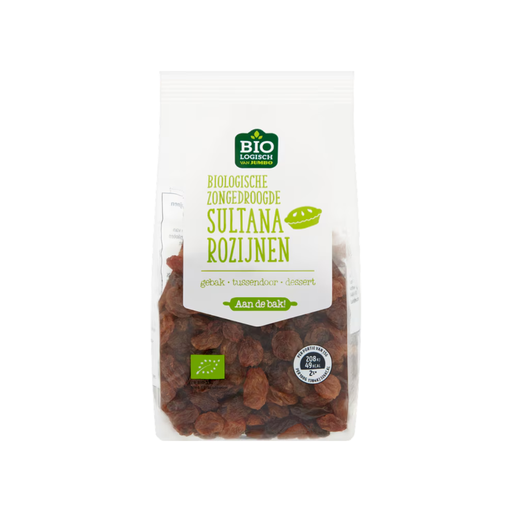
No, the code doesn’t have to be Dutch. The AH raisins reviewed display TR-BIO-154, while the Jumbo raisins display TR-BIO-132. Check the organic information for the exact product rather than looking for just one national code.
How much dried fruit should you eat a day?
The Netherlands Nutrition Centre recommends eating no more than 20 grams of dried fruit a day. This is your total daily amount, not just what you eat at breakfast. A manufacturer’s serving suggestion on the pack isn’t automatically the same as this recommendation.
Does a market stall have to provide allergen information for loose dried fruit?
Yes. According to the Netherlands Food and Consumer Product Safety Authority, the information requirement also applies to unpackaged food. Information can be provided in writing or verbally; if it’s given verbally, there must be a clear notice that you can ask for it. Before buying, ask about any allergens that matter to you.
How should you store dried fruit once opened?
Follow the storage instructions on your product’s packaging. The raisins reviewed say to store in a cool, dry, dark place. The AH pineapple and fruit and nut mix reviewed also say they have a limited shelf life once opened; follow the instructions on the pack.


