What should you look for when buying?
First decide whether both organic certification and the ‘low-fat’ threshold are essential. If one matters less, compare organic crisps and lower-fat crisps as separate options.
| What to consider |
What to check when buying |
Best suited to |
| Absolute fat content |
Check the fat per 100 g on the packaging. For the ‘low-fat’ claim, solid foods must contain no more than 3 g per 100 g under EU Regulation 1924/2006; also consider how much you eat. |
I only want to choose crisps that meet a strict fat limit, rather than relying on a claim on the front of the pack. For around 42% of consumers, absolute fat content would be the first consideration. |
| Organic origin |
For pre-packed organic crisps, check for the EU organic logo and then compare the nutritional information for the product you’ve chosen. |
If organic production is my main requirement, I want to be able to identify it on the packaging before comparing flavours. For around 33% of consumers, organic status would be the main purchasing priority. |
| Less fat than regular crisps |
Check what ‘less fat’ is being compared with, and read the fat content per 100 g too; check organic certification separately if it matters to you. |
I’d rather choose crisps with less fat than regular potato crisps, even if organic status or the ‘low-fat’ threshold isn’t decisive. This would be the main consideration for around 25% of consumers. |
Brands to compare
These brands offer different types of crisps to compare: organic, lower in fat than regular crisps, or a standard option as a reference. Always check the nutritional information on the exact pack.
Lay's
The Oven Baked range is worth considering if you want to compare crisps with less fat than regular potato crisps.
- According to Lay's Nederland, Oven Baked contains 50% less fat than regular potato crisps.
- This comparison doesn’t prove that a specific product contains no more than 3 g of fat per 100 g. Check separately for the EU organic logo if organic certification is essential.
Jumbo
Jumbo offers Organic Plain Crisps, as well as a separate range of crisps with less fat.
- The two claims give you different ways to compare products.
- Don’t assume that an organic product name means a low fat content; check the nutritional information on the pack you choose.
TerraSana
Ekoplaza describes TerraSana Thai Sweet Chili Lentil Crisps as organic lentil crisps.
- If you’re looking for organic lentil crisps, you can assess this product by checking its organic claim and nutritional information.
- A term such as ‘low-fat’ in a product description doesn’t replace the fat content per 100 g when you want to apply the ‘low-fat’ threshold.
Pringles
Pringles Original is included here as a standard crisp for comparison, not as a low-fat option.
- Pringles states that Original contains 31 g of fat per 100 g, making its fat content easy to compare.
- Under EU Regulation 1924/2006, this is above the limit of no more than 3 g per 100 g for the ‘low-fat’ claim on solid foods.
Crisps on Joybuy: the lower-fat option
This oven-baked crisp is a good option if you want to compare products with less fat than regular potato crisps and organic certification isn’t essential. If you’re also looking for organic or low-fat crisps, check the logo and fat content on the exact pack.
 No image available
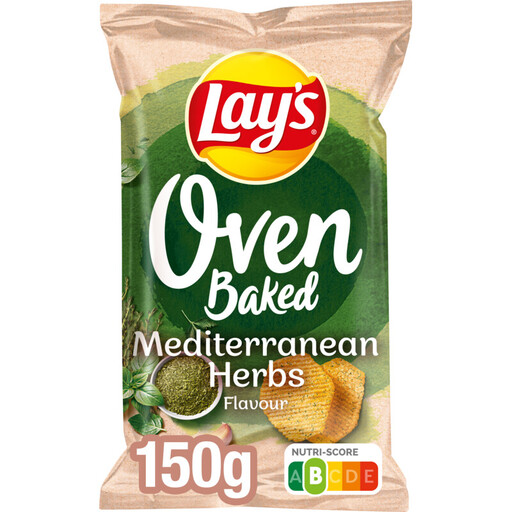
Lay's Oven Baked Mediterranean Herbs 150 g
For anyone looking to compare an oven-baked crisp with regular potato crisps, without making organic certification a requirement. According to Lay's Nederland, the Oven Baked range contains 50% less fat than regular potato crisps; this doesn’t automatically mean this product is ‘low-fat’.
Pack size: 150 g. To check whether it meets the ‘low-fat’ threshold, read the fat per 100 g on the packaging. If organic status matters to you, check separately for the EU organic logo.
View on Joybuy
Frequently asked questions
When can crisps be called ‘low-fat’?
Under EU Regulation 1924/2006, solid foods can only be labelled ‘low-fat’ if they contain no more than 3 g of fat per 100 g. So check the fat per 100 g for the exact crisp you’re considering, not just the wording on the front of the pack.
How can I identify organic crisps?
For pre-packed organic crisps, check for the EU organic logo on the packaging. Skal Biocontrole states that this logo is compulsory on pre-packed organic consumer products in the EU; to check the fat content, you’ll need to read the nutritional information separately.
Are crisps with 50% less fat also low-fat?
Not necessarily. ‘50% less fat’ compares a product with a reference, while the ‘low-fat’ claim for solid foods under EU Regulation 1924/2006 requires no more than 3 g of fat per 100 g. Check both claims against the packaging of the product you’re buying.
Are organic vegetable crisps automatically low-fat?
No. Neither the type of vegetable nor organic production determines the fat content on its own. Lidl Nederland describes its organic sweet potato crisps as being fried in sunflower oil; compare the fat per 100 g to check.
Should I compare crisps per 100 g or per portion?
Use the per-100 g figure to compare products and check the ‘low-fat’ threshold, then consider how much you actually eat. The Voedingscentrum gives average crisps as containing 215 kcal and 13.1 g of fat per 40 g; for your portion, use the figures for the specific product.


