
Weekend breakfast fan who wants to check organic credentials
You don’t want to rely on a word on the front of the pack alone. You want to check the EU organic logo, along with the certification and origin information on the packaging.


For a weekend breakfast, first choose a chocolate option whose organic status you can check on the packaging, if organic is a must for you. Then compare the nutritional information, ingredients and allergens: an organic label or a fibre claim alone won’t tell you whether the product as a whole suits your preferences.
You don’t want to rely on a word on the front of the pack alone. You want to check the EU organic logo, along with the certification and origin information on the packaging.
You’re looking for chocolate breakfast cereal for the weekend and want to compare sugar, fibre, ingredients and allergens against your own preferences.
You’re looking for an option at your usual shop, but you check each product’s organic credentials and where it’s available.
Start with the organic label if that’s a deciding factor for you. Then consider whether nutritional information, product type or availability will help you choose between chocolate options.
| What to consider | What to check | Who is it important to? |
|---|---|---|
| Organic label | Check the EU organic logo, the code of the certification body and the origin statement for the agricultural ingredients on the packaging. | I want to know what the organic label on my weekend breakfast is based on, rather than relying on a natural look. For around 42% of consumers, this check comes first. |
| Nutritional information | Compare sugar and fibre per 100 g and, where stated, per serving. Also check the ingredients and allergens. | When I choose chocolate breakfast cereal, I want to compare the full ingredients list, rather than relying on a single claim. Around 33% of consumers give comparing labels top priority. |
| Flavour, type and shop | Think about whether you want muesli, granola or another type of product, and check that the exact item is available. | For my weekend breakfast, I’m looking for a chocolate option I’ll enjoy and can find at my usual shop. For around 25% of consumers, this combination matters most. |
An organic label doesn’t tell you how much sugar or fibre a product contains. The Dutch Consumers’ Association (Consumentenbond) also warns that a fibre claim can make a product seem healthier than its overall composition warrants.
Check the organic label separately, then compare the nutrition table, ingredients and serving size on the current packaging.
A shop that sells organic muesli doesn’t necessarily sell only organic chocolate options. Words such as ‘crunchy’ or ‘natural’ don’t confirm that a specific product is organic either.
Check the exact pack for the organic label and EU organic logo.
The name of a chocolate option doesn’t tell you everything about its ingredients. Albert Heijn notes that ingredients and allergen information can change.
Read the current packaging before using the product, especially if particular ingredients matter to you.
A product listing doesn’t mean the same item is available at every branch or through every sales channel. For example, Lidl lists its chocolate muesli as an in-store product.
Check whether the exact product is available at the shop where you plan to buy it.
Jumbo lists Jumbo Biologisch Krokante Muesli Pure Chocolade 350 g in its crunchy muesli range.
Albert Heijn lists AH Biologisch Krokante muesli chocolade & hazelnoot.
Jumbo lists Zonnatura Biologische Krokante Muesli Pure Chocolade 375 g; Albert Heijn also lists a Zonnatura muesli with dark chocolate and an organic label.
This granola is a chocolate option for breakfast. If organic is a must for you, check the label and related information on the packaging before buying.
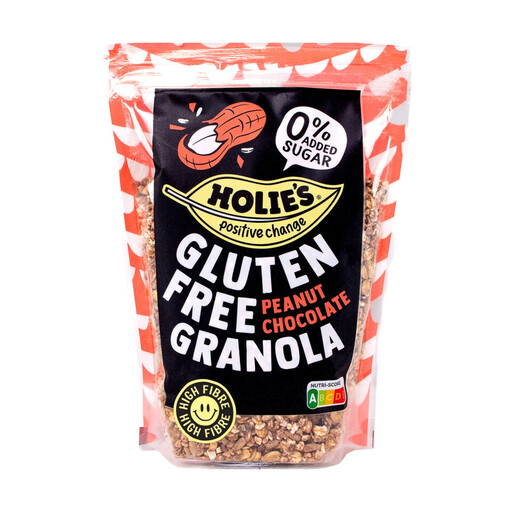 Image unavailable
An option if you’re looking for chocolate granola with peanuts for your weekend breakfast. The pack contains 330 g. Check the current label if organic certification, nutritional information or allergens are important to your choice.
Look for the EU organic logo and the related certification and origin information. According to the European Commission, the logo is compulsory for most prepacked organic food produced in the EU. Also check the certification body’s code and the statement showing the origin of the agricultural ingredients.
No. The organic label alone doesn’t tell you about sugar, fibre or the product’s overall composition. Compare the nutrition table and ingredients list of the products you’re considering, rather than judging them by a single fibre claim, which the Dutch Consumers’ Association (Consumentenbond) warns against.
Check the allergens on the current packaging of the exact option. This is important even when you recognise the product name: Albert Heijn recommends checking the packaging because product information can change.
No. A product’s place in a shop’s range doesn’t confirm that every chocolate product is organic. Check the label on the individual item and see whether that option is available at your shop.