
Budget-conscious breakfast shoppers
You want to add organic cashew nuts to your breakfast and are weighing up the price per kilo against the pack size and what you’ll spend in one go.


For breakfast, first choose a type of cashew nut whose organic status you can verify on the packaging: the European Commission says the EU organic logo may only be used for certified organic products. Then compare both the price per kilo and the price per pack. If you want to avoid oil, an unroasted variety with cashew nuts as the only ingredient is a better fit than roasted unsalted varieties, which Albert Heijn and PLUS list as containing sunflower oil. Only buy a larger pack if you’ll use that amount and can store it in a cool, dry place in a tightly sealed container.
You want to add organic cashew nuts to your breakfast and are weighing up the price per kilo against the pack size and what you’ll spend in one go.
You’re looking for unsalted cashew nuts with cashew nuts as the only ingredient. The unroasted Albert Heijn variety we looked at lists only cashew nuts; check the label, as roasted unsalted varieties may contain sunflower oil.
You want to be able to identify organic product information. The European Commission says the EU organic logo may only be used for products certified as organic; being unroasted or unsalted is not, by itself, proof of organic certification.
Choose this if: you want to add cashew nuts with no added salt or oil to your breakfast.
Bear in mind: a larger pack costs more upfront; store the nuts in a cool, dry place in a tightly sealed container.
Choose this if: you want roasted cashew nuts and are happy with added oil.
Albert Heijn lists 96% cashew nuts and sunflower oil for the variety we looked at; PLUS lists 99% cashew nuts and sunflower oil for BIO+.
Choose this if: you’re mainly after a savoury snack and are happy with added salt.
PLUS lists 0.7 g of salt per 100 g for its BIO+ salted cashew nuts; organic, then, doesn’t mean unsalted.
| What to consider | What should you check? | Who is this important to? |
|---|---|---|
| Affordability | Compare the price per kilo and the price per pack for the same type of organic cashew nuts, and bear in mind how much you use. | If keeping your grocery spend down is a priority, you’ll want a pack size that suits what you actually use. Around 33% of consumers put affordability first when shopping. |
| Organic status | Check the organic labelling and, if the EU organic logo is used, the control code and the agricultural origin shown on the label. | If you want to be sure you’re choosing organic cashew nuts, check the product labelling rather than relying on how the nuts are prepared. Around 27% of consumers put verifiable organic status first. |
| Oil and salt | Read the ingredients, the legal product description and the salt information; unsalted doesn’t mean unroasted or oil-free. | If you want to add cashew nuts to breakfast, the ingredients may be the deciding factor. Around 27% of consumers prioritise the ingredients in their breakfast topping. |
| Pack size | Choose a pack size that matches how much you use and follow the storage instructions; seal the pack tightly after use. | If you don’t want to keep too much in stock, choose an amount that suits your usage and storage options. Around 13% of consumers put pack size first when shopping. |
The way cashew nuts are prepared doesn’t tell you how they were certified as organic. Duyvis describes its cashews as oven-roasted without added oil; this is not proof of organic status.
Check the organic labelling separately from information about roasting, salt and oil.
A smaller pack may cost less at the till, while a larger pack could work out cheaper per kilo.
Compare the price per kilo and the amount you’ll pay upfront. Only choose a larger pack if you’ll use it and can store it properly.
The Albert Heijn and BIO+ unsalted varieties we looked at contain sunflower oil.
If you want to avoid added oil, check the ingredients list and choose a variety that lists cashew nuts as its only ingredient.
The Jumbo page for organic unroasted cashew nuts says that this variety is no longer part of its online range.
Check that a product is actually available to order before including it in your shopping choices.
The organic cashew nuts we looked at include unroasted and roasted unsalted varieties in different pack sizes.
BIO+ is the product brand for the organic cashew nuts we looked at from PLUS; both unsalted and salted varieties are listed.
Jumbo has product information for 175 g packs of organic unroasted cashew nuts.
Lidl has a Dutch product page titled Organic Cashew Nuts.
The Trader Joe’s cashew nuts from ALDI that we looked at are an example of preparation and packaging, not verified organic certification.
Duyvis Cashews Original is an oven-roasted cashew variety; its product description is useful for distinguishing preparation from organic certification.
These product picks are aimed at cashew nuts for breakfast or as a snack, and don’t come with a verified organic claim. Check the organic labelling and control code on the pack before choosing a variety as organic.
 No image available
Good for breakfast if you want to add cashew nuts to yoghurt or muesli.
The product description lists cashew kernels as the only ingredient and gives a pack size of 160 g.
 No image available
An option if you’re looking for roasted, unsalted cashew nuts for breakfast.
The title says roasted and unsalted; the product description lists cashew nuts as an ingredient, and the pack contains 200 g.
 No image available
Better suited to anyone looking for a savoury variety than to those wanting unsalted cashew nuts for breakfast.
The product description says the nuts are oven-roasted without added fat or oil and contain salt; the pack contains 125 g.
 No image available
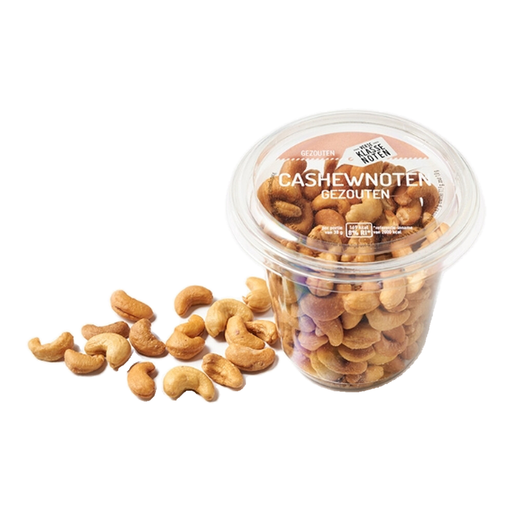
A salted option if you’re not looking for an unsalted breakfast variety.
The ingredients list states 98% cashew nuts, sunflower oil and 1% salt; the pack contains 150 g.
 No image available
A good fit if you’re looking for a ready-to-eat salted snack.
The product information lists cashew nuts and salt; the pack contains 120 g.
No, the control code doesn’t have to be Dutch. The 150 g Albert Heijn pack we looked at shows IT-BIO-009; check the code and organic labelling on the pack. The European Commission says the EU organic logo may only be used for products certified as organic.
Store the nuts in a cool, dry place in a tightly sealed container. The Voedingscentrum recommends keeping them somewhere cool, for example at 10–15 °C; Albert Heijn also advises storing the packs we looked at in a dark place and sealing them well after use. Follow the storage instructions on your own pack.
No. On 20 May 2026, the NVWA warned that Trader Joe’s 170 g unsalted cashew nuts could contain metal particles. The warning applied to barcode 2003020120930 and best-before date 23-09-2026, and advised consumers not to eat the product. The passed best-before date doesn’t invalidate the warning for a pack you still have at home; check that it’s exactly the product named in the warning.
Avoid cashew nuts if you need to avoid cashews, and also check the allergen information and any cross-contamination warnings on the pack. For example, BIO+ unsalted cashew nuts state that they may contain peanuts. The NVWA explains that relevant allergens must be listed on the label; organic certification doesn’t replace this information.
The packs we looked at warn that young children can choke on nuts. So don’t use this buying guide as a reason to give whole cashew nuts to young children.