
Vandaag of morgen in huis

Kwaliteit gegarandeerd

Welkomstaanbiedingen ontgrendelen: GRATIS bezorging | Tot 80% korting | Gratis 30 dagen JoyPlus-proefperiode
Download de app
Organic baby snacks might seem straightforward to compare at first glance. Yet small differences in age recommendations, ingredients and packaging can determine whether a product is a practical fit for your family. A squeezy pouch that’s handy for on-the-go, for example, isn’t automatically suitable for a baby from 6 months. And “no added sugar” doesn’t mean the product contains no natural sugars.
As Joybuy’s Product Recommendation Officer, I filter the most important product information on three points: age suitability, ingredients and ease of use. That way, you avoid paying for a pretty package or a generic marketing claim.
An organic product can contain ingredients that aren’t right for every age. Think nuts, seeds, salt, grains with gluten or a firm texture. Always check the official age recommendation on the packaging. Baby food from 6 months and baby food from 12 months are not interchangeable.
Products like organic seeds aren’t automatically a suitable standalone snack for young children either. Bio+ Pumpkin Seeds and Bio+ Sunflower Seeds are made from organic seeds and, according to the product information, contain none of the 14 main EU allergens. However, whole seeds aren’t automatically suitable for a baby because of their shape and texture. Only use them when the age, preparation and supervision are appropriate.
A baby snack with no added sugar can still contain naturally occurring sugars from fruit, dates or syrup. For example, the ingredients list for Organix Pear & Raspberry Squeezies is 90% pear purée and 10% raspberry purée. The nutritional information shows 10g of sugars per 100g, with no added sugar.
With De Kleine Keuken Organic Fruitjes with Apricots, the ingredients are dried apricots, dates, bananas and rice flour. Here too, the sugars come naturally from the fruit, but that doesn’t make the product sugar-free. So don’t just look at the front – check the ingredients list and the nutrition table too.
A baby squeezy pouch is light and easy to take with you. But eating straight from the packet isn’t the right choice for every child or every mealtime. For young babies, you can offer fruit purée on a clean spoon instead. Also pay attention to the advice after opening: several Organix pouches need to be kept refrigerated and used within one day, according to the product information.
At home, a bowl can be more practical. On the go, a pouch is handy when you don’t have cutlery or a fridge to hand. So the packaging is mainly a choice of convenience, not a guarantee of quality.
First, check whether the product is intended for 6 months, 12 months or older. A baby fruit purée from 6 months usually has a smooth texture, while toddlers gradually learn to eat more textured foods. Always follow the manufacturer’s age recommendation and supervise your child while eating.
Examples:
Look at the order of ingredients: what’s listed first is present in the largest quantity. For example, Organix Pear & Raspberry Squeezies contain 90% pear purée and 10% raspberry purée. Organix Apples, Strawberries & Blueberries are made up of 77% apple purée, 20% strawberry and 3% blueberry.
Also check:
A gluten-free snack isn’t automatically suitable for babies. Leev Bio Lentil Waffles and Leev Bio Chickpea Waffles are gluten-free according to the product information, but their crunchy texture, salt content and allergens mean you need to assess age and eating ability separately.
A 100g portion is practical for a day out, but isn’t always intended to be eaten in one go. Pay attention to the seal, shelf life and storage instructions. After opening, several fruit purées should be kept refrigerated and used within one day.
For regular use, multipacks can work out more cost-effective. Examples include the Organix Pear & Raspberry Squeezies 100g x 6 and the Organix Apples, Strawberries & Blueberries 100g x 6. Compare the price per 100g, not just the price of the pack.
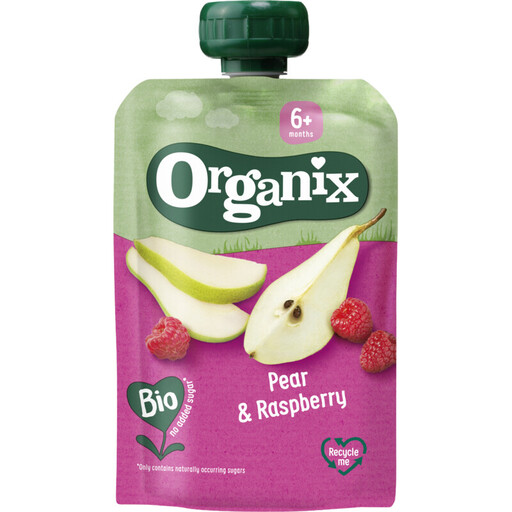
Why this fits the profile: A straightforward fruit purée for families who want to start with an organic snack from 6 months.
The age recommendation from 6 months and the short ingredients list make the choice easy to verify. No added sugar is stated.
90% pear purée, 10% raspberry purée, 100g and suitable for use as a baby fruit purée.
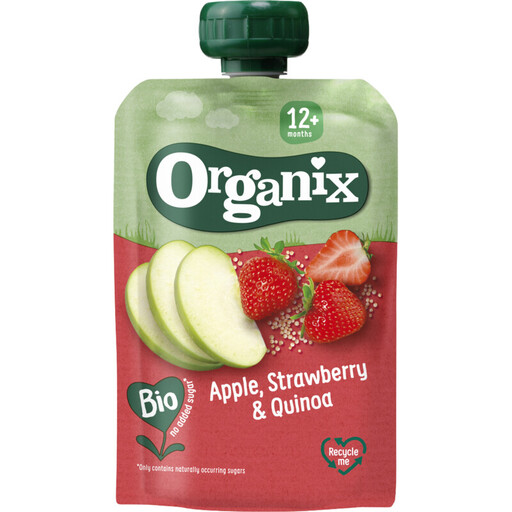
Why this fits the profile: A practical organic squeezy fruit option for toddlers from 12 months who want to eat independently on the go.
The age recommendation from 12 months is clearly stated. The product information mentions an organic recipe and no added sugar.
100g, squeezy pouch, apple-strawberry-quinoa recipe and suitable for on-the-go.
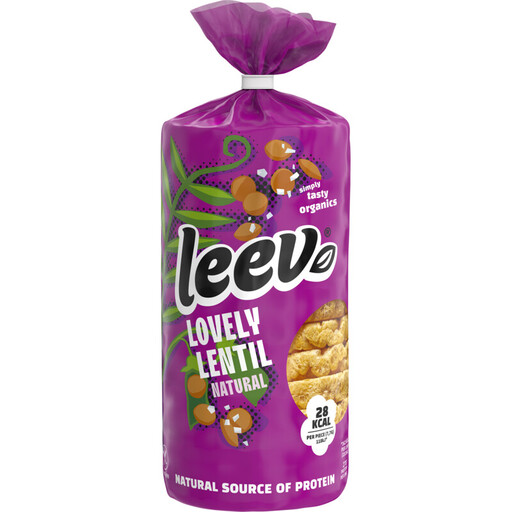
Why this fits the profile: For older toddlers and families looking for a savoury, gluten-free snack alongside fruit purée.
The ingredients list shows 99.5% lentil flour and sea salt. So you can see straight away that this isn’t a fruit product without texture.
Gluten-free according to the product information, 27.3g protein per 100g and 1.5g sugars per 100g.
We’ve put together a full, up-to-date list of products that fully meet these strict selection criteria and comply with current European safety regulations.
Choose a product that explicitly states it is suitable from 6 months. A smooth fruit purée, such as pear with raspberry or apple with berries, is easier to manage than a hard or crunchy snack. Always check the ingredients and offer the snack according to the instructions on the packaging.
No. “No added sugar” means that no extra sugar or sweetener has been added to the recipe. Fruit purée, dates and dried fruit still contain natural sugars. So compare the nutrition table and the ingredients list.
This varies by product, but for the Organix pouches mentioned, the product information generally states: keep refrigerated and use within one day. Read the label for each product, seal the packaging properly and don’t use any product where the packaging is damaged.
