What should you look for when choosing?
Start with the label: organic certification alone tells you nothing about salt, allergens or whether the quantity is right for your breakfast.
| What to consider |
What should you check? |
Who is this important for? |
| Verifiable organic status |
Check the organic label, the EU organic logo where applicable, the inspection code and the agricultural origin. The European Commission explains when the logo is used. |
I want to be able to check on the label that the almonds are organic, rather than relying on ‘natural’. Around 29% of consumers put verifiable organic status first. |
| Unsalted ingredients |
Look for ‘unsalted’ and read the ingredients; distinguish added salt from naturally occurring sodium. |
I’m looking for almonds with no added salt or seasoning for breakfast. Around 29% of consumers make an unsalted product their top purchasing priority. |
| Safe to share with guests and children |
Read the allergen information on the exact pack. Don’t give whole nuts to children under four; the MDL Fonds identifies them as a choking hazard. |
When I’m having breakfast with guests, I want to check allergens and take young children into account. Around 18% of consumers put safe sharing with guests or children first. |
| The right quantity |
Compare the net weight with how much you need for breakfast. AH and PLUS list 150 g packs; Jumbo lists 175 g. |
I want enough almonds for everyone without having lots left over unnecessarily. Around 12% of consumers prioritise buying the right quantity. |
| Storing leftovers |
Follow the storage instructions on the pack. Also check any leftovers for rancidity, toughness or mould. |
If there are almonds left after breakfast, I want to be able to store them appropriately for later. Around 12% of consumers prioritise storage and leftovers. |
Joybuy products for breakfast dishes
The Joybuy options below are almonds and nut mixes that you could add to yoghurt, breakfast cereal or other breakfast dishes. The product information does not confirm organic certification; check the packaging if organic status is a must for you.
 Image unavailable
Jia Zhou Yuan Ye Original almond kernels, 160 g
A good choice if you’d like to add almond kernels to yoghurt or breakfast cereal. Joybuy product information also suggests using them in salads.
The product listing gives a pack size of 160 g and lists 100% almond kernels as the ingredient.
View at Joybuy
 Image unavailable
g'woon almonds, raw and unsalted, 200 g
A good choice if you’re looking for unsalted almonds to add to yoghurt or granola; Joybuy product information lists both uses.
The product title describes raw, unsalted almonds in a 200 g pack.
View at Joybuy
 Image unavailable
Anatolia Badem Natural (almond), 500 gr
A good choice if you’re looking for a larger pack of almonds for breakfast dishes or as a topping.
Joybuy product information lists 500 gr, 100% almonds as the ingredient and 0,00 g of salt per 100 g.
View at Joybuy
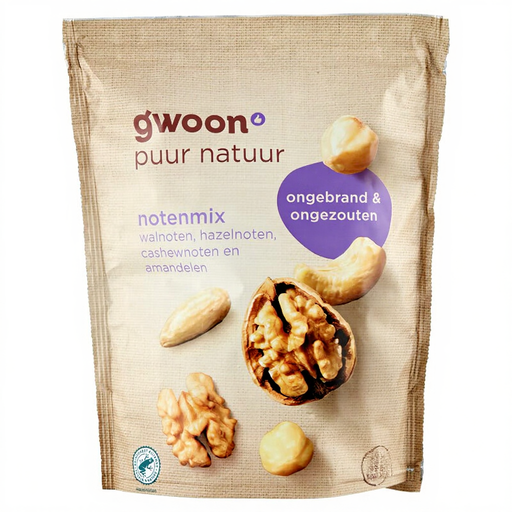 Image unavailable
g'woon Unroasted Mixed Nuts, 500 g
A good choice if you’re looking for a breakfast topping with a variety of nuts; this is a nut mix, not a pack of almonds alone.
Joybuy product information lists 500 g of unroasted, unsalted nuts, with almonds making up 20% of the mix. It also contains hazelnuts, walnuts and cashews, and may contain traces of peanuts and other nuts.
View at Joybuy
Frequently asked questions
Does every pack of organic almonds need to show the same Dutch inspection code?
No, the code doesn’t have to be Dutch. The European Commission explains that the EU organic logo is shown with the code of the relevant inspection body; the AH option reviewed lists IT-BIO-009 and Jumbo lists NL-BIO-01. Check the code alongside the organic label and agricultural origin.
Is the EU organic logo compulsory on all organic almonds?
Not in every case. According to the European Commission, the logo is compulsory for prepacked food produced in the EU and sold as organic. For imported products that meet EU import requirements and for unpackaged organic products, its use is optional.
Can I serve organic almonds to all my breakfast guests without checking?
No. Organic almonds still contain almonds, and warnings about possible other allergens vary by product. If anyone has a relevant allergy, read the information on the exact pack. Don’t give whole nuts to children under four because of the choking hazard, as advised by the MDL Fonds.
How should I store almonds left over after breakfast?
Follow the storage instructions on the pack; AH and PLUS recommend storing them somewhere cool, dark and dry. For opened unsalted almonds, Voedingscentrum’s general advice is to keep them for six months in a kitchen cupboard or one year in the freezer. Also look out for rancidity, toughness and mould; this advice doesn’t guarantee the shelf life of every pack.
What should I do if the packaging differs from the product page?
Check the current packaging before eating the product. AH and PLUS note that product information, including ingredients, nutritional values, allergen information and origin, may change. If you have any questions, contact the customer service team of the relevant shop.


