
Interviewers in a reverberant room
You can’t make the rehearsal room completely quiet and want to make sure the life story remains easy to understand. The distance from the microphone and the sound of the room both affect the recording.


Start with where the speakers will be and the room’s acoustics. A compact handheld recorder may be enough if both speakers can sit close to it, while separate microphones can be useful if you want to record each voice independently. Shure highlights that microphone placement affects the balance between direct speech and reverberation, so a test recording can help you assess your set-up. Also check the power supply and storage, and agree with the interviewee how the recording will be stored and who can access it.
You can’t make the rehearsal room completely quiet and want to make sure the life story remains easy to understand. The distance from the microphone and the sound of the room both affect the recording.
You want to record the interviewee and yourself separately, perhaps so you can adjust the levels independently later. Separate inputs and a suitable microphone set-up are important here.
You want to record the conversation without a lot of setting up and be able to play it back during the interview. Storage and power deserve extra attention in this case.
A good fit when: the speakers can sit close to the recorder and you want to keep set-up to a minimum. The Zoom H1essential and Tascam DR-05XP have built-in microphones.
Trade-off: if the recorder is far from a speaker, it may also pick up more of the room’s sound.
A good fit when: you want to give each person in the conversation their own microphone. The Zoom H4essential has two XLR/TRS inputs alongside built-in X/Y microphones.
Trade-off: you’ll need to make sure the microphones, cables and power requirements all suit your set-up.
A good fit when: simple storage and playback matter more to you than separate XLR microphone inputs. According to Philips, the Philips VoiceTracer DVT4115 offers internal memory and PCM and MP3 recording.
Trade-off: recording time depends on the settings you choose, so check the available time for your preferred recording format.
The percentages give an indicative breakdown of first-purchase priorities for an oral history interview in a rehearsal room.
| What to consider | What to look for when buying | Who is this important to? |
|---|---|---|
| Clear, intelligible speech | Make a test recording with both voices and listen back. If necessary, try a different position or a suitable external microphone. | If I can’t make the rehearsal room quiet, I want to check that both voices are clear enough. Around 36% of consumers make intelligibility their top priority. |
| Recording two voices separately | Check the number of inputs and make sure the connections and power supply suit the microphones you want to use. | If I want to give the interviewer and narrator their own microphones, I look for separate inputs. Around 29% of consumers make this their top priority. |
| Recording a long conversation | Check the available storage space, power supply and recording time for your chosen recording settings. | For a long interview, I want to avoid the recording stopping because the storage or power runs out. Around 21% of consumers prioritise uninterrupted recording. |
| Finding and listening to recordings | Before the interview, test that playback and file transfer work the way you intend to use them. | If I want to transcribe the conversation later, I want to be able to play back and save clips easily. Around 14% of consumers make this their top priority. |
A recording format won’t restore the balance between direct speech and reflected sound. Shure notes that microphone placement affects how much reverberation is recorded in relation to the voice.
First, assess the room and the distance from the speakers with a test recording. Then choose a recording format that suits the way you work.
The microphone may then pick up a relatively large amount of room sound and capture the voices less clearly. Test both speaking positions and check whether a suitable microphone can be placed closer to a speaker.
If moving the recorder doesn’t help, check whether it has a suitable input and which microphones and cables you’ll need.
A different microphone set-up may require external microphones and cables.
Available recording time can vary by format and settings. For example, Philips lists both MP3 and PCM recording for the VoiceTracer DVT4115.
Check the available time on the device for the format you want to use, and test a short recording in advance.
Depending on the recorder and the length of the conversation, you may need extra storage or a different power solution.
The H1essential is a compact recorder with built-in X/Y microphones. The H4essential is worth considering if you also want two XLR/TRS inputs for external microphones.
The DR-05XP has built-in stereo microphones and a stereo mini-jack for a compatible external microphone or line source.
The VoiceTracer DVT4115 is a voice recorder for anyone who values internal memory, a rechargeable battery and PCM or MP3 files.
This selection of Joybuy products is aimed at recording spoken interviews and finding or processing your conversations afterwards.
 No image available
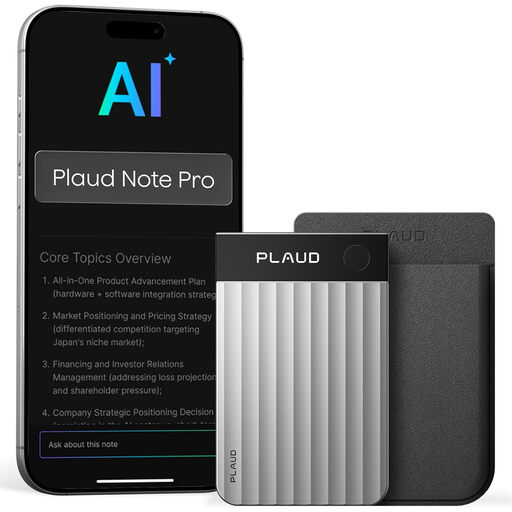
An option for recording interviews; the product name mentions notes and summaries.
Finish: Silver.
 No image available
For recording spoken interviews; the product name mentions a transcription function.
Storage according to the product name: 64 GB.
 No image available
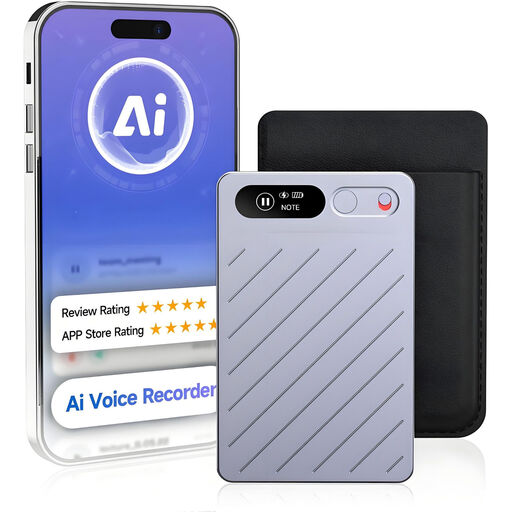
For conversations you want to record and process later; the product name mentions transcription and summarisation.
Storage according to the product name: 64 GB. The product name mentions support for 118 languages.
 No image available
An option for recording interviews and playing files back later.
Storage according to the product name: 128 GB. The product name mentions an LCD screen.
 No image available
For recording conversations and playing them back; the product information mentions the included headphones.
Storage according to the product name: 64 GB. The product information mentions WAV recording.
Where possible, choose a quiet spot with as little distracting noise as you can. The Oral History Association recommends paying attention to the interview environment, but a microphone can’t fix poor room acoustics on its own. Make a test recording if the room will remain in use.
Check the power supply and storage, record a short sample of both voices and play the file back. Also discuss the purpose of the recording with the interviewee, as well as arrangements for storage and access. The Oral History Association treats preparation, preservation and access as part of the project.
If you buy as a consumer in the Netherlands, you’re entitled to a product that works properly. The Dutch government states that there is no fixed statutory two-year guarantee period and that you should contact the retailer if a product is faulty. The right solution depends on the circumstances.
Not automatically: an identifiable audio recording contains personal data. If the GDPR applies to the processing, you need a valid legal basis; consent is one possible basis, but it isn’t automatically the only one. Whether the GDPR applies to your specific personal project, and what arrangements are needed for publication, depends on the purpose and how the recording will be used. Before recording, discuss the purpose, storage, access and any plans to publish with the interviewee.