
Interviewers who want to capture both voices
You want to be able to listen to the questions and answers separately later, and can set up two microphones. The Oral History Society discusses using external microphones for interviews.


If you need both the interviewer and the narrator to be clearly audible, choose one microphone per speaker and a recorder with separate inputs; the Oral History Society recommends using external microphones for this kind of recording. If mainly one person will be speaking and you have a computer, a USB microphone positioned close by may be simpler. A lapel microphone gives the speaker more freedom to move, provided the connection and clothing noise aren’t an issue. None of these options will automatically silence a reflective booth.
You want to be able to listen to the questions and answers separately later, and can set up two microphones. The Oral History Society discusses using external microphones for interviews.
You’re recording mainly one voice, but hard surfaces or ventilation are audible. The recording advice from the University of Leicester’s East Midlands Oral History Archive emphasises careful microphone placement and avoiding clothing noise; a test recording will help you assess the booth itself.
You want to record one main voice directly via USB and monitor it with headphones. If the narrator moves around a lot, a suitable lapel microphone may be a better fit for the recording; make sure to check the connection too.
Choose this if: you need both the interviewer and narrator to be clearly audible in the recording.
Bear in mind: you’ll need extra microphones, inputs and space to position them.
Choose this if: mainly one narrator will be speaking and you have a computer.
Bear in mind: the interviewer may sound quieter if they’re further away from the microphone.
Choose this if: the narrator moves around or can’t always speak towards a desktop microphone.
Bear in mind: the connection, power supply and possible clothing or cable rustle.
Choose this if: you already have suitable XLR inputs or need to record multiple voices separately.
Bear in mind: an XLR microphone doesn’t record on its own, so check the entire recording set-up.
| What to consider | What should you check? | Who is this important for? |
|---|---|---|
| Recording both voices clearly | Decide whether you need to keep the questions; check the number of inputs and make a test recording of both voices. | If you want to be able to follow the questions and answers separately, it’s important to have a microphone for each speaker. Around 31% of consumers prioritise capturing both voices. |
| Reflections and background noise | Listen back to a test recording; try different distances and directions, and check the ventilation and hard surfaces. | If the booth has an audible echo or picks up ventilation noise, first find out how the voice and ambient sound come across together. Around 31% of consumers prioritise a clear voice despite booth noise. |
| Connecting and monitoring | Check the USB or XLR connection, cables required, software, headphone output and file storage. | If you want to record via a computer with few connection steps and monitor the recording during the conversation, the connection and headphone monitoring matter. Around 23% of consumers prioritise this ease of use. |
| Freedom to move | Check the compatible input and power supply; test the microphone while the narrator moves and touches their clothing. | If the narrator often turns away or looks at notes, a microphone that moves with them may be more practical. Around 15% of consumers value freedom of movement over a fixed desktop set-up. |
Digital processing won’t necessarily remove other voices or reflections; the acoustics and microphone placement will still affect the recording.
First, test the distance, placement and booth itself. Then assess any digital processing using a test recording.
An interviewer sitting further away may sound much quieter in the recording than a narrator close to the microphone.
Decide in advance whether you need to keep the questions, and check both voices in a test recording.
To record two separate voices, you may also need a second microphone, cable or recorder with an additional input, depending on your existing equipment.
An XLR microphone needs a suitable input; the RØDE Lavalier GO requires a compatible 3.5mm TRS microphone input with plug-in power.
Before buying, check the connections and what’s included with that specific version.
Depending on your set-up, you may also need a recorder or interface, cable, extra input or power supply.
The MV7+ we looked at is designed for capturing a main voice from close by and has USB-C and XLR connections.
The PodMic USB we looked at suits a fixed USB/XLR speech recording set-up; the Lavalier GO is another option for a narrator who moves around.
The ATR2100x-USB we looked at combines USB-C, XLR and direct headphone monitoring for a one-person set-up.
The ZDM-1 microphone and PodTrak P4 recorder we looked at illustrate an XLR set-up with multiple microphones.
The e 835 we looked at is a dynamic cardioid XLR microphone for speech, to be used with a suitable recorder or interface.
This selection focuses mainly on lapel microphones for a narrator who moves around or for two speakers, plus a USB microphone for a fixed computer-based set-up.
 No image available
The two transmitters may suit a two-speaker recording where each person needs to stay close to a microphone.
This version includes two transmitters, one receiver and a charging case. The description mentions internal 32-bit float recording and USB-C compatibility.
 No image available
This wireless lapel microphone may be a good fit if it needs to stay close to a narrator who moves around.
The description lists USB-C compatibility, real-time audio monitoring and pass-through charging. Check that your recording device is USB-C compatible.
 No image available
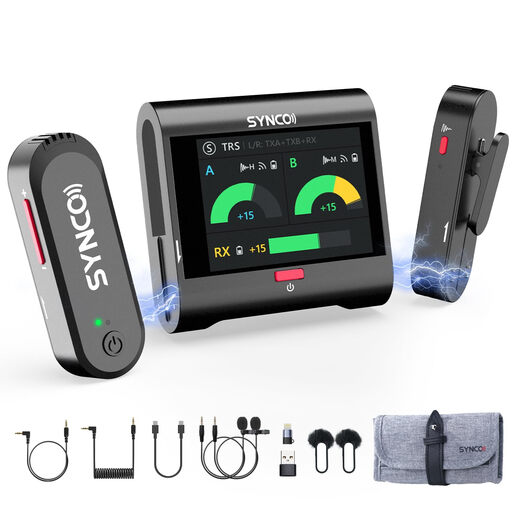
The described set-up with two transmitters is designed to record two people during an interview.
The product name lists 2TX+1RX and a 150m range. The description mentions a monitoring output and USB-C; the plug-and-play connection is designed for USB-C-compatible devices.
 No image available
The two transmitters make this model worth considering when both the interviewer and narrator need a microphone.
The description lists headphone monitoring and TRS, TRRS and USB-C outputs on the receiver. Check which connection is suitable for your recording device.
 No image available
This fixed USB microphone may suit a set-up where one speaker sits close to the microphone and recording is done via a computer.
The description lists a cardioid polar pattern, gain control, mute and a 3.5mm monitoring socket. The accessory set includes a boom arm, shock mount and pop filter.
If you need to capture both voices clearly, one microphone per speaker, with suitable inputs, gives you more control over the recording. If the interviewer only speaks occasionally, first test whether one microphone in the chosen position will be enough.
Make a test recording before the interview and listen back for distortion, voices that are too quiet, clothing rustle and room noise. Also check that the file has been saved; the Oral History Society recommends a widely recognised, uncompressed WAV format for long-term preservation.
A USB connection doesn’t automatically make a microphone a standalone recorder. Check whether the model works with another recording device, or choose a recorder that can record independently.
Check whether the version you choose includes cables and a stand, and whether you’ll also need a recorder, interface or headphones. When you buy as a consumer from a business, your statutory warranty applies alongside any manufacturer’s warranty. For many distance purchases, you’ll generally have a 14-day cooling-off period, as explained by ACM ConsuWijzer and the Dutch government.
This depends on how the recording will be used and what personal data it contains. According to the Dutch Data Protection Authority, publishing someone else’s personal data online usually requires their consent; there is an exception for personal or household use within a limited circle. Discuss with the narrator how the interview will be recorded, stored and made accessible.