What should you look for when choosing?
First, decide whether it’s mainly the storyteller or both speakers who need to sound clear. Then check that your recording equipment can connect to and record from the microphones you’ve chosen. Oral History in the Digital Age and the East Midlands Oral History Archive highlight the importance of placing a microphone close to the speaker; the UCLA Library Center for Oral History Research mentions using a second microphone for the interviewer.
| What to consider |
What to look for when buying |
Who will value this? |
| Clarity in the room |
Check whether you can place the microphone close to the storyteller, and listen back to a test recording made in the room you plan to use. |
When I record a storyteller at home, I want to be able to make out their words clearly in my own room. Around 36% of consumers give clarity in the room their top priority. |
| Recording both voices |
Decide whether you need to keep the questions, and check whether your recording equipment can record from both microphones. |
When I need to keep both the answers and my questions, I want to hear both voices clearly on the recording. Around 29% of consumers prioritise making both voices clearly audible. |
| Connection to your existing equipment |
Check which USB or XLR connections are available, how many inputs there are and which cables you’ll need. |
When I want to record using my existing computer or recorder, I look for a connection that works with it without the need for an unnecessarily complicated set-up. Around 21% of consumers give a simple, compatible connection their top priority. |
| Monitoring and preserving the recording |
Make a test recording and check how you’ll document the file and your arrangements for storage and access. |
When I want to preserve an important conversation and listen to it again later, I want to be able to check the recording and document it carefully. Around 14% of consumers prioritise monitoring and preserving the recording. |
Joybuy product picks
This selection includes wireless microphone kits for one or two speakers, as well as a USB microphone for connecting to a compatible device. Before buying, check that the receiver and connection work with your recording equipment.
 No image available
DJI Mic Mini 2S (2 TX + 1 RX + Charging Case)
With two transmitters and one receiver, this kit is designed for recording two speakers.
The product description mentions internal 32-bit float recording and storage on the transmitters. Check that the receiver works with your camera, smartphone or computer.
Joybuy
 No image available
Moman M1CXT wireless lavalier microphone, USB-C, 2TX+1RX
The two transmitters are designed for recording two speakers; check that your recording device supports the USB-C receiver.
The product description mentions a real-time monitoring port and a pass-through charging function.
Joybuy
 No image available
USB condenser microphone with cardioid polar pattern
This microphone may suit you if you want to record directly via USB; check that the connection is compatible with your device.
The product description mentions a cardioid polar pattern and a 3.5mm headphone socket for monitoring.
Joybuy
 No image available
DJI Mic 3 (2 TX + 1 RX + Charging Case)
With two transmitters and one receiver, this kit is designed for interviews with two speakers.
The product description mentions compatibility with cameras, smartphones and computers; check which connection your recording device needs.
Joybuy
 No image available
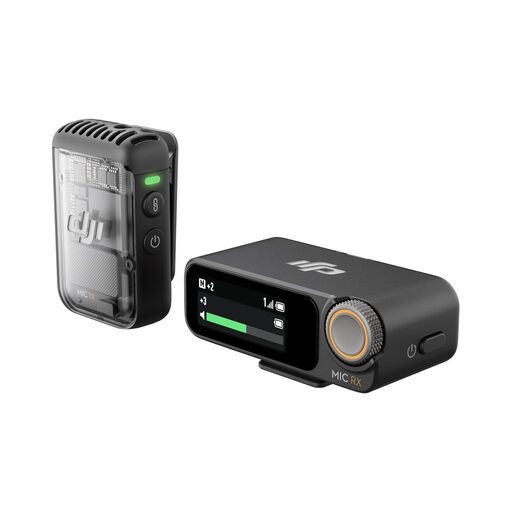
DJI Mic 2 (1 TX + 1 RX)
The version with one transmitter may suit you if you want to record one speaker; check that the receiver connects to your recording device.
The product description mentions USB-C, Lightning and 3.5mm adapters, plus internal recording on the transmitter.
Joybuy
Frequently asked questions
Do I need to buy two microphones for the storyteller and interviewer?
Not always: if the storyteller’s voice is the main priority, one microphone close to them may be enough, but test how clearly the questions come through. If you need to preserve both voices clearly, a separate microphone for each speaker may be more suitable, provided your recording equipment can handle both signals.
What can I test before the conversation starts?
Record a short conversation from the seats you’ll actually use, then listen back. Check both voices, the sound of the room, plosives and recording levels; practise using the controls beforehand, too.
What extra equipment might I need?
To record XLR audio on a computer, you’ll need a compatible audio interface or recorder with an XLR input. Also check which cables and mounting equipment you need, and whether there are enough recording inputs for both speakers; the included accessories vary by model.
What are my rights when buying online in the Netherlands?
For an online purchase as a consumer, ACM ConsuWijzer generally states that you have 14 days to change your mind after delivery, with some exceptions. Your statutory guarantee is separate from any manufacturer’s warranty; if there’s a problem, contact the seller to discuss a suitable solution.
What should I agree on if I record or publish someone’s life story?
Before recording, discuss what you’ll record, keep and potentially make public, and document the storyteller’s informed consent, as advised by the Oral History Association. According to the Dutch Data Protection Authority, an exception to the GDPR applies to use solely for personal or household purposes. Outside that exception, you need an appropriate GDPR legal basis to process personal data. Consent is one option and, if you choose it, must meet the requirements set out by the Dutch Data Protection Authority.


