What should you consider when choosing?
Several factors can matter when choosing a monitor for survival horror and working from home. Each row lists one primary buying concern and the key thing to check.
| Buying concern |
What to look for |
Who is this most important to? |
| Dark scenes |
Compare black uniformity and check whether dimming zones cause halo effects; assess the picture using the lighting you have at home. |
If I mainly play horror games with dark scenes, I want to distinguish shadows and bright details clearly. Around 36% of consumers prioritise how dark scenes are displayed when choosing a monitor. |
| Working on the same screen |
Consider prolonged use of static content and the amount of daylight; for OLED, check the model’s specific protection features and warranty terms. |
If you have lots of static windows open during the day and game in the evening, you should also consider the risk of OLED burn-in. Around 29% of consumers make the combination of work and gaming their primary consideration. |
| Motion and VRR |
Check which refresh rates the monitor, connection and source support together; look for a model-specific assessment of VRR with variable frame rates. |
If smooth motion matters to me at the frame rates my equipment can deliver, I want to know how the specific model handles VRR. Around 21% of consumers prioritise smooth motion without distracting flicker. |
| Size and connections |
Measure the available desk space and compare the ports and supported picture modes with your PC or console. |
If you first want to check whether the monitor will fit your workspace and connect to your existing equipment, consider its size, stand and ports first. Around 14% of consumers make their setup and connections their primary buying concern. |
Joybuy monitors for gaming and working from home
This Joybuy selection features gaming monitors suited to gaming and working from home. Compare each model’s size, stated panel and picture specifications, and connections with your space and equipment.
 Image unavailable
AOC Gaming Q27G42XNE, 27 inches
A 27-inch model to compare if you’re looking for QHD gaming on a shared gaming and work setup.
- QHD, 2560 × 1440
- 180 Hz
- VA panel and FreeSync Premium
- HDR10; 2× HDMI 2.0 and 1× DisplayPort 1.4
View at Joybuy
 Image unavailable
Philips Evnia 3000 34M2C3500L, 34 inches
An ultrawide model to consider if you’re looking for a large screen for gaming and working with several windows side by side.
- WQHD, 3440 × 1440; Fast VA panel
- Up to 180 Hz via DisplayPort; up to 100 Hz via HDMI
- FreeSync Premium
- 2× HDMI and DisplayPort
View at Joybuy
 Image unavailable
CRUA 49-inch curved ultrawide gaming monitor
This wide model may suit gaming and working with lots of windows, provided you have enough desk space.
- DQHD, 5120 × 1440; 32:9 aspect ratio
- 165 Hz; 1500R curvature and VA panel
- 2× HDMI 2.1 and 2× DisplayPort 1.4
- Height-adjustable
View at Joybuy
 Image unavailable
CRUA 32-inch curved gaming monitor
A 32-inch QHD model to compare if you’re considering a curved screen for gaming and office work.
- QHD, 2560 × 1440; VA panel
- 165 Hz and Adaptive Sync
- 1500R curvature
- HDMI and DisplayPort; VESA 100 × 100 mm
View at Joybuy
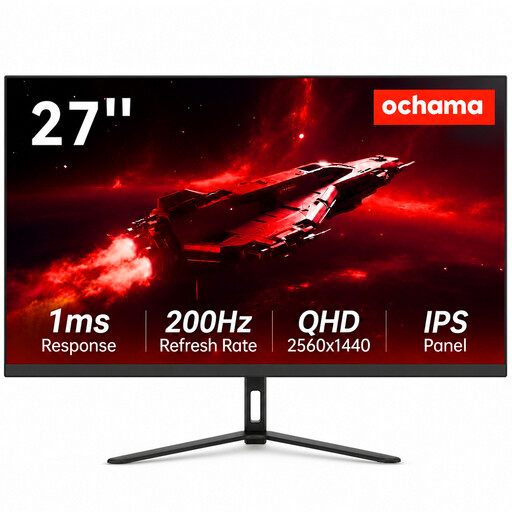 Image unavailable
Ochama 27-inch gaming and office monitor
A 27-inch model to compare if you want to use one screen for gaming and office work.
- 2K resolution
- 200 Hz
- The product title describes it as suitable for gaming and office work
View at Joybuy
Frequently asked questions
Is a high HDR or contrast rating enough to assess horror scenes?
No. One specification doesn’t cover every aspect of dark scenes. RTINGS.com treats black uniformity as a separate picture characteristic; also look at halo effects around bright objects and consider the impact of the lighting in your room.
How do I set up the monitor for gaming once it’s connected?
First check which resolution and refresh rate are supported by the monitor, connection and source together, then choose a suitable picture mode. A stated maximum refresh rate doesn’t mean every connection or game can reach it.
What should I consider when using an OLED monitor for long periods of office work?
Bear in mind the risk of permanent burn-in from prolonged exposure to static content, and read about the maintenance features and terms for the exact model. ASUS describes features that help reduce the risk, but they don’t guarantee that burn-in will be prevented.
Are you always entitled to exactly two years’ legal guarantee on a monitor in the Netherlands?
No. The Dutch government states that the Netherlands doesn’t have a fixed statutory guarantee period; what you can expect from a product depends, among other things, on the product and the sales information. If a product is faulty, contact the seller. A manufacturer’s guarantee is in addition to your statutory rights.
What cooling-off period usually applies when buying online from a business?
In many cases, distance purchases come with a 14-day cooling-off period. The Dutch government distinguishes between buying from a business and, among other things, buying online from a private individual.
What information can help you compare monitors’ energy use?
Electronic displays on the EU market must include energy-efficiency information. The European Commission describes the energy label, which shows a rating from A to G and information for comparing energy use. It’s product information, not a permit you need to apply for as a buyer.


