
Football fan who wants to follow the action
You’re comparing TVs mainly to see how they handle camera movement, players and the ball. A stated refresh rate alone won’t tell you that.


Start with your viewing distance, where your guests will sit and the light in the room. Then compare how specific TV models handle motion. OLED is a natural choice if contrast and viewing from different seats matter most, while a suitable mini-LED LCD TV is worth considering in a bright room. The Dutch Consumers’ Association points out that the technology name or stated refresh rate alone cannot guarantee a sharp picture of the football.
You’re comparing TVs mainly to see how they handle camera movement, players and the ball. A stated refresh rate alone won’t tell you that.
You want guests to enjoy the picture even from a seat at the side. That’s why viewing angle and reflections matter as well as screen size.
You sometimes watch in daylight and need to weigh brightness against viewing angle and reflections.
Best for: watching in dim light, when contrast and a clear picture from different seats are priorities.
Bear in mind: assess brightness and reflections in your own room. Prolonged display of fixed logos or score graphics can make image retention a consideration.
Best for: watching in daylight, if screen brightness is a key requirement.
Bear in mind: LCD TVs can be bright, but the Dutch Consumers’ Association says their viewing angle is generally more limited. Check the picture from the seats furthest to the sides.
Best for: when size and budget matter more than the specific screen technology, provided the model suits your room and seating.
Bear in mind: the ‘LED’ label alone doesn’t tell you enough about motion handling, viewing angle or picture uniformity.
| What to consider | What should you check? | Who is this most relevant to? |
|---|---|---|
| Motion handling | Compare sports footage on the exact model. Don’t look only at the panel refresh rate: motion interpolation can make smooth movement look smoother, but it doesn’t guarantee a clear picture of fast, erratic action. | If I want to keep track of the ball and fast camera movements, I compare how specific TVs display sports. Around 29% of consumers put motion handling first for football. |
| Watching from different seats | Assess the picture and reflections from the seats furthest to the sides, not just from the middle seat. | When guests are sitting at an angle to the screen, I want to know whether the picture still looks good from those spots. Around 23% of consumers give shared seating top priority. |
| Light and reflections | Check the TV in the lighting and daylight you expect during the match. Compare both brightness and reflections. | If I’m not watching the final in a darkened room, I check whether the picture remains visible in my usual lighting. Around 18% of consumers make the amount of light in the room their main consideration. |
| Screen size and placement | Measure your viewing distance and check the TV’s external dimensions, including the stand. The Dutch Consumers’ Association suggests around 2.4 times the screen’s diagonal as a comfortable viewing distance. Use this as a starting point, not a fixed requirement. | I want a screen that suits my viewing distance and fits on my TV stand. Around 18% of consumers prioritise size and placement. |
| Broadcast and sound | Check the provider, app or receiver for the final in question, and make sure the connections work with your audio equipment. | If I want to watch a specific broadcast and use my existing soundbar, I check in advance that my TV set-up is suitable. Around 12% of consumers put reception and connections first. |
A stated panel refresh rate or motion interpolation setting doesn’t tell you on its own how fast, erratic action will look. The Dutch Consumers’ Association explains that interpolation can make smooth movement look smoother, but can also cause picture artefacts during fast movement.
Compare sports footage on the exact model and assess the picture you see. Don’t rely on the panel refresh rate as your only measure.
If you’re watching with others, the viewing angle and reflections may look different from the side seats than they do straight on.
Check the seats furthest to the sides in the lighting you expect during the final.
The diagonal measurement doesn’t tell you how much space the TV takes up with its stand. The distance between the seating and the screen also affects your choice of size.
Measure your TV stand and viewing distance, then compare them with the dimensions of the exact model.
The OLED65C68LA is a specific 65-inch OLED model to compare if contrast and viewing from different seats are important to you.
The 65C7L is a specific 65-inch mini-LED LCD model to assess alongside an OLED TV, for example if you watch with ambient light.
The QE65QN90FATXXN is an example of a 65-inch Neo QLED Mini LED TV to compare as part of the LCD range.
The K-65XR70 is a 65-inch mini-LED LCD model to include when comparing specifications and placement.
This Joybuy selection includes OLED TVs and other 4K TVs in a range of screen sizes. Compare the size and model features with your viewing distance, seating and the broadcast you want to watch.
 No image available
An option to compare if you’re looking for a large OLED screen for your home cinema.
77 inches; OLED; 4K; native 120 Hz. The product description also mentions Reflection Free Premium; compare reflections in your own room.
 No image available
A 65-inch OLED option to weigh up against your viewing distance and the seating in your room.
4K; 120 Hz; VRR up to 165 Hz; Dolby Vision; four HDMI 2.1 connections.
Prolonged display of fixed logos or score graphics can make image retention a consideration. The Dutch Consumers’ Association says that with normal, varied viewing, the risk is small but cannot be ruled out.
No image available
A 55-inch OLED option to compare if your available space and viewing distance call for a more compact size.
4K; native 120 Hz; VRR up to 165 Hz; Dolby Vision; Dolby Atmos.
Prolonged display of fixed logos or score graphics can make image retention a consideration. The Dutch Consumers’ Association says that with normal, varied viewing, the risk is small but cannot be ruled out.
 No image available
A 65-inch model to compare if screen size and watching from several seats matter to you.
4K UHD; 60 Hz; MEMC. The product description lists a 178° viewing angle; assess the picture from your side seats too.
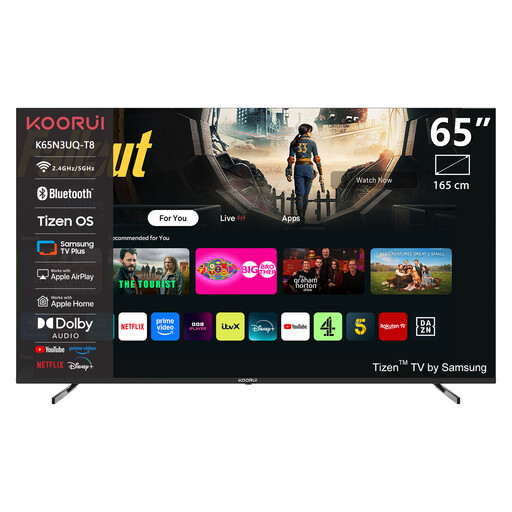 No image available
A 65-inch model to include when comparing screen size and smart features.
4K UHD; QLED; Tizen TV; LAN connection.
No. A stated refresh rate doesn’t guarantee a sharp picture of the football. The Dutch Consumers’ Association explains that motion interpolation can make smooth movement look smoother, but can also cause artefacts during fast, erratic movement. So compare the sports performance of the specific model.
Measure the distance from your eyes to where you plan to place the screen, and check its external dimensions, including the stand. The Dutch Consumers’ Association suggests around 2.4 times the screen’s diagonal as a comfortable viewing distance. It’s a starting point, not a minimum requirement.
Assess the picture using the lighting you normally have, and compare your home settings with the shop mode. Also check that motion handling looks good in your chosen picture mode.
Compare the EU energy label for the specific models and check the information for SDR and HDR. The European Commission gives electronic displays an energy label scale from A to G. Don’t judge energy use based only on the screen technology.
For a standard online purchase of a new TV, ACM ConsuWijzer says you generally have up to 14 days after delivery to change your mind. You’re also entitled to a product that, under normal use, meets what you could reasonably expect. If it doesn’t, the seller is your point of contact. This doesn’t mean there’s a fixed guarantee period that applies to every TV.