
Vandaag of morgen in huis

Kwaliteit gegarandeerd

Welkomstaanbiedingen ontgrendelen: GRATIS bezorging | Tot 80% korting | Gratis 30 dagen JoyPlus-proefperiode
Download de app
Choosing a workspace, storage cabinet or compact fridge might seem straightforward. Yet many disappointing purchases come down to the same problems: a piece of furniture is just a little too big, a cabinet offers less usable space than expected, or a fridge turns out to be too small in practice. So if you’re looking for practical office and household products, it’s worth first thinking about how you’ll use them and noting down the key measurements.
This buying guide helps people who work from home, students, small business owners, garage owners and households assess product information with a clear head.
A modern design says little about how practical a product is. With a desk, for example, legroom, drawer layout and cable positioning matter more than colour alone. An L-shaped desk can save space, but it won’t necessarily fit every corner. Always check the overall dimensions, which way it can be set up, and where the drawers or shelves are positioned.
A metal storage cabinet with certain external dimensions may offer less usable space than expected because of its doors, hinges and adjustable shelves. The same applies to a small fridge: its total capacity isn’t the same as the space available for bottles, tubs and packaging.
Check the internal layout, shelf height and door opening. A compact 90-litre fridge, for example, may suit a small amount of food but might not be enough for several people who cook every day.
Terms such as ‘sturdy’, ‘quiet’ or ‘safe’ should always be backed up by information you can check. Look at the materials, load capacity, noise level, lock, adjustability and assembly instructions. According to TCL’s product information, the RF120DWE0 has a noise level of 40 dB; that’s more specific than simply describing it as ‘quiet’.
A brand’s claims about how a product works aren’t a general guarantee either. According to the manufacturer’s own information, this fridge has adjustable glass shelves and a bottle rack. Also check that the layout suits the way you’ll use it.
Measure not only the space available, but also the room around the product. For a corner desk, allow for:
A computer desk with drawers is practical if you need documents and accessories close to hand. Check that the drawers can open fully without hitting a wall or chair.
Desks commonly combine a metal frame with board materials. The LANTINE desk, for example, specifies E1 particleboard, a metal frame and adjustable feet. E1 refers to a formaldehyde emission class for board materials. It isn’t an assessment of overall quality, but it is a useful technical specification to consider.
For a tool cabinet in a garage or workspace, steel, shelf load capacity and wall fixing are all relevant. The JOYFURNOS cabinet specifies a maximum static load of 30 kg on top and 25 kg per adjustable shelf. Use the supplied anti-tip device as directed in the assembly instructions, and secure the cabinet to the wall if needed for stability.
For a fridge in a bedroom, office or student room, the energy label, noise level and capacity are important points of comparison. The EU energy label runs from A to G. An energy class E fridge may suit your available space, but also check the annual energy consumption on the energy label and in the product information.
Also check:
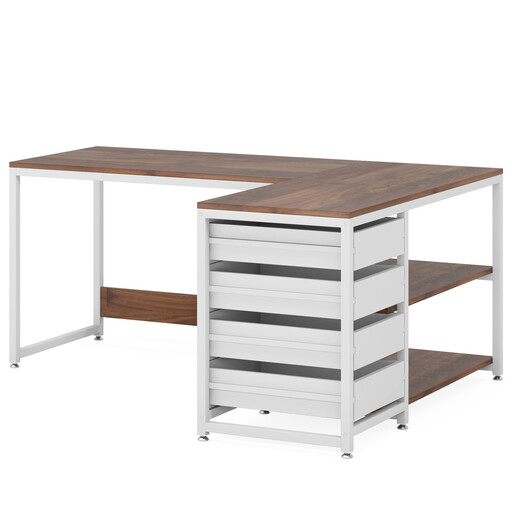
Why it suits this profile: This corner desk combines a work surface and storage in one piece of furniture. Measuring 150 x 110 x 75 cm, it could suit a home office or student room, provided the corner is large enough.
The reversible design lets you place the drawers on the left or right. Check in advance which side will have enough clearance in your room.
Two work surfaces, two open shelves, four drawers, adjustable feet and a metal frame.
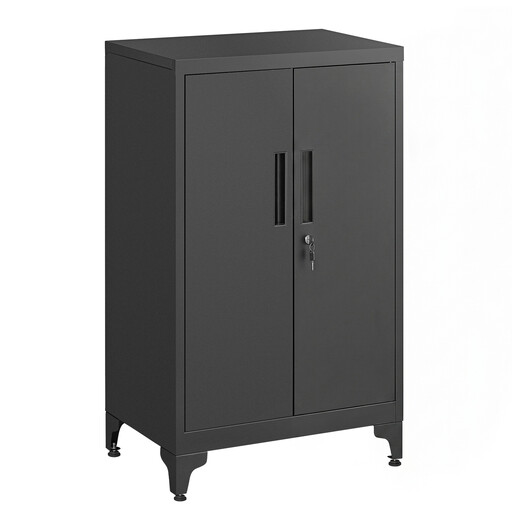
Why it suits this profile: For an office, garage or storage room where you need to keep items out of sight and under lock and key. The cabinet measures 40 x 60 x 90 cm and has adjustable shelves.
The adjustable shelves help avoid being stuck with a fixed layout that doesn’t work for you. The lock and supplied anti-tip kit address two practical risks: unauthorised access and instability.
Steel construction, lockable doors, adjustable shelves and a stated load capacity of 25 kg per shelf.

Why it suits this profile: A compact fridge for a bedroom, office or student room with limited floor space. It has a capacity of 90 litres and three glass shelves.
The stated external dimensions of 449 x 485 x 842 mm make it easier to check whether the fridge will fit before you buy. Adjustable shelves help you organise bottles and food to suit your needs.
90-litre capacity, chiller box, adjustable feet, mechanical controls and an E energy label.
We’ve put together a complete, up-to-date list of products that meet these strict selection criteria and the applicable European safety regulations.
Start with the space where you plan to put the product. Note down the width, depth and height, and allow for doors, drawers and ventilation. Then decide what you’ll actually store or use. A lockable filing cabinet is most useful for documents and items that shouldn’t be freely accessible. For heavy tools, load capacity and wall fixing matter more than a decorative finish.
For a fridge in an office or student room, how often you’ll use it is key. If you mainly store drinks and lunch, your needs will differ from someone who keeps several meals in it. Also compare the energy label and stated consumption, as electricity use will contribute to your running costs over time.
Follow the manufacturer’s installation instructions. Also make sure the door can open fully and that the ventilation openings aren’t blocked. Measure the route to the final position too, including doorways and stairs.
It can be, if the corner shape suits the room and the drawers can open freely. Measure the space for your chair and check the location of sockets and cables. A reversible L-shaped desk gives you more layout options.
Lifespan depends on the materials, assembly, load, maintenance and how often you use the product. Keep heavy items within the stated load capacity, secure cabinets as instructed, and clean fridge shelves and door seals regularly. Always check the warranty terms and information about servicing and spare parts before you buy.
