What should you look for?
First decide how much you want to open at a time. Then compare the amount you want to measure out yourself and consider how you’ll store any opened supply.
| What to consider |
What should you check? |
Who is this most relevant to? |
| Number of bags and amount per opening |
Compare the number of individual packs, the weight of each bag and the total contents separately. According to Foods & Goods and Kantinewinkel.nl, the Duyvis boxes reviewed contain either ten 125 g bags or ten 235 g bags. |
If I want to open the supply one portion at a time, I focus on how much is in each bag. Around 25% of consumers prioritise the number of bags and the amount per opening when making this choice. |
| Lunchbox portions measured out yourself |
Check the portion size on the label and calculate from the total contents. For the pack reviewed, Albert Heijn lists a portion size of 25 g. This is a product-specific basis for calculation, not personal dietary advice. |
If I want to take a set amount with me, I’d rather check the weight than the number of bags. Around 25% of consumers prioritise measured lunchbox portions when making this choice. |
| Unsalted ingredients |
Read the ingredients and nutritional information for the exact variant. Albert Heijn lists sunflower oil in the unsalted cashews reviewed; the Netherlands Nutrition Centre includes unsalted nuts in its Wheel of Five healthy eating guidelines. |
If I want to share cashews regularly, I check whether the variant is unsalted and what else it contains. Around 20% of consumers put unsalted ingredients first. |
| Storage after opening |
Check the storage instructions and whether you can seal the pack securely. The Netherlands Nutrition Centre recommends storing nuts in a sealed container in a dry place. |
If I open a larger supply, I want to know how to store the rest properly. Around 15% of consumers focus mainly on managing an opened supply when making this choice. |
| Allergen information when sharing |
Read the information on the label for each variant and keep it with the supply. The NVWA says that allergen information must appear on the label of prepacked products. |
If I share cashews with others, I want to keep the product information available. Around 15% of consumers prioritise clear allergen information when making this choice. |
Cashews at Joybuy
These Joybuy products are single packs of cashews to measure out yourself; they aren’t multipacks with several individual bags.
 Image unavailable
Jiazhouyuanye Original Flavour cashew nuts 160 g
The 160 g pack is intended for measuring out portions yourself. The ingredients list states 100% cashew kernels.
Keep the allergen information with the supply if you’re sharing the cashews.
Buy at Joybuy
 Image unavailable
g'woon roasted, unsalted cashews 200 g
The 200 g pack is suitable for measuring out portions yourself; the product title describes the cashews as roasted and unsalted.
The product description recommends storing them in a cool, dry place and resealing the pack securely after opening.
Buy at Joybuy
 Image unavailable
Duyvis Dry Roasted Cashews 125 g
The title says Dry Roasted Cashews; the product description lists sea salt. Check the variant and ingredients on the pack before choosing.
The pack contains cashews. The product description also mentions gluten, wheat and peanuts; keep the allergen information with the supply if you’re sharing it.
Buy at Joybuy
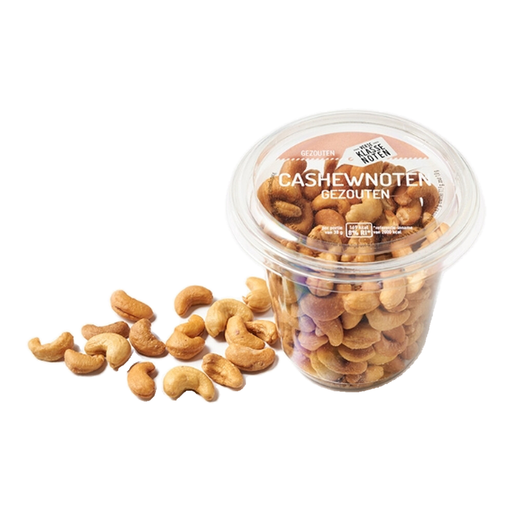 Image unavailable
Verse Klassenoten salted cashews 150 g
The 150 g pack is intended for measuring out portions yourself. The ingredients list states 1% salt.
This is a salted variant; keep the allergen information with the supply if you’re sharing it.
Buy at Joybuy
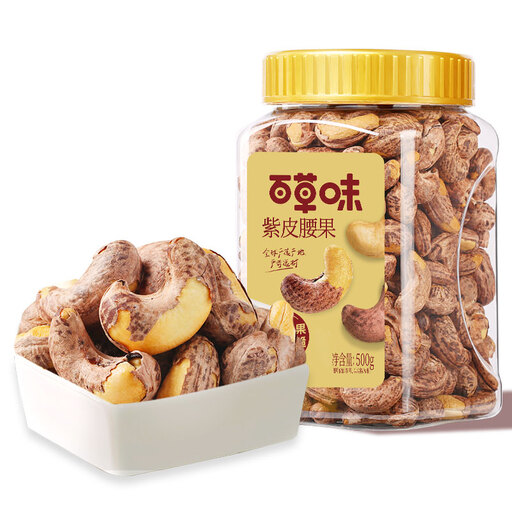 Image unavailable
Be&Cheery cashews with purple skin, 180 grade, 500 g
The 500 g pack is a single supply to measure out yourself. The ingredients list includes salt.
Check the ingredients and allergen information on the pack before sharing it with others.
Buy at Joybuy
Frequently asked questions
How do you calculate how many lunchbox portions are in a multipack?
Divide the total contents by your chosen portion size. At 25 g per portion, 10 × 125 g theoretically makes 50 portions, while a 500 g pack makes 20, with nothing wasted. Albert Heijn lists 25 g as the portion size for the pack reviewed; that amount isn’t personal dietary advice. The ten bags in a multipack aren’t the same as fifty individual portion packs.
Can I use an ordinary biscuit tin to store cashews?
Yes, if the tin seals well and stays dry. The Netherlands Nutrition Centre recommends storing nuts in a sealed container in a dry place. Also follow the storage instructions on the exact pack: a decorative tin isn’t necessarily airtight.
Does unsalted mean cashews are also unroasted or oil-free?
No, these are separate product characteristics. The unsalted cashews from Albert Heijn reviewed contain sunflower oil. For the 250 g pack reviewed, ALDI describes the cashews as both roasted and unsalted. So check the preparation method and ingredients as well as the salt information.
What allergen information should be available when nuts are offered loose?
Allergen information must be available for unpackaged food sold commercially. For catering and hospitality, the NVWA says this can be provided in writing or verbally, with a visible notice telling customers they can ask for it. This doesn’t automatically mean that every informal snack tin filled by colleagues is a catering business. In any case, keep the original product information with shared supplies.
What does ‘may contain’ mean on a pack?
Since 1 January 2026, rules have applied in the Netherlands to precautionary allergen warnings about allergens that may be unintentionally present in prepacked food. According to the NVWA, such a warning must be based on a risk assessment. Permitted wording includes ‘May contain X’ and ‘Not suitable for people with an X allergy’. Such a warning refers to possible cross-contamination, not an ingredient that has been deliberately added.


