
Biscuit tin manager
You want to estimate how many biscuits a pack contains for the team and how often the tin needs refilling. Net weight, quantity and how the biscuits will be used in the office are all separate things to consider.


If the office biscuit tin empties quickly, a large pack of loose biscuits is an obvious choice; compare the net weight with the number of biscuits. Choose individually wrapped portions if you want to hand them out at coffee breaks or meetings and keep unopened portions separate. With either option, check the ingredients and allergens on the pack you choose.
You want to estimate how many biscuits a pack contains for the team and how often the tin needs refilling. Net weight, quantity and how the biscuits will be used in the office are all separate things to consider.
You hand out biscuits at meetings, when welcoming visitors or during regular coffee breaks. Knowing how many packets there are and how many biscuits each contains makes it easier to prepare.
You need to consider colleagues who may need to check the ingredients or allergens. The information on the pack you choose matters more than a general description of the brand or type of biscuit.
First decide whether the biscuits are for a shared tin or to be handed out at specific occasions. Then check the pack’s contents, portioning and label information.
| What to consider | What to check when buying | Who it matters most to |
|---|---|---|
| Keeping enough in stock | Check the net weight and number of biscuits; see whether the quantity is exact or approximate. | If the biscuit tin needs to last through lots of coffee breaks, I want to know when to top it up. For around 38% of consumers, having enough in stock is the main priority when making this choice. |
| Handing out portions | Check the number of packets and biscuits per packet, and whether that format suits your coffee break. | For meetings, I want to be able to set out portions without counting loose biscuits every time. Around 31% of consumers say that ease of handing them out is their main priority. |
| Ingredients and allergens | Read the ingredients and allergen information on the current pack; if needed, compare similar biscuits by nutritional value per 100 g. | If colleagues need to check what they’re eating, I look first at the label on that exact pack. For around 31% of consumers, this information matters most. |
A large pack may be described by weight, number of biscuits or number of packets. For example, ALDI lists Biscotto jodekoeken or coffee biscuits at around 20 biscuits and 380 g, while Jumbo lists Lotus Biscoff XL as 10 packets, each containing 2 biscuits. These figures don’t tell you the same thing about how many occasions you can serve them on.
Work out how many biscuits or packets you need for each coffee break at your office, then check which unit is shown on the pack.
A description such as vegan doesn’t tell you which allergens are present. Jumbo lists wheat and soya for Lotus Biscoff XL.
For the variant you choose, check the ingredients, listed allergens and any warnings about cross-contamination on the current pack.
A nutrition claim or a single score doesn’t show every difference between biscuits. The Netherlands Nutrition Centre advises comparing products side by side per 100 g.
For similar biscuits, compare the nutritional information per 100 g and read the ingredients list too. Use any Nutri-Score only to compare products of the same type, as explained by the Dutch government.
Whether a pack of biscuits can be ordered and delivered to the office may change. A similar-looking variant may also have different contents or allergen information.
Check availability, delivery options and the exact pack variant just before placing your order.
Speculoos biscuits available in different pack formats. Albert Heijn describes a pack of 300 individually wrapped biscuits; Jumbo lists an XL variant with 10 packets of 2 biscuits.
A supermarket own label with a range of everyday biscuits. Albert Heijn lists, among other options, 300 g tea biscuits and 400 g digestive biscuits.
Lidl presents Sondey as its own label for biscuits and cookies, among other products.
Under this own label, ALDI lists jodekoeken or coffee biscuits at around 20 biscuits and 380 g, as well as a separate chocolate biscuit variant packaged in pairs.
These biscuit packs are options for topping up a shared supply or choosing portions for coffee breaks. Compare the stated contents and check how the biscuits are packed inside each product.
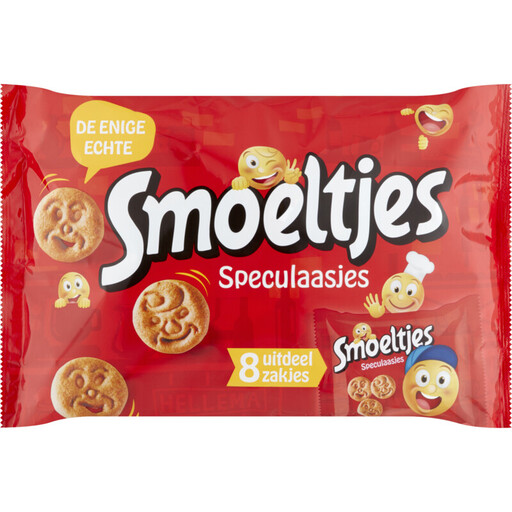 Image unavailable
An option for coffee breaks when you want to estimate the number of biscuits in advance. The product name states 8 biscuits and 200 g; check how they’re packed if you want to hand them out individually.
 Image unavailable
For anyone who wants to keep biscuits for coffee in the shared stock. The pack is labelled 250 g; check the number of biscuits and the inner packaging if you want to plan portions.
 Image unavailable
If you’re handing these out individually, the pack format is particularly important. The pack is labelled 403 g; check how many biscuits or portions it contains and read the label before putting them out for colleagues.
 Image unavailable
A speculoos option for the shared biscuit tin. The pack is labelled 250 g; check the number of biscuits and the label information for this variant before topping up your office supplies.
 Image unavailable
A multipack for splitting up your biscuit supplies. The product name states 10 × 66 g; check how many biscuits each inner pack contains if you want to work out the number of portions to hand out.
First check whether both packs suit the same way of handing out biscuits. Then look at the net weight, number of biscuits and any individual packets. To compare nutritional values, compare similar biscuits per 100 g, as advised by the Netherlands Nutrition Centre.
Yes, make sure colleagues can check the label information for the pack you’ve chosen. According to the Netherlands Food and Consumer Product Safety Authority, specified allergens must be clearly shown on the label of prepacked foods when present. Keep the packaging or make sure the current product information is available.
It’s a warning about possible cross-contamination, not a statement that milk has deliberately been added as an ingredient. If you have a food allergy, check both the ingredients and any such warnings on the current pack; a description such as vegan doesn’t replace this check.
No, Nutri-Score alone doesn’t tell you what’s right for your office. The Dutch government describes it as a tool for comparing products of the same type; portioning, ingredients and allergens still need to be considered separately.