
Vandaag of morgen in huis

Kwaliteit gegarandeerd

Welkomstaanbiedingen ontgrendelen: GRATIS bezorging | Tot 80% korting | Gratis 30 dagen JoyPlus-proefperiode
Download de app
A warning light on your dashboard. It's a familiar scenario that often leads to uncertainty and the question: what's wrong, and how much will the repair cost? A trip to the garage for a simple diagnosis can quickly become expensive. With your own OBD2 scanner, you take back control. You can read your car's fault codes yourself, diagnose the root cause of the problem, and in many cases, fix the issue on your own.
This article is intended as a practical guide. We'll help you understand the different types of diagnostic tools and find a model that fits your car, your technical skills, and your budget. This way, you not only save money but also get to know your own car better.
The market for OBD scanners is vast. To make the right choice, it's helpful to know which features are important to you.
The simplest automotive code reader focuses purely on the engine management system. It allows you to read diagnostic trouble codes (DTCs) that trigger the check engine light and reset them after a repair. Want more? Then look for a device with service functions. A good service reset tool, for example, can reset the oil service, release the electronic parking brake (EPB), or register a new battery with the battery management system (BMS).
A traditional OBD scanner uses a fixed cable. This ensures a stable and reliable connection. The OBD2 Bluetooth adapter is becoming increasingly popular. You plug it into your car's port and perform the diagnosis via an app on your smartphone or tablet. This offers more freedom of movement and a compact solution, ideal for those who want to work quickly and wirelessly.
Although most devices are sold as universal diagnostic tools for standard OBD2 engine functions, support for advanced systems (like ABS, airbags, transmission) varies by car make and model. Therefore, always check the device's vehicle coverage. For the serious DIYer or semi-professional, there are even models that offer bi-directional control (actuating components) or an ECU programming tool for coding and adaptations.
Based on functionality and intended use, we have listed some interesting options for you.
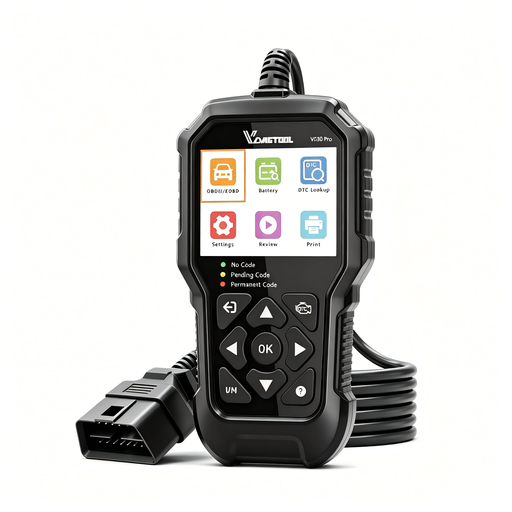
Why it stands out: The VD30 Pro is the definition of plug-and-play. You can get started immediately without apps, Wi-Fi, or complicated installation. Ideal for anyone who wants to read an engine fault code quickly and without hassle.
Key features:
Who is this for? This is an excellent choice for the beginner DIYer or car owner looking for a reliable and simple car diagnostic tool to read and clear engine fault codes.
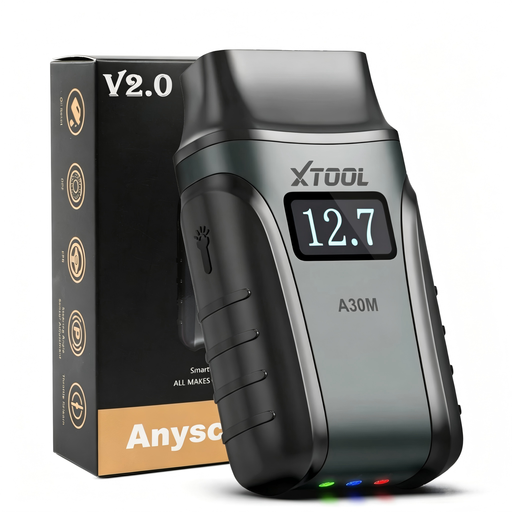
Why it stands out: The A30M combines the convenience of a wireless OBD2 Bluetooth adapter with features you normally only find on more expensive devices, such as bi-directional control and a wide range of service resets. The lifetime free updates make it a future-proof investment.
Key features:
Who is this for? Perfect for the enthusiastic car lover who wants to do more than just read fault codes and perform maintenance and service tasks themselves.
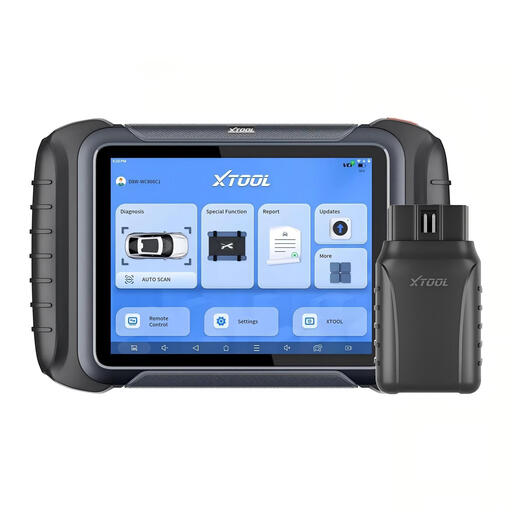
Why it stands out: The D8W is a professional automotive diagnostic tool that offers wireless freedom via a stable Wi-Fi connection with the included 8-inch tablet. Features like topology mapping and ECU coding provide deep insight into the vehicle's electronics.
Key features:
Who is this for? This device is aimed at the serious auto technician, the small garage owner, or the highly advanced hobbyist who needs in-depth diagnostics, coding, and extensive vehicle coverage.
The world of car diagnostics is broad, and there are many different tools, each with its own specialities. If the options above don't quite match what you need, or if you're looking for a model with a specific function, there's more to discover.
Check out our full range of Wired Car Diagnostic Scanners for more choices.
An OBD2 (On-Board Diagnostics II) scanner is a tool that you connect to your car's OBD2 port (usually under the dashboard). It communicates with the vehicle's on-board computer to retrieve diagnostic information. Its primary function is to read and clear Diagnostic Trouble Codes (DTCs).
Yes, one of the basic functions of almost every OBD scanner is to clear fault codes. When you clear the code, the check engine light will turn off. However, it's important to remember that this does not fix the underlying problem. Use the code to find and repair the cause before you reset the warning.
For engine-related fault codes (the OBD2 standard), a universal device works on almost all petrol cars built after 2001 and diesel cars after 2004 in the EU. For more advanced functions, such as reading the airbag, ABS, transmission, or performing specific service resets, compatibility can vary by car make and model. It is always advisable to check the vehicle support list of the specific diagnostic tool.
