
Families preparing several lunches
You regularly prepare oats at home and want to decide for yourself how much to use for each lunch.


For a regular school lunch, a pack of plain wholegrain oats is a sensible choice if you’re happy to measure out and prepare portions at home. Individual portions are more practical when a pupil needs to take a measured amount with them. Choose a protein variety only if its ingredients suit the lunch you’re planning to make. If there are allergies or coeliac disease to consider, always check the current label and the school’s rules.
You regularly prepare oats at home and want to decide for yourself how much to use for each lunch.
You prepare your own lunch and would benefit from a measured portion or a preparation method that fits into your morning routine.
You need to check which grains and other allergens are listed on the packaging, as well as the school’s rules for packed lunches.
First decide whether you’ll measure out the lunch at home or need to take an individual portion with you. Then check the ingredients, nutritional information and, where necessary, the allergen information on the pack.
| What to consider | What to check | Who is this important for? |
|---|---|---|
| Amount for several lunches | Check the pack weight and decide how many portions you’d like to measure out yourself. | If I prepare several lunches at home, I don’t want to need a separate sachet for every lunch. For around 36% of consumers, having a pack for repeated use is the priority. |
| Preparing it independently | Check the portion size, preparation instructions and equipment needed. | When I prepare my own lunch, I want to take an amount that I don’t have to measure out first. Around 29% of consumers say this convenience is their priority. |
| Gluten and other allergens | Read the ingredients and allergen information on the current label. If you have coeliac disease, also check for the gluten-free label and Crossed Grain trademark. | If I have a relevant allergy or coeliac disease, I need to know before packing whether this particular product is suitable for me and complies with the school’s rules. For around 21% of consumers, this check is their main concern. |
| Ingredients in protein varieties | Compare the protein per 100 g with plain oats and check which ingredients have been added. | If I’m specifically looking for a higher-protein variety, I want to know what else it contains besides oats. Around 14% of consumers make the ingredients their priority. |
A large pack still means measuring and preparing the oats yourself. Individual portions take away some of that work, but they won’t necessarily be the right size for the amount a pupil wants to take.
Decide in advance how much you’ll use for each lunch and who will prepare the oats.
According to the Voedingscentrum, plain oats are not automatically suitable for someone with coeliac disease, as they can come into contact with gluten during processing.
Check the current label. If you have coeliac disease, look for the gluten-free label and official Crossed Grain trademark, and make sure the product complies with the school’s rules.
A protein variety may contain different ingredients from plain oats. For example, the AH protein variety described by Albert Heijn contains soya protein.
Read the full ingredients and allergen information, and compare the nutritional values per 100 g if extra protein is important for this lunch.
Jumbo sells plain fine wholegrain oats in packs of 500 g and 1 kg, among other options, as well as individual portions.
AH offers fine wholegrain oats and a separate protein variety.
Golden Bridge is ALDI’s own brand, with fine and coarse wholegrain oats in 500 g packs.
Quaker sells plain wholegrain oats as well as individual Oats Express varieties.
According to the product information, Brinta Havermout 450 g contains extra-fine oat flakes.
At Lidl, you can check the oats in store by looking at the packaging.
These products include plain oats to measure out at home, an Express variety and a Protein variety. First choose the type that suits how you prepare a school lunch, then read the label on the pack you’ve chosen.
 Image unavailable
An option if individual portions make it easier to prepare lunch independently. The pack contains 324 g; check the preparation instructions and allergen information on the packaging.
 Image unavailable
For anyone who wants to measure out their own amount of oats at home for lunch. The pack contains 600 g; check the current label for allergen information.
 Image unavailable
A smaller pack of plain oats for anyone who wants to measure out lunch at home. It contains 375 g; follow the preparation instructions on the packaging.
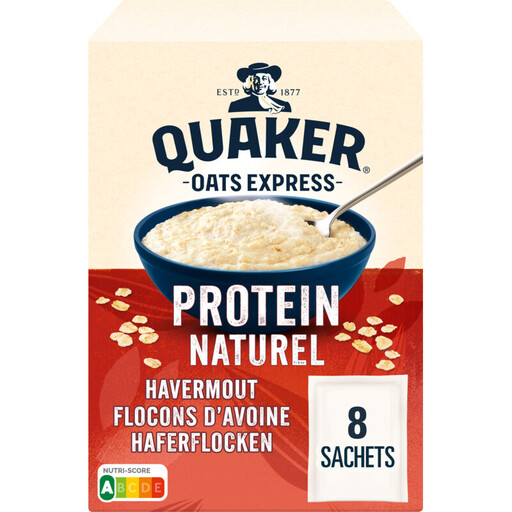 Image unavailable
For anyone who wants to compare the ingredients in a Protein variety specifically with plain oats. The pack contains 302 g; check the label for soya and gluten-containing grains.
 Image unavailable
A 500 g pack for anyone who wants to measure out lunch at home. Check the packaging for the exact grain type, ingredients and allergens before choosing this product.
No, plain oats are not automatically suitable for someone with coeliac disease. The Voedingscentrum warns that oats may be contaminated with gluten during processing and says that oat products must carry the official Crossed Grain trademark on the packaging. Also check the current gluten-free label and the product information.
Yes, read the ingredients and allergen information on the pack you’re actually putting in the lunchbox. The Netherlands Food and Consumer Product Safety Authority explains allergen labelling, including the requirement to name the relevant grain. Ingredients and warnings can vary between products.
Follow the preparation and storage instructions on the pack you’ve chosen. If you’re taking prepared oats with you, check how to store them according to those instructions and what rules the school has for packed lunches.
Individual portions are useful when a pupil needs to take or prepare a measured amount independently. Do check the portion size and preparation requirements, though: a sachet doesn’t automatically remove the need to prepare it at school.