
Budget-conscious breakfast preppers
You prepare several breakfasts in advance and want to compare the price per kilo and pack size. With loose oats, you decide how much to use in each container and what to add.


If you prepare several breakfasts in advance and want to weigh out your own portions and add ingredients, a large pack of plain oats is usually the better choice. Instant portion sachets are particularly handy when a measured serving and quick, hot preparation matter more; compare the price per kilo and the weight per serving. If you have coeliac disease, check the certification on the packaging before choosing oats.
You prepare several breakfasts in advance and want to compare the price per kilo and pack size. With loose oats, you decide how much to use in each container and what to add.
You don’t want to weigh out your oats every morning and would rather have a set portion that’s quick to prepare hot. Check that the weight of each sachet suits your breakfast, though.
You want to read the ingredients and allergen statement before buying. If you have coeliac disease, the official Crossed Grain symbol on the packaging is also important, according to the Netherlands Nutrition Centre.
First decide whether you mainly want to put together several portions yourself or quickly prepare a measured hot serving on the day. Then compare the pack weight, serving size and ingredients of the products you’re actually considering.
| What to consider | What to check when buying | Who it matters to |
|---|---|---|
| Price and stock | Compare the price per kilo and the net weight; work out how many servings your recipe makes from one pack. | When I make several breakfasts at once, I want enough plain oats in the cupboard without relying on the size of a single pack. Price and stock are the top priorities for around 40% of consumers. |
| Speed and servings | Check the weight of each sachet and the preparation instructions; decide whether you want hot porridge or chilled overnight oats. | On a busy morning, I want to be able to prepare a measured serving without weighing anything first. Around 30% of consumers give top priority to speed and portion control. |
| Ingredients | Read the ingredients and nutritional information per 100 g and per serving, including any toppings you add. | I want to choose what goes into my breakfast alongside the oats and know which source of protein a product contains. This matters most to roughly 20% of consumers. |
| Allergens | Check the latest allergen statement; if you have coeliac disease, look for the official Crossed Grain symbol. | If I need to account for coeliac disease or a food allergy, whether the product is suitable comes before convenience or price. This is the main concern for around 10% of consumers. |
A low price for one box tells you little about how much oats you’re getting. Among the Quaker products listed by Albert Heijn, the price per kilo and serving weight differed between the loose pack and the Express sachets.
Compare the price per kilo on the same day you shop, and base your calculations on how much you use for each breakfast.
You can also mix regular oats with liquid in advance and leave them in the fridge for a cold breakfast, as in a recipe from Jumbo. Instant sachets are mainly convenient because they’re pre-measured and quick to prepare hot.
First decide how you want to eat your oats, then choose a pack size to suit.
According to the Netherlands Nutrition Centre, oat products can be contaminated with gluten. So a product name containing ‘oats’ doesn’t confirm that it’s suitable for people with coeliac disease; some varieties may also contain other allergens, such as soya.
If you have coeliac disease, check for the official Crossed Grain symbol and read the allergen statement every time you buy.
The Netherlands Nutrition Centre advises not leaving prepared food out of the fridge for more than two hours and keeping it refrigerated for no longer than two days.
Plan chilled portions for no more than two days at a time, use sealed containers and keep your fridge at 4 °C.
Quaker offers both a 600 g pack of loose oats and Oats Express portion sachets, as well as a protein version.
Jumbo is worth considering when comparing a large pack of plain oats with smaller portion packs.
The 500 g Instant Oatmeal described by Jumbo shows that instant oats don’t only come in portion sachets.
These products are aimed at anyone looking for instant oats for a quick, hot breakfast: one comes in measured portions and the other contains soya protein. If you’re mainly after a large supply of plain oats for several breakfasts you’ll put together yourself, you can’t base that choice on these two products alone.
 Image unavailable
For anyone who wants a measured hot breakfast serving without weighing it out themselves.
Joybuy’s product information lists 12 portion packs and a two-minute preparation time in the microwave or in a pan. Compare the weight of each sachet with your usual serving size and check the latest allergen information.
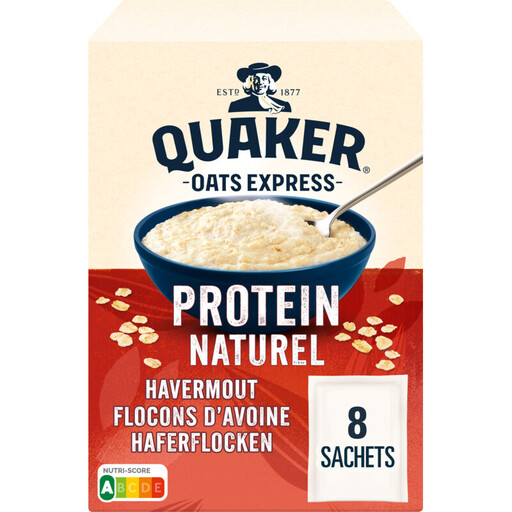 Image unavailable
For anyone specifically considering an instant option with added soya protein instead of a plain oat base.
Albert Heijn’s product information for this variety lists 85% wholegrain oats and 15% soya protein. Check the allergen statement and the number of servings on the pack when preparing breakfasts in advance.
Not if you mainly want to put together several breakfasts yourself. Portion sachets save you weighing things out and can be handy for quick, hot porridge, while you can also mix regular oats in advance and chill them to make overnight oats. Compare the price per kilo and weight per serving before you choose.
Following the meal-prep advice from the Netherlands Nutrition Centre, keep prepared portions in sealed containers in the fridge at 4 °C for no more than two days. Don’t leave them out of the fridge for more than two hours, and follow the storage instructions for any other ingredients you use.
Not without checking the packaging. According to the Netherlands Nutrition Centre, oats can be contaminated with gluten; if you have coeliac disease, only choose oat products with the official Crossed Grain symbol on the pack.
Check the product label. The Netherlands Food and Consumer Product Safety Authority states that allergen information must appear on the label of prepacked foods. For example, if you’re considering a protein version, check whether soya is listed as an ingredient and look out for warnings about the possible presence of other allergens too.