
Easter breakfast planner
You want to choose your own toppings for several breakfasts or brunches, and you’re keeping an eye on fibre. According to the Voedingscentrum, an average 40 g bowl of porridge oats contains 4.4 g of fibre.


Choose plain rolled oats if you want to decide on your own portions and toppings, or an instant portion pack if convenience matters most. A protein option is worth considering if you’re specifically looking for a different nutritional profile. Always compare fibre and sugars on the same basis. If you have coeliac disease, check the packaging for the official Crossed Grain mark, as advised by the Voedingscentrum.
You want to choose your own toppings for several breakfasts or brunches, and you’re keeping an eye on fibre. According to the Voedingscentrum, an average 40 g bowl of porridge oats contains 4.4 g of fibre.
You want to make a portion of porridge on a busy morning without weighing it out first. Quaker describes Oats Express as a two-minute option; check the instructions for the variety you choose.
You check the ingredients, sugars and allergens for each flavour. If you have coeliac disease, regular oats aren’t automatically suitable: the Voedingscentrum advises looking for the official Crossed Grain mark on the packaging.
First decide whether you want to make your own breakfast, prepare a measured portion quickly or choose an option with added ingredients. Then compare the nutritional information and ingredients on the specific pack.
Choose these if: you want to decide how much oats and which toppings to serve at Easter breakfast.
Bear in mind: you’ll need to measure out the portions yourself and follow the preparation instructions for your chosen oats.
Choose these if: a pre-measured portion and quick preparation are your priorities.
Bear in mind: flavoured varieties may contain different ingredients from plain porridge oats.
Choose this if: you specifically want a different nutritional profile instead of plain oats.
Bear in mind: added ingredients and allergens vary from product to product.
| What to consider | What to check before buying | Who it matters to |
|---|---|---|
| Fibre | Compare fibre per 100 g and per portion on the same basis. | If I’m choosing oats for several Easter breakfasts, I want to know how much fibre is in my usual portion. Fibre is a key reason for buying for around 42% of consumers. |
| Preparation and portions | Check the preparation time, portion size and the amount of milk or water needed. | On a busy morning, I want to be able to make a portion without weighing it out. Ease of preparation is the top priority for around 33% of consumers. |
| Ingredients and allergens | Read the ingredients and allergen information for the specific variety; if you have coeliac disease, check for the Crossed Grain mark. | If ingredients or allergens affect my choice, I want to be able to check the packaging before serving it for breakfast. Checking the label is the first priority for around 25% of consumers. |
The preparation method doesn’t tell you which ingredients a flavoured variety contains. So you can’t compare a portion pack with plain porridge oats based on the word ‘instant’ alone.
Read the ingredients and compare sugars and fibre for the specific variety before choosing several packs.
The nutritional values for oats and for a prepared portion made with milk aren’t based on the same serving.
Where possible, compare products in the same state of preparation and take into account anything you add yourself.
According to the Voedingscentrum, oats can be contaminated with gluten. If you have coeliac disease, the name of the grain alone isn’t enough to determine whether it’s suitable.
If you have coeliac disease, check every pack for the official Crossed Grain mark.
Product listings don’t guarantee that a particular variety will be available when you do your Easter shopping.
Check that your preferred pack is available shortly before buying, and stick to your label criteria if you choose an alternative.
These brands give you options for comparing plain oats with portion packs; ingredients vary by product.
Quaker offers plain porridge oats and Oats Express portions. According to Quaker, Oats Express is ready in two minutes.
According to Albert Heijn’s product information, Brinta Porridge Oats are made from 100% rolled oats.
The Jumbo range includes wholegrain fine rolled oats and porridge portions.
These two packs are Quaker Express options for anyone looking at preparation and ingredients for Easter breakfast: one porridge oat variety and one Protein variety. Compare their nutritional information on the packaging before choosing.
 Image unavailable
For anyone looking to serve an Express porridge oat option at Easter breakfast and compare the nutritional information for themselves.
Pack size: 324 g. Compare fibre and sugars on the label per 100 g and per portion.
If you have coeliac disease, check the packaging for the official Crossed Grain mark.
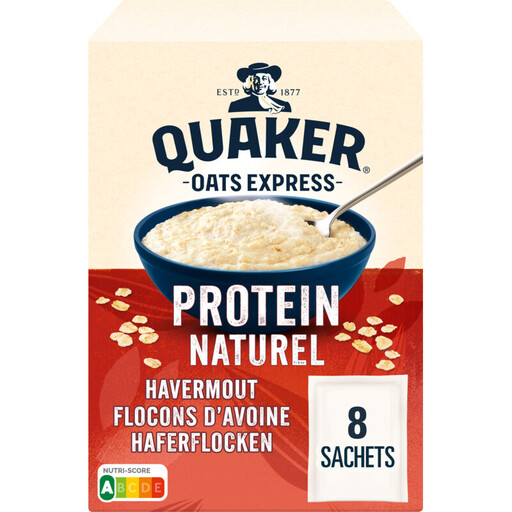 Image unavailable
For anyone considering an Express option with a different nutritional profile from regular porridge oats.
Pack size: 302 g. Compare protein, fibre and sugars per 100 g and per portion on the label.
Check the allergen information, including soya, and look for the official Crossed Grain mark if you have coeliac disease.
Check the fibre per 100 g and per portion, and compare products on the same basis. As a guide, the Voedingscentrum lists 4.4 g of fibre in an average 40 g bowl of plain porridge oats; the value for your chosen variety is shown on its own label.
Not automatically: according to the Voedingscentrum, oats can be contaminated with gluten. If you have coeliac disease, check whether the specific product’s packaging carries the official Crossed Grain mark.
If you’re not used to eating a lot of fibre, you may initially experience wind, according to the Voedingscentrum. Increase the amount gradually if you want to add more fibre to your breakfast.