
Breakfast at home, with time to measure
You make oatmeal on several weekdays and have time at home to measure out loose flakes and prepare them according to the instructions on the pack.


Fine loose oats are a good choice for a weekday breakfast if you can measure out a portion and follow the preparation instructions. Express portions are especially handy when you want a pre-measured serving with minimal preparation. If you have specific requirements relating to ingredients or allergens, check the individual packaging rather than relying on the product format alone. For people with coeliac disease, the Netherlands Nutrition Centre recommends looking for the official Crossed Grain trademark on oat products.
You make oatmeal on several weekdays and have time at home to measure out loose flakes and prepare them according to the instructions on the pack.
You want a pre-measured portion and as little preparation as possible. Just check that the preparation method suits the equipment you have available.
You might be looking for a product labelled gluten-free or comparing protein content. For you, the current label, ingredients and allergen information are what matter.
First, decide whether you want to measure out a portion yourself or simply grab a pre-portioned one. Then compare the preparation instructions and, if you have specific dietary requirements, check the label of the product you’re considering.
| What to consider | What to check before buying | Who it matters to |
|---|---|---|
| Measuring out loose flakes | Check the pack size and preparation instructions for the portion you want. | If I often have breakfast at home, I can measure out a portion myself as long as preparation fits into my morning. For around 39% of consumers, choosing loose flakes is the priority. |
| Minimal preparation | Check the portion sizes, preparation time and equipment needed. | On a busy weekday, I want to be able to prepare a pre-measured portion without weighing out the flakes first. Around 31% of consumers put convenience first. |
| Ingredients and allergens | Read the current label; if you have coeliac disease, also look for the official Crossed Grain trademark. | If I need to avoid an ingredient, I don’t want to rely on the words ‘oats’ or ‘wholegrain’. This check is the top priority for around 15% of consumers. |
| Protein content | Compare the nutritional information per 100 g and per portion, along with the ingredients. | If I’m specifically looking for a high-protein option, I want to know how much protein is in my usual portion. Around 15% of consumers put this at the top of their comparison list. |
Finely cut oats aren’t automatically ready to eat without cooking. Albert Heijn says its fine wholegrain oatmeal still needs to simmer gently for a minute.
Read the preparation instructions for the product you’ve chosen and make sure you have the right equipment at home or on the go.
According to the Netherlands Nutrition Centre, standard oat products aren’t automatically suitable for people with coeliac disease. It says they should carry the official Crossed Grain trademark.
Check the trademark and the current label on the pack you’re buying.
Quaker Netherlands lists soya protein as an ingredient in Oats Express Protein Naturel and says it may contain barley and wheat. The name of a product variant doesn’t tell you which allergens are relevant to you.
Compare the nutritional information with the ingredients list and allergen information for that exact variant.
Quaker offers standard oatmeal and express varieties, including a high-protein option.
According to Jumbo, Brinta Havermout is made with extra-fine oats that are quick to prepare.
The supermarket’s own brand offers fine wholegrain oatmeal in loose flakes for preparing at home.
Jumbo’s own-brand range lets you compare loose fine oats with portion-packed oatmeal.
Lidl lists Healthy Fit Proteïne havermout as an in-store product.
ALDI lists Golden Bridge fine wholegrain oatmeal as loose flakes.
These products suit weekday shoppers looking for express oatmeal: one high-protein option and one standard oatmeal variety. Compare the packaging and label of each product if portion sizes or ingredients are important to you.
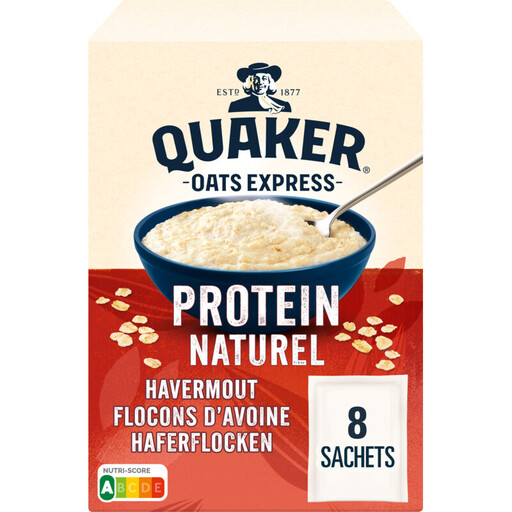 No image available
An express variety to consider if you want to compare protein content for your weekday breakfast. The pack contains 302 g; check the current label for portion sizes, ingredients, allergens and preparation instructions.
 No image available
An express oatmeal to consider when you want minimal preparation on weekdays. The pack contains 324 g; check the packaging for preparation instructions, the number of portions and any listed allergens.
Not automatically. According to the Netherlands Nutrition Centre, oat products are suitable for people with coeliac disease only when the pack carries the official Crossed Grain trademark. Check the product’s current label too.
On the label of the pre-packed product. The Netherlands Food and Consumer Product Safety Authority says allergen information must be shown there. If you’re looking at varieties with added ingredients, check the full ingredients list too.
You can’t tell from the product name alone. Quaker Netherlands lists soya protein as an ingredient in Oats Express Protein Naturel. So check the ingredients and allergen information for the exact variety you want to buy.