
Office worker with a microwave
Want to make warm oatmeal and choose your own milk, water or other ingredients? Fine flakes are an option if you have a bowl and the instructions are suitable for the microwave at work.


Choose fine oats in a larger pack if you can measure out a portion at work and have a suitable bowl and a way to prepare it. Sachets are a better choice if you want to take some with you without weighing it out, but check how many grams each sachet contains. If you need gluten-free oats, look for an explicit gluten-free label on the pack rather than relying on oats as an ingredient.
Want to make warm oatmeal and choose your own milk, water or other ingredients? Fine flakes are an option if you have a bowl and the instructions are suitable for the microwave at work.
A pre-measured sachet is handy for your bag or desk drawer. Check the weight of each sachet, though: the Jumbo portions listed by Jumbo contain 27 g each.
Don’t rely on the type of grain alone. Look for an explicit gluten-free label and check the ingredients and allergen information on the pack you choose each time you buy it.
Start with what’s available at work: having a bowl and a microwave gives you different options from simply having room in your bag. Then compare the portion size and the information on the pack.
| What to consider | What to check when buying | Who it matters to |
|---|---|---|
| Preparing it at work | Check the instructions for the quantity, liquid, microwave power and cooking time; make sure you can use a suitable bowl. | If I only have a short break, I want to know in advance whether I can make the oatmeal at my desk. For around 42% of consumers, quick, practical preparation is the top priority. |
| Taking it with you without measuring | Check the number of sachets and the weight of each one; a single-portion pack isn’t necessarily the same size as the serving instructions on another pack. | On days when I’m working in different offices, I’d rather take one pre-measured sachet than a larger pack. Around 33% of consumers say convenience when carrying and measuring out a portion comes first. |
| Stocking up for several days | Compare the net weight and think about where you’ll store the pack and how you’ll measure out a portion. | If I often eat oatmeal at my desk, I’d rather have one larger pack in stock and don’t mind measuring out a portion myself. For around 17% of consumers, stocking up is the first consideration. |
| Gluten-free label | Check for an explicit gluten-free label and read the ingredients and allergen information on the current pack. | If I need to eat gluten-free, the label determines which pack I can choose. For around 8% of consumers, this is the top priority. |
A compact pack could also be a sachet, box or cardboard sleeve. And small doesn’t mean you can turn it into lunch without liquid or crockery.
Check the type of packaging, net weight and preparation instructions before choosing something for your desk drawer.
Ingredients and allergen information vary by product. For example, Jumbo says its regular value pack contains gluten.
If you need a gluten-free option, choose a product with an explicit gluten-free label and check the pack again when you buy it.
The cooking time and power setting depend on the instructions for the specific product. For example, Albert Heijn recommends 3 minutes at 650 W for Quaker oatmeal, using 40 g of oats and 250 ml of milk or cold water.
Follow the instructions on your pack and use a suitable, roomy bowl.
Brinta offers oatmeal made with extra-fine flakes, as listed on Albert Heijn’s product page.
Quaker offers regular oatmeal and Oats Express single-portion packs; Albert Heijn lists a 12-portion pack of Oats Express Naturel.
Albert Heijn lists fine and coarse wholegrain oatmeal under its own brand, as well as a separate gluten-free variety.
Jumbo lists a 1 kg pack of fine wholegrain flakes and five individual 27 g portions under its own brand.
ALDI Netherlands lists Golden Bridge fine wholegrain oatmeal in a 500 g pack.
These Quaker varieties are worth considering if you’re looking for oatmeal for lunch at your desk. Check how to prepare the product you choose and whether the portion is right for your lunch.
 Image unavailable
If you want to take oatmeal with you without measuring it out, check how many portions this variety contains and how many grams are in each one. Also read the preparation instructions and allergen information on the pack.
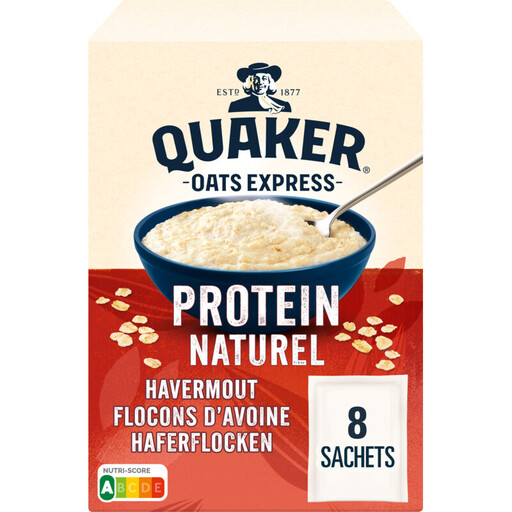 Image unavailable
If you only have access to hot water at your desk, check whether the preparation instructions for this variety are suitable. Also check the pack type, portion size and allergen information; the name Protein alone doesn’t tell you whether it’s suitable for lunch.
You can’t tell from the packaging alone. Jumbo lists its Havermout Porties Original sachets as 27 g each, while Albert Heijn gives a 40 g serving for regular Quaker oatmeal. Compare the weight with the amount you want to prepare and what you plan to add.
Yes, if the instructions for your chosen product say it can be microwaved. For regular Quaker oatmeal, Albert Heijn recommends 3 minutes at 650 W using 40 g of oats and 250 ml of milk or cold water. Follow the instructions on your pack and use a suitable bowl.
No, don’t assume it is. Jumbo lists gluten in its regular 1 kg pack of oatmeal, while Simply Free by Leev is specifically labelled as gluten-free oatmeal. If you need a gluten-free option, always check the current pack and allergen information.
The Netherlands Nutrition Centre advises against replacing bread entirely with oatmeal: iodine is added to bread, but not to oatmeal. Having oatmeal for lunch and deciding to cut bread out completely are therefore two different things.