
Desk lunchers looking to avoid added sugar
You want to flavour your own oatmeal, without sugar already being added as an ingredient. Read the ingredients list and compare ‘of which sugars’ per 100 g of dry product.


Choose wholegrain rolled oats with a single ingredient, or a plain variety with no added sugar, if you want to put together a quick desk lunch with less added sugar. Compare the ingredients and ‘of which sugars’ per 100 g of dry product: sachets save you measuring, while loose oats let you choose your own portion. If you have coeliac disease, the Voedingscentrum says the packaging must carry the official Crossed Grain symbol.
You want to flavour your own oatmeal, without sugar already being added as an ingredient. Read the ingredients list and compare ‘of which sugars’ per 100 g of dry product.
You want to make a portion during a short break. A plain portion can save you measuring, provided you have access to the microwave, pan or hot water you need.
Regular oatmeal is not automatically suitable. The Voedingscentrum says that products for people with coeliac disease must carry the official Crossed Grain symbol on the packaging.
Start with the ingredients and sugars per 100 g of dry product. Then check whether the preparation method fits your lunch break and, if you have coeliac disease, look for the symbol on the packaging.
| What to consider | What to check when buying | Who it matters to |
|---|---|---|
| Added sugar | Read the ingredients list and compare ‘of which sugars’ per 100 g of dry product. No added sugar does not automatically mean 0 g of sugars. | If I want to choose the flavour myself, I need to know what is already in the oatmeal. Around 36% of consumers say avoiding added sugar is their top priority. |
| Preparation time | Check the preparation instructions and whether you can use the microwave, pan or hot water required. | I don’t want to spend ages measuring and preparing food during a short work break. For around 29% of consumers, quick preparation comes first. |
| Portions and storage | Choose between oats you measure yourself and pre-portioned sachets. Store opened oatmeal in a cool, dry, dark place in a tightly sealed container, as advised by the Voedingscentrum. | If I take oatmeal to work for several days, I want to be able to portion it out and store the rest properly. This is the main consideration for around 21% of consumers. |
| Gluten-free oats | If you have coeliac disease, look for the official Crossed Grain symbol on the current packaging and read the allergen information. | If I’m choosing oats because I have coeliac disease, I need to look beyond the word ‘oats’. Around 14% of consumers put this packaging check first. |
Quick preparation tells you nothing about added sugar. Jumbo describes Quaker Oats Express Cinnamon as containing sugar as an ingredient, with 19 g of sugars per 100 g.
For cinnamon, fruit and other flavoured varieties, read the ingredients and compare the sugars per 100 g with those in a plain variety.
The Voedingscentrum says that oat products are suitable for people with coeliac disease only if the packaging carries the official Crossed Grain symbol.
Check the symbol on the pack you’re buying; ‘wholegrain’ or ‘oats’ on its own is not enough.
The nutritional values for a prepared portion may include milk or other added ingredients. They therefore cannot be compared directly with the values per 100 g of dry oatmeal.
First compare the nutritional information for the dry product, then look separately at what you add to your lunch.
Brinta Oatmeal, as described by Albert Heijn, is made from 100% extra-fine rolled oats and can be used as a base for porridge.
Quaker offers both plain portions and flavoured varieties; ingredients differ between varieties.
AH Wholegrain fine oatmeal is an own-brand staple you can use to put together your own lunch.
Jumbo sells fine wholegrain rolled oats, as well as a separate gluten-free oat option.
ALDI describes Golden Bridge fine wholegrain oatmeal as coming in a 500 g pack.
These two products are worth considering for a desk lunch when you’re short on preparation time: a pack of Quaker oatmeal and a Family Whole oatmeal mix with separate glucose sachets. Check the ingredients and nutritional information for the variety on offer before choosing based on its sugar content.
 Image unavailable
An option to consider if you want to prepare oatmeal during a short lunch break. Before comparing it with other oatmeal, check the preparation instructions, ingredients and the basis used for the sugar figures in the nutritional information.
If you have coeliac disease, check that the packaging carries the official Crossed Grain symbol and read the allergen information.
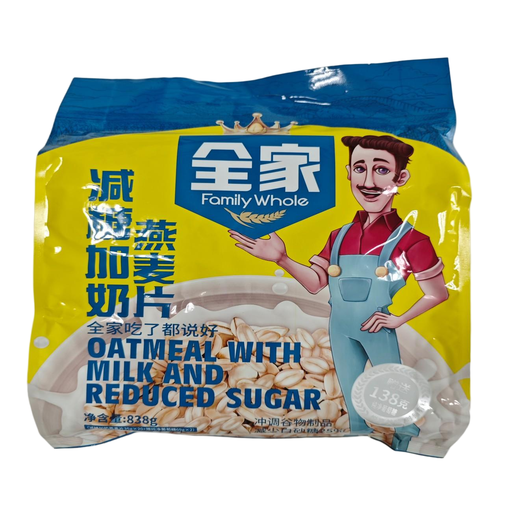 Image unavailable
An oatmeal mix to consider if you have access to hot water at lunchtime. Don’t judge the ‘reduced sugar’ claim on its own; also check the ingredients and sugars per 100 g of the mix.
The glucose sachets included separately will change the composition of your lunch if you use them. Also read the allergen information on the current packaging.
No. A product with no added sugar may still contain naturally occurring sugars. So check both the ingredients list and ‘of which sugars’ per 100 g, making sure you compare the same nutritional basis.
A plain portion can save you measuring if you have the equipment needed to prepare it. Albert Heijn lists a preparation time of two minutes for Quaker Oats Express Plain. With loose oats, you’ll need to measure the portion yourself and follow the preparation instructions for the product you choose.
Not necessarily. The Voedingscentrum says that oat products for people with coeliac disease must carry the official Crossed Grain symbol. Check this on the packaging of the product you’re actually buying.
Store oatmeal in a cool, dry, dark place in a tightly sealed container, as advised by the Voedingscentrum. Also follow the storage instructions on the packaging.