What should you consider when choosing?
Start with the allergen requirements that apply to you. Then compare the energy per equal quantity of edible product and consider whether the portion and ingredients work with the rest of the lunch.
| What to consider |
What to look for |
Who is this important for? |
| Energy per portion |
Compare kcal per 100 g, then weigh out the same quantity of edible product. The Netherlands Nutrition Centre’s 25 g portion is an example for calculation, not personalised advice on what to pack for lunch. |
If I want to know how much energy I’m taking to school in my lunch, I compare weighed portions rather than random handfuls. Around 36% of consumers prioritise the energy content of the portion they take with them. |
| What’s in the lunch |
Check the unsalted variety and the ingredients, and consider the nuts alongside the rest of the meal. The Netherlands Nutrition Centre includes unsalted nuts in its Wheel of Five. |
If I want to put together a filling lunch, I look at the whole meal rather than just the lowest calorie figure. Around 29% of consumers give providing enough food for the school day their highest priority. |
| Allergens and school rules |
Read the ingredients and any cross-contamination warnings on the current packaging. Also check the requirements at your school. |
If an allergy or school rule determines what I can take with me, I check the specific ingredients and warnings before making a choice. Around 21% of consumers prioritise allergens or school requirements. |
| Portioning and storage |
Check the net weight, edible weight and storage instructions. For nuts in their shells, don’t compare the gross packet weight with shelled portions. |
If I want to prepare something for several school days, I consider how easy it is to portion, pack and store. Around 14% of consumers say that ease of packing every day is their main purchasing priority. |
Nuts and peanuts at Joybuy
Joybuy options for a weighed portion of nuts or peanuts to enjoy with lunch; check the ingredients and nutritional information for each variety.
 No image available
g’woon Unsalted Peanuts, 250 g
Suitable if you want to take peanuts as a lunch snack and weigh out your own portion.
The product information lists 99% peanuts and sunflower oil. The packaging may contain cashews.
View at Joybuy
 No image available
Jiazhouyuanye Original Flavour Large Cashew Nuts, 160 g
Suitable if you want to portion out cashews and check the ingredients for each variety.
The product information lists 100% cashew kernels and 604 kcal per 100 g. Contains cashews, a tree nut.
View at Joybuy
 No image available
g’woon Cashew Nuts Roasted & Unsalted, 200 g
Suitable if you’re looking for roasted, unsalted cashews and comparing portions by weight.
The product information lists 596 kcal per 100 g. Contains cashews.
View at Joybuy
 No image available
Verse Extra Large Roasted Peanuts, 210 g
Suitable if you want to take peanuts as a snack and weigh out your own portion.
The product information lists 100% peanuts and 626 kcal per 100 g. Contains peanuts.
View at Joybuy
 No image available
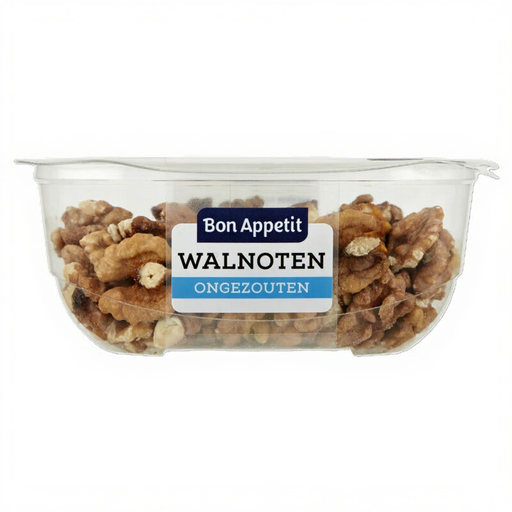
Bon Appétit Walnuts Unsalted, 110 g
Suitable if you want to take walnuts in their shells and can assess the edible weight separately.
The product information lists 674 kcal per 100 g. The walnuts need to be shelled first, so the packet weight isn’t the same as the edible weight. Contains walnuts.
View at Joybuy
Frequently asked questions
Are plain nuts a low-calorie food?
Not according to the nutritional information reviewed. For a ‘low energy’ claim on solid foods, the European Commission sets a limit of no more than 40 kcal (170 kJ) per 100 g; the nut products reviewed are above this limit. A smaller portion doesn’t make the product itself low in calories.
Is 25 grams a set amount for every pupil’s lunch?
No. The Netherlands Nutrition Centre uses 25 g as a portion in its calorie checker, not as a set amount for every pupil. Overall needs vary, including with growth and activity, so consider the whole lunch.
Can I have peanuts as a substitute if I’m allergic to nuts?
Not automatically. Peanuts and nuts are separate allergens, and the Duyvis peanuts reviewed may contain traces of nuts. Follow your personal allergy advice and check the current packaging.
What allergen information should I check on a pack?
Check the ingredients and allergen warnings on the label. The Netherlands Food and Consumer Product Safety Authority states that allergen information for prepacked products must appear on the label; peanuts and nuts are assessed separately.
How can I fairly compare pistachios in their shells with other nuts?
Compare the same quantity of edible product. For pistachios in their shells, the gross packet weight isn’t the same as the weight of the shelled nuts; Albert Heijn lists shelled portions of around 25 g for the pistachios reviewed.


