If you want to eat less fat during a night in front of the TV, compare products’ nutritional values on the same weight basis and check exactly what a fat-related claim refers to. ‘No added fat or oil’ does not, on its own, prove that a product has a lower total fat content. Energy per portion and salt are separate factors to consider.
Who is this guide for?
TV snackers watching their fat intake
You want to choose nuts based on a verifiable fat-related property, rather than relying on words such as ‘light’ or ‘oven-roasted’. The Netherlands Food and Consumer Product Safety Authority explains that nutrition claims must comply with European rules.
Portion-conscious nut eaters
You want to decide in advance how much you’ll eat during your TV evening, so you pay attention to nutritional values for a measured amount and packaging that suits the way you’ll use it.
Snackers looking for unsalted nuts
You’re mainly looking for nuts with no added salt and want to be able to switch between different varieties. Unsalted, on its own, says nothing about fat content.
What should you look for when choosing?
First decide whether fat content, portion size, salt or the type of snack matters most to you. Then check the relevant information on the packaging.
| What to consider |
What should you check? |
Who is this most important to? |
| Fat content and claims |
Read the exact claim, the total fat per 100 g and the basis for any relative claim. Distinguish between total fat and added fat. |
If I want to eat less fat, I want to know what the claim and nutrition table actually say. Around 36% of consumers put reducing fat first when choosing. |
| Energy per portion |
Compare the energy per 100 g and per the amount you weigh out for yourself. The weight on the pack is not automatically a portion. |
I want to decide in advance how much to have during the film and be able to assess the nutritional value of that amount. Around 29% of consumers prioritise energy per portion of their own choosing. |
| Salt and type of nuts |
Check the ‘unsalted’ description, salt content and ingredients in a mix. Unsalted does not mean low in fat. |
If I’m mainly looking for an unsalted snack, I want to assess that separately from fat and energy. Around 21% of consumers choose unsalted as their top priority. |
| Flavour and texture |
Check whether they’re plain nuts, roasted nuts or coated party snacks. Also check the ingredients and allergen information on the packaging. |
I like to choose based on the type of snack and its texture, but I also want to check the nutritional values. Around 14% of consumers prioritise a roasted flavour or snack texture. |
Common mistakes
-
Assuming a preparation description means less fat
‘No added fat or oil’ describes what was added during preparation. It doesn’t tell you how much total fat the product contains or whether it has relatively less fat than a comparable product.
Read the exact claim and nutrition table. Compare products on the same weight basis, and don’t use the preparation description as a substitute for that comparison.
-
Confusing unsalted with a low-energy snack
Unsalted refers to salt, not fat or energy. The Netherlands Nutrition Centre gives general values of 164 kcal and 14.9 g of fat for 25 g of unsalted nuts. These are not specifications for a particular product or pack.
Choose unsalted nuts if that’s your goal, and assess the amount you eat separately.
-
Assuming the pack size is your portion
A 200 g or 500 g bag shows the weight of the pack, not how much you’ll eat during one TV evening.
Pour out the amount you want to eat beforehand, then follow the storage advice on the pack for the rest.
With a larger pack, you’ll also need to store the remainder according to the product’s instructions after serving yourself.
Brands to consider
Duyvis
The range described includes coated party snacks and roasted nuts. Duyvis describes its coated peanuts as peanuts with a crunchy coating.
- The different product types let you choose between plain nuts and coated party snacks.
- Roasted or coated does not prove that a product has less fat. A description of flavour or texture is not an independent comparison.
Albert Heijn
The nut range described includes unsalted cashews and shelled unsalted pistachios.
- The products mentioned suit shoppers choosing by type of nut and looking for an unsalted option.
- ‘Unsalted’ doesn’t tell you how much total fat or energy a specific product contains.
Jumbo
The range described includes an unsalted nut mix and various coated party snacks.
- There are different product types to choose from, depending on the kind of snack you’re looking for.
- A nut mix and coated party snacks can’t be treated as equivalent or labelled low-fat without comparing their nutritional values.
Lidl
The 200 g nut mix described contains unroasted, unsalted nuts and is sold under the Alesto name.
- The product description suits shoppers looking for an unsalted option.
- Unroasted and unsalted does not prove that a product has less fat.
ALDI
Trader Joe’s 200 g nut mix is described as an unroasted mix of hazelnuts, cashews, walnuts and almonds, in a resealable pack.
- A resealable pack can be handy if you’re not using everything at once.
- The packaging doesn’t prove that you’ll eat less or that the product contains less fat.
PLUS
The PLUS nut mix described is unroasted and unsalted, and comes in a 500 g stand-up pouch.
- The pack size may be useful if you want to use or share a larger amount.
- The contents of the pack are not a portion recommendation, and unroasted or unsalted does not prove that a product has less fat.
Nuts and snacks at Joybuy
These products suit shoppers looking for roasted, unsalted or ready-to-eat snacks. Those features don’t automatically make a product a reduced-fat option.
 Image unavailable
Duyvis Dry Roasted Cashews - 125 g
Suits anyone looking for roasted cashews with no added fat or oil; that description doesn’t prove the product has less fat.
Per 100 g: 43 g of fat and 0.92 g of salt. The product information describes the pack as containing 4–5 portions.
The product information lists cashews, gluten, wheat and peanuts.
Joybuy
 Image unavailable
g’woon Unsalted Peanuts - 250g
Suits anyone looking for peanuts as an unsalted snack; that, on its own, says nothing about fat reduction.
Per 100 g: 50 g of fat and 0.02 g of salt.
The product information lists peanuts and states that the product may contain cashews.
Joybuy
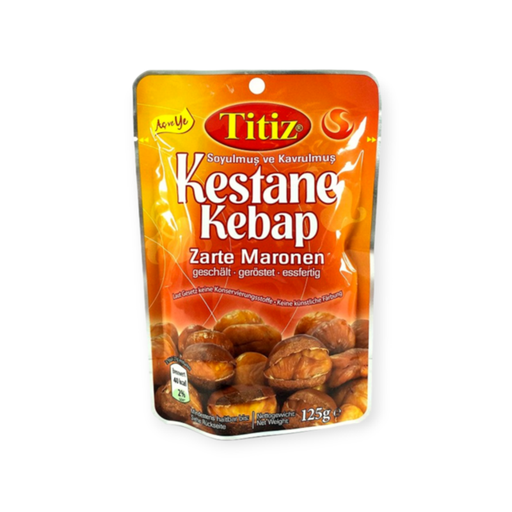 Image unavailable
Titiz Roasted Chestnuts 125g
Suits anyone looking for a ready-to-eat snack of peeled, baked chestnuts. Chestnuts are not a nut mix.
The pack contains 125 g.
Joybuy
 Image unavailable
Anatolia Badem Natural (Amandel) 500 gr
Suits anyone looking for almonds with no added salt as a ready-to-eat snack.
Per 100 g: 50 g of fat and 0 g of salt.
The product information lists almonds.
Joybuy
 Image unavailable
g’woon Cashew Nuts Roasted & Unsalted - 200g
Suits anyone looking for roasted cashews with no added salt; these features don’t prove the product has less fat.
Per 100 g: 46.67 g of fat and 0.067 g of salt.
The product information lists cashews.
Joybuy
Frequently asked questions
Does ‘no added fat’ mean the same as reduced fat?
No. The product description for Duyvis Dry Roasted Cashews says that no fat or oil has been added. On its own, that feature doesn’t tell you the total fat content or substantiate a relative reduction in fat.
Can I use 25 g of unsalted nuts as a general comparison?
Yes, as a general point of reference: the Netherlands Nutrition Centre gives values of 164 kcal and 14.9 g of fat for 25 g of unsalted nuts. For a specific product, use the nutrition table on the pack; these general values are not product specifications.
What should I check if someone sharing the snack has an allergy?
Check the allergen information on the specific pack. The Netherlands Food and Consumer Product Safety Authority lists peanuts and nuts separately among the allergens that must be declared, and requires allergen information on prepacked products.
How should I store opened nuts?
Follow the storage advice for the specific product. For unsalted cashews, the Netherlands Nutrition Centre lists rancidity, a tough texture or mould as signs of spoilage. Check the product information for other types of nuts and seasoned mixes.


