
Taking in less fat
You want to include less fat in lunch and understand the difference between a product’s fat content, how it’s prepared and portion size. Compare the fat per 100 g: ‘no added fat’ doesn’t automatically mean ‘low fat’.


If you’re looking for a nut product that is low in fat, check the fat content per 100 g for the exact variety. For solid foods, the European Commission sets a limit of no more than 3 g of fat per 100 g for the ‘low fat’ claim. A smaller portion or roasting without added fat doesn’t prove that a product is low in fat. Choose plain, unsalted nuts only if they suit your portion needs, any allergies and your school’s rules.
You want to include less fat in lunch and understand the difference between a product’s fat content, how it’s prepared and portion size. Compare the fat per 100 g: ‘no added fat’ doesn’t automatically mean ‘low fat’.
You’re looking for unsalted nuts to have with lunch, without assuming that this makes them low in fat. Also check that the nuts are suitable for any allergies and your school’s rules.
You want to be able to portion out the nuts and store them properly. Check the pack size and storage instructions, and seal the pack carefully after portioning.
First compare the fat content per 100 g, then decide how much to take with you. Next, check the ingredients and allergen information, as well as any rules set by the school.
| What to consider | What should you check? | Who should pay particular attention? |
|---|---|---|
| Fat content and portion | Compare the total fat per 100 g for the exact variety. Then use the portion weight to work out how much fat you’re taking with you. | If you want to take in less fat, it’s important to distinguish the product’s fat content from the portion size. Around 36% of shoppers prioritise a demonstrable reduction in fat. |
| Unsalted options | Check that the exact variety is unsalted and read the ingredients. Unsalted doesn’t automatically mean low in fat. | If you’re mainly looking for unsalted nuts to have with lunch, don’t confuse that quality with a lower fat content. Around 28% of shoppers prioritise an everyday food choice. |
| Allergens and school rules | Read the ingredients and allergen information on the pack, and check what the rules are at your school or in the relevant area. | If you need to take a known allergy or a nut-free school rule into account, the product must be suitable for the situation. Around 22% of shoppers prioritise allergens and school rules. |
| Portioning and storage | Check the net weight and storage instructions. Store nuts in a dry, airtight container; the Netherlands Nutrition Centre says this is important because nuts are susceptible to mould. | If you’re taking nuts with you for several school days, you’ll want to be able to portion and store them easily. Around 14% of shoppers prioritise everyday convenience. |
A description of how a product is prepared doesn’t tell you how much fat the finished product contains per 100 g. For solid foods, the European Commission sets a limit of no more than 3 g of fat per 100 g for the ‘low fat’ claim.
Read the nutrition table for the exact variety and check the total fat per 100 g, separately from any claim about how it’s prepared.
A smaller portion may contain less fat than a larger one, even when both have the same composition per 100 g.
First compare products on the same weight basis. Then use the nutrition table and the weight of your own portion.
Peanuts and tree nuts are separate allergens. A peanut is a legume, but that doesn’t automatically make it suitable for someone with an allergy or where a school has a nut-free rule.
Before choosing an alternative, check the allergen information and exactly what the school’s rules require.
Nuts need to be stored in a dry, airtight container. The Netherlands Nutrition Centre notes that nuts are susceptible to mould.
Choose an amount you can store properly, and seal the pack carefully after portioning.
The product options mentioned include unsalted peanuts and Oven Baked Peanuts Original.
The relevant product variety is AH Unsalted Cashew Nuts.
The variety mentioned is Jumbo Unsalted Cashew Nuts, in a 200 g pack.
Alesto is the nut range mentioned; Lidl also offers Way To Go cashew nuts.
The TRADER JOE’S Unsalted Nut Mix mentioned contains almonds, hazelnuts, walnuts and Brazil nuts, and comes in a 500 g pack.
The own-brand variety mentioned is PLUS Unsalted, Unroasted Cashew Nuts, in a 200 g bag.
This selection features peeled chestnuts with a stated nutrition value that falls within the limit for the ‘low fat’ claim. Also check the portion size, allergen information and any school rules.
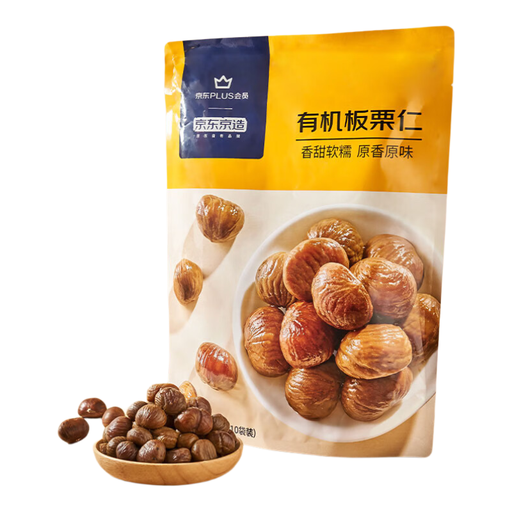 Image unavailable
A good fit if you’re looking for chestnuts with a stated fat content per 100 g that falls within the limit for the ‘low fat’ claim.
The nutrition table provided states 1.7 g of fat per 100 g. The product description lists 100% chestnut kernels, ten 100 g bags and peeled, ready-to-eat chestnuts.
Don’t take this product with you if your school’s specific rules exclude nuts; also check the allergen information on the pack.
According to the European Commission, the ‘low fat’ claim can be used for solid foods if the product contains no more than 3 g of fat per 100 g. A smaller portion doesn’t replace this product requirement.
No. ‘No added fat’ describes how a product is prepared, not the total fat content of the finished product. Check the nutrition table for the exact variety to find out how much fat it contains.
Multiply the fat per 100 g shown on the pack by the portion weight in grams, then divide the result by 100. The Netherlands Nutrition Centre gives 14.9 g of fat per 25 g of unsalted nuts as a general example; this isn’t the nutrition value for every brand or variety.
Don’t assume that you can. Peanuts are legumes and tree nuts are a different category, but both can be relevant when it comes to allergies. Check the exact school rules and the allergen information before choosing an alternative.
Store nuts in a dry, airtight container. The Netherlands Nutrition Centre recommends keeping them somewhere cool if possible; also follow the storage instructions on the pack you’ve chosen.