If you want to keep your calorie intake from nuts down while camping, weigh your portion and work out the energy content using the kcal per 100 g on the pack; regular nuts aren’t automatically low in calories. The Netherlands Nutrition Centre gives 164 kcal per 25 g portion of unsalted nuts. Choose unsalted varieties if that suits your preferences, but assess energy, preparation method and salt separately, and follow the storage instructions on the specific pack.
Who is this buying guide for?
Campers keeping an eye on their snack portions
You want to take nuts with you without accidentally eating a large amount. Weighing a portion and checking the nutritional information for the specific variety will help you work out the energy content of each snack.
Snackers looking for unsalted options
You’re looking for unsalted nuts and want to assess salt, ingredients and calories separately. The Netherlands Nutrition Centre includes unsalted nuts in its Wheel of Five healthy eating guidelines.
Campers who want to store their supplies properly
You choose an amount that suits your trip and want to store opened nuts according to the instructions, for example in a cool, dark, dry place and sealed tightly if the pack says to do so.
What should you look for when choosing?
| What to consider |
What should you look for? |
Who is this important for? |
| Energy per portion |
Compare kcal per 100 g and weigh your portion. Work out the energy content by multiplying the kcal per 100 g by the portion weight and dividing by 100. |
If I want to limit the energy in my snacks, I want to be able to weigh my portion and calculate the energy myself; around 42% of consumers say calories per portion eaten are their top purchasing priority. |
| Unsalted ingredients |
Check the salt and ingredients on the specific pack. Assess calories separately from claims such as unsalted or made without added oil. |
If I’m looking for unsalted nuts, I want to assess salt and ingredients separately from energy; around 25% of consumers give the unsalted composition the greatest importance. |
| Storage after opening |
Read the storage instructions and check whether you can store and seal the pack at the campsite as directed. |
When I take an opened pack with me, I want to know how to store it properly; around 17% of consumers say storage after opening is the deciding factor. |
| Size of pack |
Compare the net weight with the amount you plan to use and can store during your trip. A bag size isn’t automatically a snack portion. |
If I’m planning my camping supplies, I want to choose an amount that suits my trip and portions; around 16% of consumers say having the right amount of supplies is most important. |
Common pitfalls
-
Assuming unsalted or made without added oil means low in calories
These terms describe the ingredients or preparation method; they don’t automatically tell you the energy content per 100 g. According to the European Commission, a claim of low energy for solid foods is only permitted at a maximum of 40 kcal (170 kJ) per 100 g.
Check the nutrition table for the specific variety and calculate the energy in your own weighed portion. Treat salt and preparation method as separate criteria.
-
Counting the whole pack as one snack portion
The packs from Jumbo, ALDI and PLUS that were reviewed contain 130, 250 and 500 g respectively. These are pack sizes, not portion recommendations. The Netherlands Nutrition Centre gives 25 g as an example portion of unsalted nuts.
Weigh out the amount you want to take as a snack and store the rest separately.
-
Assuming general storage instructions apply to a warm tent
The AH cashew nuts reviewed should be stored in a cool, dark and dry place. General instructions for storing food in a kitchen cupboard don’t automatically apply to every campsite. The Netherlands Nutrition Centre lists rancidity, a chewy texture and mould as signs of spoilage.
Follow the instructions on the pack, seal opened nuts tightly and choose an amount you can store appropriately during your trip.
If nuts turn rancid, chewy or mouldy, some of your supplies may become unusable.
Brands to compare
These examples will help you compare product varieties, pack sizes and storage instructions. The information applies to the products mentioned and isn’t a general assessment of an entire brand.
Duyvis
Worth considering if you want to compare unsalted peanuts with Duyvis Cashews Original.
- Flink Nederland lists Duyvis Pinda’s Ongezouten 235 g at 614 kcal per 100 g.
- The ingredients information for those peanuts lists sunflower oil. Duyvis describes Cashews Original as oven-roasted without added oil; this description of how they’re prepared doesn’t prove they have fewer calories.
Albert Heijn
AH Unsalted Cashew Nuts are an example to consider if you’re looking for unsalted cashews with clear storage instructions.
- For this variety, Albert Heijn advises storing the nuts in a cool, dark and dry place and closing the pack securely after use.
- Unsalted doesn’t in itself tell you how many calories a product contains; compare the nutrition information on the specific pack.
Jumbo
Jumbo Unsalted Cashew Nuts 130 g are a specific example of a smaller pack size.
- Jumbo lists a net weight of 130 g and advises storing the nuts in a cool, dry and dark place.
- The bag isn’t automatically one snack portion, and its smaller size doesn’t mean it has less energy per 100 g.
PLUS
The unroasted, unsalted PLUS Nut Mix in a stand-up pouch of 500 g is an example of a larger mixed-nut pack.
- PLUS confirms the product type and 500 g pack size.
- Unroasted and unsalted don’t determine the calorie content. Check the ingredients and nutrition information for the specific variety, and weigh your portion.
Lidl
Unsalted Californian pistachios are worth comparing if you’re specifically looking for pistachios.
- Lidl Netherlands’ product range information confirms the product type.
- The product name alone doesn’t confirm a calorie benefit or suitability for people with allergies. Check the nutrition and allergen information on the specific pack.
ALDI
ALDI lists TRADER JOE’S as the product brand for roasted, unsalted cashews in a 250 g pack.
- ALDI Nederland confirms the preparation method, unsalted variety and net weight of 250 g.
- Roasted and unsalted doesn’t mean fewer calories; compare the nutrition information on the specific pack.
Nuts for your camping supplies
These Joybuy products are nuts and mixed nuts that you can compare by energy per 100 g, portion size and storage instructions.
 Image unavailable
g'woon raw, unsalted almonds 200 g
Suitable if you want to take almonds with you and calculate the energy in a weighed portion.
Product information lists 591 kcal per 100 g. Contains almonds; bear allergies in mind. Store in a cool, dry place and close the pack after opening.
View at Joybuy
 Image unavailable
Anatolia Badem Natural (almond) 500 g
An option to compare if you’re looking for a larger supply of almonds and prefer to weigh your own portions.
Product information lists 100% almonds and 578 kcal per 100 g. Contains almonds; bear allergies in mind. Store in a cool, dry place and close the pack after opening.
View at Joybuy
 Image unavailable
g'woon roasted, unsalted cashew nuts 200 g
Suitable if you’re looking for roasted, unsalted cashews as a camping snack and want to weigh out your portion.
Product information lists 596 kcal per 100 g. Contains cashews; bear allergies in mind. Store in a cool, dry place and seal tightly after opening.
View at Joybuy
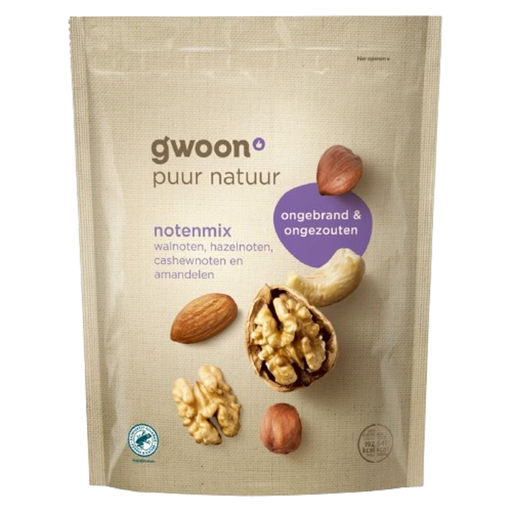 Image unavailable
g'woon raw, unsalted mixed nuts 200 g
A mixed-nut option to take with you if the ingredients and a weighed portion suit your needs.
Nutrition information lists 2650 kJ per 100 g. Product information lists nuts and possible traces of peanuts. Store in a cool, dry place and close the pack after opening.
View at Joybuy
 Image unavailable
g'woon unsalted mixed nuts 200 g
Suitable if you want to compare unsalted mixed nuts and calculate the energy in a portion of your choice.
Product information lists 615 kcal per 100 g. Contains peanuts and tree nuts; bear allergies in mind. Store in a cool, dry place and seal tightly after opening.
View at Joybuy
Frequently asked questions
Can you call regular nuts low in calories?
Not based on the general nutrition information for unsalted nuts from the Netherlands Nutrition Centre. It gives 164 kcal per 25 g, which works out to 656 kcal per 100 g. According to the European Commission, a ‘low energy’ claim for solid foods is only permitted at a maximum of 40 kcal (170 kJ) per 100 g. You can, however, work out the energy in a smaller, weighed portion.
Are unsalted peanuts also free from added oil?
Not necessarily: Flink Nederland lists sunflower oil in Duyvis Pinda’s Ongezouten 235 g. Check the ingredients list for the specific variety; ‘unsalted’ doesn’t tell you whether oil has been added.
How should you store an opened bag of nuts while camping?
Follow the instructions on the specific pack. For the AH cashew nuts reviewed, Albert Heijn advises storing them in a cool, dark and dry place and sealing the pack tightly after use. For the Duyvis peanuts reviewed, Flink advises storing them in a light- and airtight container after opening. General storage instructions for home don’t automatically guarantee suitable conditions in a warm tent.
What allergen information should you check on packaged nuts?
Check the allergen information on the specific pack. The NVWA says allergen information must appear on the label of pre-packed products and lists peanuts and nuts separately. Unsalted doesn’t mean a product is allergen-free.
Are whole nuts suitable as a snack for young children?
Not necessarily. Product information from Jumbo and Flink warns that young children can choke on nuts or peanuts. So don’t assume a bag of whole nuts is automatically suitable as a snack for children.


