What should you look for in nuts to take on the go?
First decide which reason for buying matters most to you, then compare the portion, ingredients and packaging of the exact product variant.
The table groups consumers taking nuts on a Dutch NS train journey according to their main purchasing priority.
| What to consider |
What to check when buying |
Who this is for |
| Protein per portion |
Convert the label’s value per 100 g to the amount you’ll take with you. Compare the energy content for the same portion size, too. |
If I take a snack with me around a workout, I want to know how much protein my measured portion provides. Around 33% of consumers give protein content the highest priority. |
| Portioning and storage |
Check the pack size, any portion guidance and the instructions for storing the product after opening. |
For a single train journey, I want to take a portion with me and be able to seal the rest properly. Around 27% of consumers prioritise practical portioning and storage. |
| Allergens |
Check the ingredients and any cross-contamination warnings on the exact packaging. |
If I have a relevant food allergy, I need to be able to assess whether a specific product variant is suitable, rather than relying on the name of the nut alone. Around 20% of consumers say allergen suitability is their top priority. |
| Ingredients and nutrition |
Check the salt, ingredients and energy content alongside the protein; assess a nut mix based on its own ingredients. |
If I’m watching my salt intake or the ingredients, I want to consider the full ingredients list rather than just the protein figure. Around 20% of consumers prioritise nutritional composition. |
Nut options at Joybuy
These products are nut options for a measured snack on the go. When choosing, check the portion, how the product is prepared and the allergen information for the exact product variant.
 Image unavailable
g’woon unsalted peanuts 250 g
An option if you want to take peanuts with you and measure out your own portion.
The product description lists 27 g of protein per 100 g and 0,02 g of salt per 100 g. The ingredients are listed as 99% peanuts and sunflower oil; the product contains peanuts and may contain cashews.
View at Joybuy
 Image unavailable
Verse Extra Large roasted peanuts 210 g
A good fit if you’re looking for a roasted peanut snack to take on the go.
The product description lists 26 g of protein and 0,02 g of salt per 100 g, and says the ingredients are 100% peanuts. It states that no salt has been added; the product contains peanuts.
View at Joybuy
 Image unavailable
g’woon peanuts in the shell 500 g
An option if you want to take peanuts in the shell and don’t mind shelling them as you eat.
The product description lists 29 g of protein and 0 g of salt per 100 g, and names peanuts as an ingredient. Shelling them and taking the shells with you or disposing of them involves a little extra effort while travelling; the product contains peanuts.
View at Joybuy
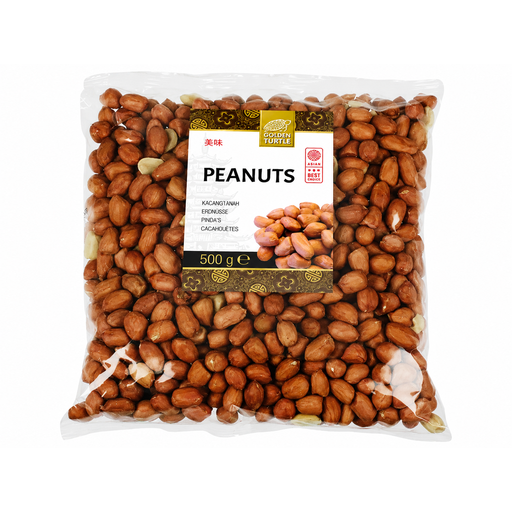 Image unavailable
Golden Turtle Premium raw peanuts with skins 500 g
A good fit if you want to prepare peanuts with their skins before taking them as a snack.
The product description lists 26 g of protein per 100 g and recommends roasting them for a crunchy snack. This product is unroasted and contains peanuts.
View at Joybuy
 Image unavailable
Jiazhouyuanye Original Flavour Large cashews 160 g
An option if you want to take a ready-to-eat cashew product with you and measure out your own portion.
The product description lists 19,8 g of protein and 0,028 g of salt per 100 g, and says it contains 100% cashew kernels. The pack contains 160 g; the product contains cashews, a tree nut.
View at Joybuy
Frequently asked questions
Are nuts essential for recovery after exercise?
No, nuts aren’t an essential food category for recovery. The Netherlands Nutrition Centre emphasises that most people who exercise don’t need special protein products, and that getting enough protein is part of a varied diet.
How should you store opened nuts during and after a train journey?
Follow the instructions for the exact product variant. For the Duyvis peanuts checked, the advice is to store them in a light-proof, airtight container after opening. The Netherlands Nutrition Centre recommends storing nuts in a cool, dark, dry place and using a container with a secure lid.
What should you look for in nut allergen information?
Check the ingredients and any cross-contamination warnings on the packaging of the product variant you want to eat. The NVWA says allergen information must appear on the label of prepacked foods; peanuts and tree nuts are separate allergens.
Can a product with a high protein content automatically be called ‘high in protein’?
No, a protein value per 100 g doesn’t in itself prove that a product can carry the ‘high in protein’ claim. The European Commission says nutrition claims are only permitted if they’re included in the annex to Regulation (EC) No 1924/2006; check the claim against the conditions that apply to the exact product.
Does this comparison confirm that whole nuts are suitable for young children?
No, this comparison doesn’t confirm that whole nuts are suitable for young children. The product pages checked warn of a choking hazard; follow the instructions on the exact packaging.


