
Portion-conscious hosts
You want to include nuts on your snack spread, but would like to know how much energy your portion provides. Compare the nutritional values for the same quantity and weigh what you serve.


If you want to consume fewer calories from nuts, weigh your portion and compare products using the same quantity. Unsalted or unroasted doesn’t automatically mean low in calories. According to their product information, the checked unsalted products from PLUS, Duyvis, Albert Heijn and Jumbo provide 598–622 kcal per 100 g, or 149.5–155.5 kcal per 25 g. For a ‘low energy’ claim, the European Commission sets a limit of no more than 40 kcal per 100 g for solid foods, so the nuts mentioned here don’t qualify.
You want to include nuts on your snack spread, but would like to know how much energy your portion provides. Compare the nutritional values for the same quantity and weigh what you serve.
You’re looking for unsalted nuts and want to know whether cooking oil or other ingredients have been added. Unsalted or unroasted doesn’t, by itself, tell you how much energy the product provides.
You’re choosing snacks for a group and want to think about variety, flavour and allergens. A nut mix and coated party nuts need to be checked separately for their ingredients.
First decide how much you want to serve, then compare nutritional values for the same quantity. Next, choose based on product type, ingredients and the packaging that suits how you’ll use it.
| What to consider | What should you look for? | Who is this most important for? |
|---|---|---|
| Calories per portion | Compare kcal per 100 g and weigh your portion; calculate the value for the number of grams you’re serving. | If I want to include nuts on my snack spread, I weigh my portion and check the energy per 100 g. Around 42% of consumers prioritise energy per portion. |
| Ingredients and salt | Read the full ingredients list and check the nutritional information for energy and salt separately. | When I’m choosing mainly based on ingredients, I check whether oil or anything else has been added, and look at the salt content too. Around 25% of consumers prioritise simple ingredients. |
| Flavour and variety | First choose between a single type of nut, a mix or a coated product; then check the ingredients and allergens. | For a varied snack spread, I first choose the type of nuts and flavour profile I want. Around 17% of consumers start with flavour and variety. |
| Packaging and storage | Choose a net weight that suits how you’ll use the product, and follow the storage instructions after opening. | If I buy a bag for several get-togethers, I check whether the size suits how quickly I’ll use it and how I’ll store the rest. Around 16% of consumers prioritise pack size and storage. |
These words describe how a product is prepared or tastes, not its energy content. For solid foods, the European Commission sets a maximum of 40 kcal per 100 g for a ‘low energy’ claim.
Check the energy per 100 g on the packaging, then calculate the value for your portion based on the weight you’re serving.
PLUS product information lists 598 kcal per 100 g for the checked unroasted cashews; Albert Heijn and Jumbo list 622 kcal per 100 g for their checked cashews. That works out to a difference of 6 kcal per 25 g portion.
Decide how much you’ll serve first, then compare products using the same weight.
As well as peanuts, the Duyvis Cocktail variety contains ingredients including wheat-containing starch and milk products. Its ingredients and allergens therefore differ from those of plain nuts.
Check the ingredients and allergens for the exact variety you plan to serve. Keep the packaging so you can refer to the information later.
The packs mentioned here vary in net weight. A larger bag isn’t necessarily right for occasional use, and needs to be stored properly once opened.
Choose a size that suits how you’ll use it, and follow the storage instructions on the packaging.
The product information covers both unsalted peanuts and coated party nuts with a crunchy shell.
The product information in question is for a 170 g cup of unsalted cashews.
The own-brand variety mentioned is a 200 g bag of unsalted cashews.
The product information in question describes a 200 g bag of unroasted, unsalted cashews.
The unsalted nut mix mentioned is sold under the product name TRADER JOE'S.
The product page mentioned describes unsalted Californian pistachios in a 250 g pack.
These Joybuy products are nuts and nut mixes that you can serve in weighed portions; compare the energy and ingredients in the product information.
 No image available
An option if you’re looking for cashews to serve in a measured portion and want to calculate the energy per portion.
The product description lists 604 kcal per 100 g and cashew kernels as the only ingredient. The pack contains 160 g.
 No image available
A good fit if you’re looking for raw, unsalted almonds to serve with drinks.
The product information lists almonds as the ingredient and 591 kcal per 100 g. The title gives the pack size as 200 g.
 No image available
An option if you’d like to serve roasted, unsalted cashews on your snack spread.
The product information lists cashews as the ingredient and 596 kcal per 100 g. The title gives the pack size as 200 g.
 No image available
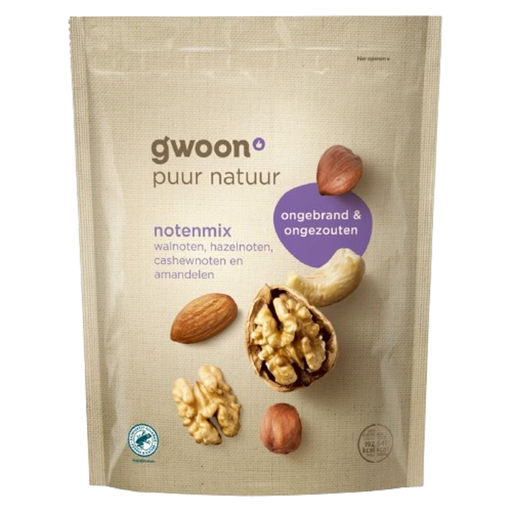
A good fit for a snack spread where you want to serve a variety of nuts.
The product description lists hazelnuts, walnuts, almonds and cashews, and 2650 kJ per 100 g. May contain traces of peanuts and other nuts.
 No image available
An option if you’re looking for roasted, unsalted peanuts to serve in measured portions.
The product description lists 100% peanuts and 626 kcal per 100 g. The title gives the pack size as 210 g.
Multiply the kcal per 100 g on the label by the weight of your portion in grams, then divide the result by 100. Weigh your portion to calculate the value for the amount you’re serving.
No, 25 g is used here as a comparison amount, not as personalised dietary advice. For example, Jumbo’s Dutch product page for Duyvis unsalted peanuts lists an average portion of 30 g; convert portions like this first when comparing products.
No, a small portion doesn’t change the product’s nutritional value per 100 g. For solid foods, the European Commission sets a maximum of 40 kcal per 100 g for a ‘low energy’ claim. According to the European Commission, a reduced energy claim requires at least 30% less energy and a statement explaining the characteristic that reduces the energy content.
Check the allergen information on the packaging of the exact variety. The NVWA states that allergen information must be shown on the label of prepacked foods; as well as peanuts, the Duyvis Cocktail variety contains ingredients including wheat and milk products.
Follow the instructions on your product’s packaging. For Duyvis unsalted peanuts, Jumbo’s Dutch product information recommends storing them in a cool, dry place and putting an opened bag in a light- and airtight container. For the cashews mentioned, Albert Heijn recommends storing them in a cool, dark, dry place and resealing the packaging securely after use.