What should you look for when buying?
Start with the protein in the portion you actually eat, then consider how important energy, salt, storage and pack size are to you.
| What to consider |
What should you check? |
Who is this important for? |
| Protein per portion |
Check the protein value per 100 g and calculate it for your weighed portion. |
If you want to know how much protein your small coffee-break portion provides, look at the value for that portion. Around 36% of consumers prioritise protein per portion. |
| Portion, energy and salt |
Compare energy and salt on the same basis, and check whether the variety is salted or seasoned. |
If you’re looking for an everyday snack with a portion size and salt content that suit you, you’ll also want to consider the energy. Around 29% of consumers say this is their top buying priority. |
| Taking them with you and storage |
Check the packaging and storage instructions, and decide how much you want to save for future breaks. |
If you take portions with you and save the rest for later, a handy closure and proper storage matter. Around 21% of consumers prioritise this convenience. |
| Pack size and ingredients |
Check the net weight and ingredients, and choose a pack size that suits how often you eat nuts. |
You want to choose a pack that suits the way you use it, rather than relying on the brand name alone. Around 14% of consumers prioritise a suitable pack size and ingredients. |
Joybuy products
These products are suited to a coffee break with unsalted peanuts or nuts; the nut mix is an option if you’re looking for variety.
 Image unavailable
g'woon unsalted peanuts, 250 g
An option for anyone looking for unsalted peanuts to enjoy with their coffee.
The product description lists 99% peanuts, sunflower oil, 27 g of protein and 0.02 g of salt per 100 g. The product may contain cashews.
View product
 Image unavailable
Verse extra large roasted peanuts, 210 g
A good fit for anyone looking for unsalted peanuts with peanuts as the only listed ingredient.
The product description lists 100% peanuts, 26 g of protein, 626 kcal and 0.02 g of salt per 100 g.
View product
 Image unavailable
g'woon unsalted peanuts in shells, 500 g
A larger pack for anyone who wants peanuts for several coffee breaks; bear in mind that you’ll need to shell them before eating.
The product description lists 29 g of protein and 0.12 g of salt per 100 g. Store the pack tightly sealed.
View product
 Image unavailable
g'woon unsalted nut mix, 200 g
A mix for anyone who wants to enjoy different types of nuts at coffee break.
The product description lists hazelnuts, walnuts, almonds and cashews, 20.1 g of protein and 0 g of salt per 100 g. The mix may also contain peanuts and other nuts.
View product
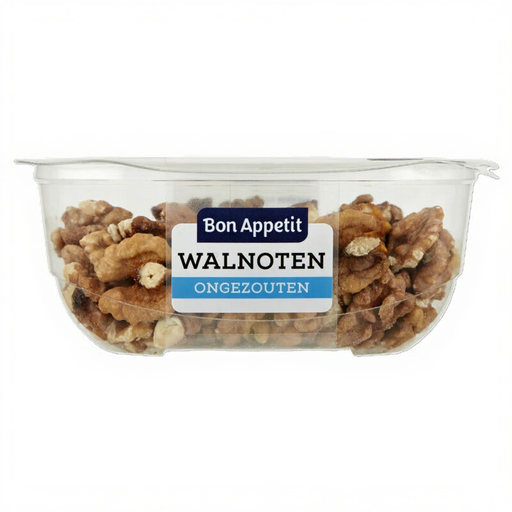 Image unavailable
Bon Appétit unsalted walnuts, 110 g
An option if you’d like walnuts with your coffee; the product description says they’re in their shells and need to be shelled before eating.
The product description lists 15.9 g of protein, 674 kcal and 0 g of salt per 100 g.
View product
Frequently asked questions
Do you need special protein nuts for a regular day of exercise?
Not necessarily. According to the Netherlands Nutrition Centre, most people who exercise don’t need special protein shakes or bars if they eat a healthy, varied diet. Consider what your overall diet provides; a general figure for unsalted peanuts is 6.3 g of protein per 25 g handful.
Does a ‘protein’ label mean my portion contains a lot of protein?
No, the product name doesn’t tell you how much protein your portion provides. Check the nutrition table for the exact variety and calculate the values for the amount you eat. The NVWA explains that nutrition claims are covered by Regulation (EC) No 1924/2006; a claim doesn’t prove improved sports performance.
Where can I check allergens in packaged nuts?
Check the ingredients and warnings on the specific pack. According to the NVWA, allergen information must appear on the label of prepacked foods; if you have a relevant allergy, don’t rely on the product name alone.
How should I store an opened bag of nuts?
Store nuts in a dry place in a tightly sealed container, preferably somewhere cool, and follow the instructions on your pack. Duyvis product information advises storing an opened bag in a light- and airtight tin.
Which specific recall warnings are relevant to these shops?
Do not eat the AH Pinda’s extra groot gezouten tub with a best-before date of 04-11-2026; Albert Heijn issued a warning on 20 May 2026 about possible metal fragments in that specific pack. On 20 May 2026, the NVWA also warned about TRADER JOE’S unsalted cashews, 170 g, barcode 2003020120930, with a best-before date of 23-09-2026. That date has passed, but the warning is still relevant if you still have that pack at home. These warnings apply to the products named and not to the entire range.


